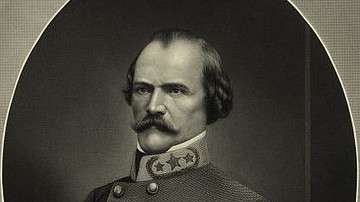


The Battle of Fort Donelson (11-16 February 1862) was a Union victory in the Western theater of the American Civil War on the Cumberland River near the Tennessee-Kentucky border. The campaign followed the Union victory at the Battle of Fort Henry (6 February 1862) and was a joint venture between Ulysses S. Grant of the US Army and Andrew H. Foote of the US Navy, commanding over 24,000 troops.
Defending Fort Donelson were over 16,000 Confederate troops under the generals John B. Floyd, Simon Bolivar Buckner, and Gideon J. Pillow. After Union attacks on the fort were thrown back for two days, Confederate forces attempted a breakout on 15 February, but Grant rallied his troops, leading to the fort's surrender on 16 February 1862.
The Union victory at Fort Donelson opened the Cumberland River to Union traffic – as the victory at Fort Henry had done for the Tennessee River – leading to Nashville becoming the first Confederate state capital to fall and giving the Union control of Kentucky and Tennessee.
Grant wanted to capitalize on this victory through an aggressive campaign – and could have – but was thwarted by his superior officer, the overly cautious Major General Henry Halleck. Fort Donelson then became a might-have-been – the victory that could have launched a campaign to win the war in the West.
Background
In early 1862, Confederate General Albert Sidney Johnston's defensive line was thinly formed across the neutral state of Kentucky. The left of the line was at Columbus, held by Major General Leonidas Polk, and the right was at Bowling Green, under Brigadier General Simon Bolivar Buckner. The center of the line was Fort Henry on the Tennessee River and, 12 miles (19 km) overland to the east, Fort Donelson on the Cumberland River.
None of the Confederate high command gave any thought to Forts Henry and Donelson, garrisoned, respectively, with 3,400 and 5,000 troops.
Grant understood that Columbus and Bowling Green were too heavily fortified to take without large losses – and had no idea how many troops were at Fort Henry or Fort Donelson – but proposed a joint venture against them between his forces and those of the navy under Flag Officer Andrew H. Foote.
Foote, with his four ironclads and three timberclads, had won the Battle of Fort Henry on 6 February 1862 before Grant's forces arrived. Still, over 2,000 troops from Fort Henry had been able to escape before the battle, fleeing overland to Fort Donelson, so that position now became Grant's objective.
Confederate and Union Preparations
Confederate
On 7 February, when the news of the fall of Fort Henry reached Johnston, it was decided that Brigadier General John B. Floyd would take command of Fort Donelson and Buckner's troops would move from Bowling Green to Nashville. The brigades of Floyd and Buckner were sent through Clarksville, which was under the jurisdiction of General Gideon Pillow.
Pillow's understanding was that all supplies coming into Clarksville were to be forwarded to Fort Donelson, and he expanded this policy to include troops. Buckner's men, along with Floyd's, were therefore sent to Fort Donelson and, on 9 February, Pillow joined them there with his forces.

The command at Fort Donelson was far from united, and Buckner strongly objected to Pillow's rerouting his troops to Donelson and assuming command. Pillow, ignoring him, took over from General Bushrod Johnson in strengthening the fort's defenses.
Union
Twelve miles away, on 7 February, Ulysses S. Grant was at Fort Henry and had planned on moving against Donelson that day. His plan was completely unrealistic, however, as it included Foote's flotilla, which had been damaged during the battle. Foote took his ironclads back to Cairo, Illinois, on the 7th to be repaired.
At Cairo, Foote was informed that two of the ironclads were so severely damaged they would require extensive repairs. He therefore manned two other ironclads – the USS Louisville and the USS Pittsburg – to replace them.
These two joined the other ironclads that had taken Fort Henry – the USS St. Louis and USS Carondelet – and the three timberclad gunboats – USS Conestoga, USS Lexington, and USS Tyler – that had also participated in the battle. The damage to the two ironclads and manning their replacements delayed Foote's departure from Cairo.

Unable to move his army due to flooding and road conditions, Grant rode out with his staff and a regiment of cavalry to reconnoiter the defenses of Fort Donelson, still believing it was a weaker position than Fort Henry had been.
He remembered General Pillow from the Mexican-American War and knew he was no threat, and he also knew Floyd had no military experience. The only Confederate commander he needed to worry about was Buckner, a friend of his before the war, but Grant was sure he outnumbered and could outcommand him. He was certain the fort would fall easily.
Battle of Fort Donelson
11-12 February
Grant was finally able to move his army beginning on 11 February (he followed on the 12th). The rain had stopped, and the day was unseasonably warm, causing many soldiers to discard their heavy overcoats and winter blankets as they marched. Meanwhile, inside Fort Donelson, the Confederates were shoring up their defenses.
Confederate Captain Ruben R. Ross arrived at the fort with his artillery company and volunteered to man a battery on the Cumberland River that would defend against Foote's flotilla, which was expected to appear soon. The other guns of the water batteries were commanded by Captain Joseph Dixon and Lieutenant Colonel Milton Haynes.
Union forces, delayed by skirmishes with Confederate cavalry under Lieutenant Colonel Nathan Bedford Forrest, arrived at Donelson on 12 February. Grant established his headquarters to the left of the front at the house of the Widow Crisp. Troops under Brigadier General Charles F. Smith were deployed on the Union left and those under Brigadier General John A. McClernand on the right.
13 February
The USS Carondelet arrived on the 12th, under the command of Captain Henry Walke, and, on the 13th, opened fire on the fort. Fire was returned by the big guns under Haynes. The Carondelet was struck and retreated downriver before returning to resume the attack.
Grant had given orders that no attack on the fort should be made until Foote arrived with his flotilla, but General Smith ignored these and sent two of his brigades against the Confederate right flank; these were repulsed. McClernand did the same against the Confederate left, also without success. Grant then sent orders for Brigadier General Lew Wallace, who had been left back at Fort Henry, to proceed with haste to Fort Donelson and reinforce McClernand's line.
Inside the fort, General Floyd understood he had no idea of what he was doing and turned over command to Buckner and Pillow, who held the line against periodic Union advances. Pillow took over command of the Confederate left, facing McClernand, and Buckner held the Confederate right against Smith. Fire was exchanged throughout the day, but no progress was made by either side.
The weather had changed on the 13th, and a cold rain fell all day. Temperatures dropped at night to 10-12 degrees Fahrenheit (-12 Celsius), and strong winds turned the rain into a driving storm of snow, sleet, and freezing rain that covered the ground with up to 3 inches (8 cm) of snow. The Union soldiers who had thrown off their coats and blankets along the road missed them dearly now and, in the fort, Confederate soldiers also suffered as the wind shrieked in off the river.
14 February
On the morning of the 14th, after holding a council of war, Floyd decided to evacuate the fort, drive back McClernand, and secure Forge Road and Wynn's Ferry Road, both leading to Charlotte and Nashville. Pillow commanded the breakout but was driven back into the fort under heavy fire.
The situation seemed to get worse for the Confederate defenders when Foote's flotilla arrived, bringing 10,000 Union reinforcements. General Wallace's troops from Fort Henry also arrived to form a third brigade between McClernand and Smith. All was now in readiness for the attack Grant had planned: Foote would proceed just as he had done at Fort Henry, destroying the river defenses from the rear, while Grant's infantry advanced on Donelson from three sides at the front.
Foote was uneasy about the attack because, unlike at Fort Henry, he had not been able to conduct his own reconnaissance. Grant insisted on the attack, however, as the army needed naval support. Foote proceeded as directed, in the same formation and using the same tactics that had won Fort Henry. Scholar James R. Knight comments:
As the Federal gunboats would shortly discover, Fort Donelson was not Fort Henry. Instead of being situated in a virtual swamp, Fort Donelson's two "water batteries" were fifty to one hundred feet above the river on the side of a hill. They were in no danger of being flooded and had a much higher angle of fire.
(94)
Foote's flotilla began its attack around 3:00 in the afternoon and, by 4:30, the battle was over and the four ironclads severely damaged. The flagship USS St. Louis alone was struck 59 times; the pilots were killed, and Foote was wounded in the arm and ankle. The USS Pittsburg almost sank, and the other two were hit so hard and so many times that they were adrift on the river.

Grant had been waiting to hear the fort's guns silenced by Foote's ships but instead heard the cheer of the "rebel yell" and knew the flotilla had failed. He canceled the attack, and both sides settled in for another cold night. Fires in the Union camp were prohibited, as they would give away positions and provide opportunity for sharpshooters.
15 February
Although the water batteries had driven off Foote's attack, the gunboats still held the river, and, with Grant's forces encircling the front, Fort Donelson was surrounded by a superior force with more efficient weaponry. The three Confederate commanders held a meeting the night of the 14th and agreed to attempt the same breakout maneuver that had failed earlier. Knight describes the plan:
[Pillow] would sweep the Confederate left around and attack McClernand's forces, pushing them back to clear the Forge and Wynn's Ferry roads or farther, if he could. Simon Buckner would move his division from the right to the center and hit the Yankees in the flank and rear as they fell back.
Buckner's men would then hold the roads open and act as the rear guard as the rest of the army escaped toward Charlotte…This seemed straightforward enough, and it was agreed to by all – in fact, though, the three generals each went away with slightly different ideas as to what the plan really was.
(114-115)
Before dawn on the 15th, Grant rode to the landing to meet Foote, who could not come to him because of his wounds. Grant had left orders that everyone should hold their positions and provoke no action from the fort. He informed no one that he was going to see Foote and left no second-in-command. As he left the Widow Crisp's house, he heard gunfire but thought nothing of it, thinking it was probably a skirmish.
The Breakout
The gunfire was actually Pillow leading the pre-dawn Confederate breakout against Union forces that were barely awake after a long and difficult night. McClernand's men were taken completely by surprise and fell back. McClernand sent word to Wallace for reinforcements, but Wallace obeyed Grant's order to hold his position and would not move.
McClernand's men continued to fall back, firing as they went, but were running out of ammunition. Another message was sent to Wallace for help, and this time he sent a brigade under Colonel Charles Cruft. Cruft initially helped hold the line before falling back. Buckner's forces joined with Pillow's to drive the Union forces from Forge Road and Wynn's Ferry Road, according to plan.
At this point, around 12:30 in the afternoon, the escape route was open, and according to the plan, Pillow should have now begun leading troops out of the fort and down the roads while Buckner protected their rear. Instead, Pillow halted the offensive and ordered the troops back into the fort.

Although Pillow had initiated the plan, his understanding was that, once the roads were open, the troops would return to the fort and retrieve supplies, ammunition, and other items before marching out at night. Buckner's understanding was that Pillow would instantly begin the evacuation while Buckner held off Union forces and gradually fell back down the road. By around 2:00 in the afternoon, having successfully gained the ground they needed to escape, the Confederate forces were again penned up in Fort Donelson.
Grant's Counterattack
While all this was going on, word of the battle finally reached Grant, who then swiftly rode 7 miles (11 km) back over icy roads to the battlefield. Upon being apprised of the situation, Grant ordered the position on the right retaken. He observed that many of the fallen and wounded Confederates were carrying knapsacks, strongly suggesting they were trying to escape, not launching an offensive from a position of strength.
Grant did not panic. He ordered General Smith to take the fort and then rallied the troops, as scholar Kendall D. Gott describes:
Grant then turned his horse and rode off at an ordinary trot…Passing groups of men, Grant called out to them: "Fill your cartridge-boxes, quick, and get into line; the enemy is trying to escape, and he must not be permitted to do so." This acted like a charm. The men only needed someone to give them a command, and they sprang to life.
(224-225)
Grant had gone to see Foote that morning to ascertain which boats were still in play for an assault on the fort. Only the Carondelet would be of any use and, now, Grant sent Foote orders to deploy that ship only to 'demonstrate' on the river and hold the fort's attention.
While the Carondelet lobbed shells into the fort from a distance, General Smith attacked the Confederate right with two brigades, taking the outer entrenchments. Meanwhile, McClernand and Wallace attacked from the front, securing the ground the Confederates had taken earlier and positioning their men for a full assault the next morning. Fort Donelson was now tightly surrounded. Fires were lit in the Union camp the night of the 15th for the first time because the Donelson garrison was no longer considered a threat.
16 February
Buckner, Floyd, and Pillow gathered at the Confederate headquarters in the Dover Hotel at 1:30 in the morning to decide on what they should do next. Floyd and Pillow argued the fort should be held and they should make another attempt at escape. Buckner noted that they would surely be attacked at first light, and he could only hold Smith off for, at most, a half hour before the fort fell. There was no means of escape down the roads to Nashville, he pointed out, as evidenced by Union fires in the darkness at that position.
Floyd was afraid of capture because he was sure he would be tried, convicted, and hanged for treason due to illegal acts he had committed while Secretary of War under President James Buchanan. Pillow also feared capture because of his absurd belief in his own value and what the Federal authorities might do to him. Floyd passed command of the fort to Pillow, who passed it to Buckner, who accepted responsibility for surrender.

Nathan Bedford Forrest, entering the meeting toward the end, was outraged, crying, "I did not come here with the purpose of surrendering my command," and left with his men to cut his way out near the river (Gott, 241). Pillow escaped across the Cumberland River by boat, and Floyd did the same aboard a steamer along with his two Virginia regiments.
After the day had dawned, Buckner sent a note to Grant asking for terms. Gott describes the Union general's response:
Grant smiled and wrote out his reply. He took but a few moments, but these few lines would make him a national hero.
Sir: yours this date, proposing armistice and appointment of commissioners to settle terms of capitulation is just received. No terms except unconditional and immediate surrender can be accepted. I propose to move immediately upon your works.
(256-257)
Buckner had no choice but to accept, and the two men, former friends, met at the Dover Hotel, talked about old times, and Fort Donelson had officially fallen to the Union.
Conclusion
The Union victory at Fort Donelson was widely celebrated in the North and, following so soon after the fall of Fort Henry, elevated Grant's status even further. Newspaper reports on how "Unconditional Surrender" Grant had won while chewing on a cigar prompted people to send him boxes of cigars. He was promoted to Major General of Volunteers by Abraham Lincoln and was hailed as a national hero.

The Union casualty count was 2,691 to the Confederates' 13,846. Grant captured over 12,000 Confederate soldiers at Fort Donelson – almost one third of Johnston's forces – a loss the Confederacy could ill afford. The Union now controlled both the Tennessee and Cumberland rivers; the industrial center of Nashville was taken shortly after Donelson, and Polk evacuated Columbus in March.
Grant then planned on pressing his advantage to break Confederate control in the West but was sidelined by a jealous Halleck who stripped him of field command over unverified rumors of misconduct. If Grant had been left alone by his so-called superior, he might have been able to end the war in the Western theater in 1862 through the same aggressive campaigns that would win the whole war in 1865.