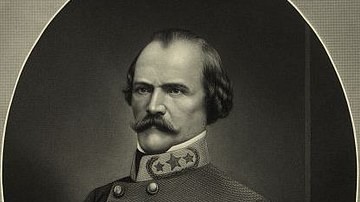


Joseph E. Johnston (1807-1891) was a Confederate general in the American Civil War (1861-1865). Known for his cautious style of command, he led the Army of Northern Virginia and the Confederate Army of Tennessee at various points in the war, and led troops at the First Battle of Bull Run (First Manassas), the Battle of Seven Pines, and the Atlanta Campaign. He surrendered at Bennett Place on 26 April 1865.
Early Life
Joseph Eggleston Johnston was born at Longwood House near Farmville, Virginia, on 3 February 1807. He was the seventh (out of an eventual nine) sons born to Judge Peter Johnston, a lawyer and politician who was finishing his final term as speaker of the Virginia House of Delegates. Judge Johnston had fought in the American Revolutionary War (1775-1783) under the command of Henry Lee III, and had named his seventh son in honor of one of his fellow soldiers, Major Joseph Eggleston. Joseph's mother, Mary Wood Johnston, was connected to old aristocratic Virginian stock, and was the niece of Patrick Henry, one of the most prominent Founding Fathers of the United States.
In 1811, Peter Johnston moved the family out to Abingdon, Virginia, a small town on the border with Tennessee, where he had been appointed circuit judge. There, he built a home on the edge of town which he named Panecillo. It was here that Joseph spent much of his childhood. As a young boy, he often went deer hunting out in the woods with his father and brothers, developing a lifelong passion for the hunt. When he was ten, he broke his leg in a fall from a horse; as the doctor reset the leg, Joseph "endured the operation without a tear or groan" (Hughes, 14). He attended Abingdon Academy where he developed a love for classical literature, particularly the works of Homer.
Yet it was not a literary life that young Joseph wanted, but a military one. He had spent his entire childhood listening, enraptured, to his father's war stories, and longed to go off and have adventures of his own. When Judge Johnston learned that his seventh son wished to follow in his martial footsteps, he not only gave his approval, but gifted Joseph with his own revolutionary sword. Through his father's political connections, Joseph was able to secure an appointment to the prestigious US Military Academy at West Point, New York. He enrolled in the academy in 1825 at the age of 18, and graduated four years later, finishing thirteenth in a class of 46. "There is nothing specially noteworthy about the career of Johnston at West Point," writes biographer Robert Morton Hughes. "He made the most of his opportunities and was unremitting in his studies" (16). Johnston did, however, graduate with Robert E. Lee, the son of his father's former commanding officer.

Rising Through the Ranks
Upon graduating from West Point, Johnston was commissioned a second lieutenant in the US Army. He spent the first years of his career on garrison duty, first in New York and then in Fortress Monroe in Virginia. In 1832, he participated in the brief Black Hawk War, though he did not see any action. In March 1837, he decided to resign from the Army in order to study civil engineering. The next year, as a civilian topographer, he accompanied the Army to Florida, where the Second Seminole War (1835-1842) was underway. The war was being fought by a group of Indigenous peoples collectively known as Seminoles, who were resisting efforts by the US Army to remove them from Florida. On 12 January 1838, Johnston and the group of sailors he was with were attacked by a Seminole war party. Though he survived the encounter, he claimed to have no less than 30 bullet holes in his clothing; one bullet grazed his scalp, giving him a scar that he would carry for the rest of his life.
This experience reinvigorated Johnston's military passions. He travelled to Washington, D.C., and rejoined the Army in April 1838, and was appointed first lieutenant of topographical engineers. He served in this capacity for the next few years and periodically returned to the battlefront in Florida, where he helped the US Army "[break] up the crops and encampments" of the Seminoles (Hughes, 21). During this time, he also began courting Lydia McLane, the 20-year-old daughter of a prominent Maryland politician and railroad president. The couple was married in Baltimore on 10 July 1845. Though they never had any children, their marriage was a happy one.
The next year, Johnston was pleased by the outbreak of the Mexican-American War (1846-1848), which he viewed as his chance to win glory on the battlefield. He served on the staff of General Winfield Scott and participated in the Siege of Veracruz (9-29 March 1847). When the port city fell after a 20-day bombardment, General Scott sent Johnston to deliver the demands for surrender to the provincial governor. After taking Veracruz, the US Army began its push inland, with Johnston serving in the vanguard. He was severely wounded by grapeshot while performing reconnaissance before the Battle of Cerro Gordo (18 April 1847). He spent the next few weeks recovering in a field hospital, but was appointed a brevet lieutenant colonel for his actions.

Johnston returned to the army in time to join General Scott's advance toward Mexico City. He was second in command of a unit of light skirmishers, and fought in several battles. He was wounded three times at the Battle of Chapultepec (12-13 September 1847), leading Scott to remark that "Johnston is a great soldier, but he has an unfortunate knack of getting himself shot in nearly every engagement" (quoted in Hughes, 32). The US victory at Chapultepec opened the path to Mexico City, which was captured by Scott's forces on 15 September. For Johnston, the taste of victory was soured by the death of his nephew Preston, who had been killed in action. Johnston was informed of Preston's death by his old classmate Robert E. Lee; the two men wept together, a touching moment that Johnston would remember for the rest of his life.
Interwar Years & Secession
A few months after the fall of Mexico City, the war came to an end; the victorious and land-hungry United States forced Mexico to cede 525,000 square miles of Western territory in the Treaty of Guadalupe Hidalgo. This victory, however, turned out to be a poisoned chalice – the question over whether slavery should be allowed to expand into the conquered Western lands ignited a fierce debate over the institution itself, dividing the nation between the 'free states' of the North and the 'slave states' of the South. As the debate raged, Johnston continued his military career. By the early 1850s, he was supervising topographical surveys and river improvements in the West. At the same time, he was engaged in a long legal battle with the Army, arguing that his honorary brevet rank of colonel should be made permanent. In 1855, Secretary of War Jefferson Davis ruled against Johnston, the first of many disagreements between the two men.
Despite ruling against him, Davis was impressed with Johnston enough to appoint him second in command of the newly formed 1st US Cavalry Regiment at Fort Leavenworth, Kansas. In this capacity, Johnston fought against the Sioux people in the Wyoming Territory. He was also charged with keeping the peace during Bleeding Kansas, in which proslavery and antislavery settlers were fighting, and even murdering, one another. In early 1855, Johnston befriended one of his junior officers, George B. McClellan, whom he took under his wing as a sort of protege. In 1857, Davis was replaced as secretary of war by John B. Floyd, who was related to Johnston by marriage. Floyd promoted Johnston to brevet colonel, leading many in the Army to complain about favoritism.

On 10 June 1860, Floyd appointed Johnston as Quartermaster General of the US Army, which came with a promotion to brigadier general. Although Johnston accepted the position, he did not enjoy it, preferring field command to administrative duties in Washington. At this time, the sectional crisis over slavery had only worsened, and it seemed that secession and civil war were inevitable. When Abraham Lincoln, candidate of the antislavery Republican Party, won the US Presidential Election of 1860, seven states seceded from the Union. Johnston himself remained loyal to the Union until April 1861, when his home state of Virginia finally seceded and joined the Confederate States of America. Johnston resigned from the US Army - becoming the highest-ranking officer to do so - and would later explain his decision:
I believed like most others, that the division of the country would be permanent; and that ... the revolution begun was justified by the maxims so often repeated by Americans, that Free government is founded on the consent of the governed, and that every community strong enough to establish and maintain its independence, has a right to assert it. Having been educated in such opinions, I naturally determined to return to the State of which I was a native, join the people among whom I was born, and live with my kindred, and if necessary, fight in their defense. (Johnston, 10)
Bull Run to Seven Pines
Almost immediately, Johnston was made a brigadier general in the new Confederate Army, and was given command of the Army of the Shenandoah in July 1861. By this point, US President Abraham Lincoln had been marshalling an army of 75,000 volunteers across the Potomac River to crush the fledgling rebellion; it was imperative that Johnston and his compatriots defend Richmond, Virginia, which had just been designated as the Confederate capital. During the First Battle of Bull Run on 21 July, Johnston rushed to reinforce fellow Confederate General P.G.T. Beauregard, whose army was under attack at Manassas Junction. His 12,000 soldiers arrived via railroad, in time to help tip the scale of battle toward the Confederates. Though the battle resulted in a stunning Confederate victory, saving the capital of Richmond, neither Johnston nor Beauregard capitalized on their success, allowing the battered Union army to escape beyond the Potomac, back to friendly soil.

For their victory, Johnston and Beauregard were lauded as heroes throughout the South, and each man expected to be rewarded for his efforts. On 31 August 1861, Jefferson Davis – who was now serving as President of the Confederate States – promoted both men to the rank of full general. The problem, however, was that Johnston was ranked fourth on the list of full generals; he was preceded by Samuel Cooper, Albert Sidney Johnston (no relation), and Robert E. Lee. Johnston considered this a stinging insult; so far, he had done more than any of those three men for the Confederacy. Bristling with anger, Johnston wrote to Davis, accusing the president of having "tarnished my fair fame as a soldier and a man" (quoted in Encyclopedia Virginia). This infuriated Davis, who interpreted the letter as insubordination. The two men would become bitter rivals for the remainder of the war.
Still, Johnston had at least superseded Beauregard (who ranked fifth on the infamous general list) and assumed command of the combined Confederate army encamped at Manassas Junction. This force - soon to be christened as the Army of Northern Virginia – continued to grow as Johnston stayed put, waiting for the enemy to make the first move. In spring 1862, after a relatively quiet winter, he received word that a large Northern army, under his old friend General McClellan, had landed on the peninsula between the York and James rivers, and was threatening Richmond. Johnston and Davis once again butted heads, disagreeing about how best to handle this threat; Johnston, who knew that his army was smaller than McClellan's, wanted to concentrate his forces around Richmond itself, while Davis urged the general to contest every inch of ground on the peninsula.
In the end, Johnston did things his way, withdrawing up the peninsula rather than offering battle. Luckily for him, McClellan proved similarly cautious; believing that Johnston's army was larger than it really was, he kept refusing to attack until he had more men. The two sluggish generals finally clashed on 31 May 1862 at the Battle of Seven Pines; Johnston had decided to attack, throwing his army against the Union troops amidst the flooded banks of the Chickahominy River. Johnston's plan was aggressive, but ended up being too complicated for his subordinates to execute correctly. Frustrated, Johnston galloped back and forth, barking orders to his men. In the process, he was severely wounded, taking first a musket ball to the shoulder, and then fragments of an artillery shell to the chest. After Johnston was carried off the field in agony, President Davis turned over command of the army to the more aggressive General Lee.

Vicksburg & Georgia
Ultimately, Lee led the Army of Northern Virginia to victory, beating back McClellan at the Seven Days' Battles and saving the capital. Johnston, meanwhile, spent the next several months recovering in a hospital in Richmond. He was discharged in November 1862 and appointed to the command of the Department of the West, tasked with overseeing operations in the Western theater of the war. The primary objective here was to defend the vital river town of Vicksburg, Mississippi; should Vicksburg fall, the Union would gain control of the Mississippi River and effectively cut the Confederacy in two. In early 1863, Union forces under General Ulysses S. Grant laid siege to the town; as the siege progressed, it seemed likely that, unless it received reinforcement, Vicksburg would fall. On 9 May, the Confederate government directed Johnston to personally go to Mississippi and take command of the forces in the field.
Though he complained that he had not fully recovered from his wound, Johnston went to Mississippi and gathered 24,000 men. But he was still anxious that he did not have enough soldiers to break the siege, and opted to wait for reinforcements before marching to Vicksburg's relief. Time was of the essence, but still Johnston did not move, provoking another round of heated arguments with Davis. Finally, on 4 July, Vicksburg fell to Grant's forces. Davis bitterly blamed the defeat on both a lack of "provisions inside [Vicksburg] and a general on the outside who would not fight" (Symonds, 218). Johnston, who had never wanted the responsibility in the first place, blamed Davis for demanding too much from him. Despite the rift between the two men, Johnston remained popular within the rank and file of the Confederate Army, meaning Davis could not get rid of him.

On 27 December 1863, Johnston was appointed commander of the Confederate Army of Tennessee. This time, his task was to defend the state of Georgia, which was being threatened by a Union army under General William Tecumseh Sherman. On 7 May 1864, Sherman launched his Atlanta Campaign. For the first few weeks, the army maneuvers followed the same pattern: Johnston would set his men up in a strong defensive position, inviting Sherman to attack; rather than take the bait and launch a risky frontal assault, Sherman would successfully move around Johnston's flanks; Johnston would then swiftly withdraw before Sherman could finish the trap. This dance continued as Johnston drew Sherman deeper into Georgia, hoping to isolate his army and stretch the Union supply lines to their breaking point.
But although there was certainly method to Johnston's madness, President Davis was running out of patience. He accused Johnston of giving up Georgia without a fight, and believed that he would give up Atlanta - an essential supply and railroad center – just as he had given up Vicksburg. So, on 17 July 1864, Davis fired Johnston, and replaced him with the aggressive and impulsive General John Bell Hood. The decision rankled the officers and men of the Army of Tennessee, who still loved Johnston despite his faults. Hood indeed proved more aggressive than Johnston, launching several costly attacks against Sherman that achieved little except watering the Georgian ground with blood. In the end, Hood was not able to save Atlanta, which fell to Sherman's forces on 2 September.
End of War & Later Life
In February 1865, Johnston was once again given command of the Army of Tennessee, this time tasked with defending the Carolinas from Sherman, who had completed his conquest of Georgia and was advancing north. Johnston and Sherman faced off at the Battle of Bentonville (19-21 March 1865), one of the last major engagements of the war, where Johnston was defeated and forced to retreat. By this point, his army was quickly dwindling and was running low on supplies. On 3 April, Richmond fell to Union forces; six days later, Robert E. Lee surrendered to Grant at Appomattox Court House. Seeing that further resistance was futile, Johnston surrendered the remnants of his own army to Sherman on 26 April 1865 at Bennett Place, North Carolina.

In the decades after the war, Johnston tried to make a living for himself in several ways. In 1866, he became president of a small railroad company before establishing his own life insurance agency, which he ran out of Savannah, Georgia, until 1877. During these years, he devoted his free time to defending his actions during the war. In 1874, he published a book entitled Narrative of Military Operations in which he defended his own conduct while heaping the blame for the Confederacy's defeat on Davis. He had become close friends with Sherman, grateful for the way he had been treated during the surrender. When Sherman died, Johnston went to New York City and served as a pallbearer at the funeral. However, Johnston caught a cold during the funeral which developed into pneumonia, and led to his own death on 21 March 1891, at the age of 84.