



George B. McClellan (1826-1885) was an American army officer and engineer who was elevated to the position of Commanding General of the United States Army in 1861 and was the Major General of the Army of the Potomac from 1861-1862, during which time he was criticized for his failure to actually use that army effectively.
McClellan had created the professional Army of the Potomac out of demoralized and undisciplined volunteers after the Union defeat at the First Battle of Bull Run (First Manassas) on 21 July 1861; he had secured the defense of Washington, D.C., and, earlier, was credited with driving the Confederates out of Northwestern Virginia. In all of this, McClellan's clear strengths were in organization and administration. His successes in what would become West Virginia were due largely to the work of others on the field, not to his command, and, once he was in charge of the Army of the Potomac, his overly cautious nature prevented him from fully engaging with his enemy in two major campaigns.
He is often cited as one of the worst generals of the American Civil War – and perhaps he was – but it seems fairer to conclude that he was simply the wrong man for the job. If the Lincoln Administration had kept McClellan in an administrative position, it seems clear he would have excelled. His character, forged in large part by a life of early success, prevented him from taking the kinds of risks necessary for a field commander.
Early Life & West Point
George Brinton McClellan was born on 3 December 1826 in Philadelphia, the son of George and Sophia McClellan, who had four other children and who emphasized the importance of education. McClellan was enrolled in an 'infant school' at the age of five and then studied at the private school of Sears Cook Walker for the next four years. He was privately tutored in the classics between the ages of ten and 13, learning Latin and French, and then entered university. His father was a doctor, and McClellan was to follow in that profession but, when he was 14, his parents found they could not afford to pay for the education of both McClellan and his older brother John.
McClellan took up the study of law, but it did not interest him, and at the age of 15, he was accepted at West Point Military Academy, which waived the age requirement of 16 following a letter from his father to the Secretary of War and the possible intercession of President John Tyler. At West Point, McClellan excelled at his studies without even trying. As scholar Stephen W. Sears observes, "Cadet McClellan sometimes worked only as hard as was necessary to get by" (5). McClellan graduated second in his class in 1846 at the age of 19 and, soon after, was sent to the Rio Grande to serve in the Mexican-American War.
Mexican-American War & In-Between Wars
McClellan arrived in Mexico eager to prove himself in battle but contracted malaria and dysentery soon after his arrival and was hospitalized for a month. Once released, he served in the US Army Corps of Engineers and built roads, bridges, and performed combat reconnaissance for General Winfield Scott. He saw action at the battles of Contreras, Churubusco, and Chapultepec and was breveted twice, first to lieutenant and then to captain. He learned a great deal from Scott about tactics, especially flanking movements, and how a siege, well-handled, was more effective and less costly than a frontal assault. His knowledge of Latin helped him learn Spanish easily, and he was fluent by the time the war ended and he returned to West Point.
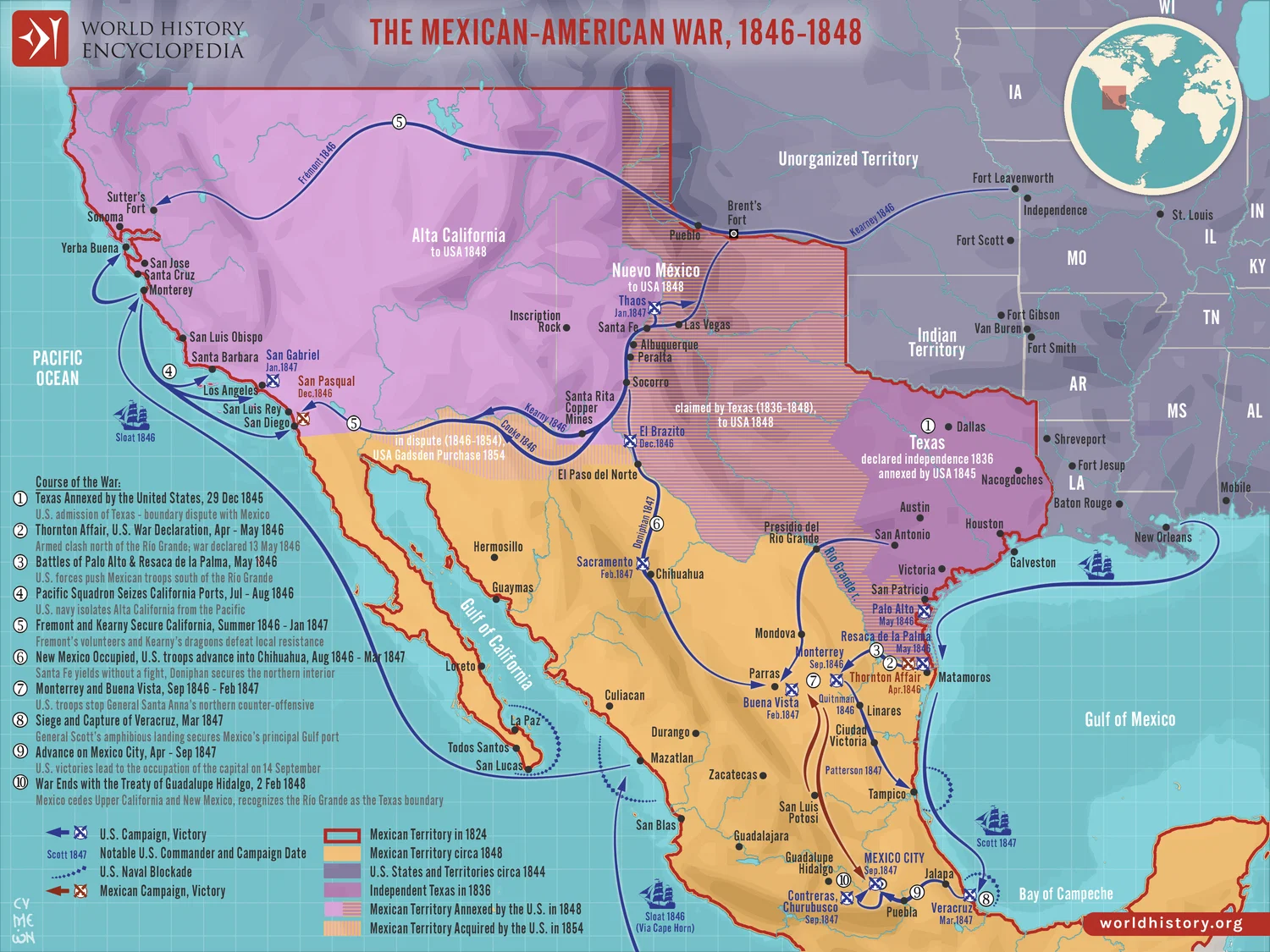
At the academy, he became an instructor, teaching engineering and, in 1852, was sent to Arkansas to serve under Captain Randolph B. Marcy on an expedition to find the source of the Red River. In 1853, he was tasked with surveying duties in finding the best route for the transcontinental railroad. In both, McClellan demonstrated a tendency that would characterize his behavior during the Civil War: a belief that he was always right and knew more than others, and a disdain for authority figures, especially those who contradicted him.
Owing to his fluency in French, engineering skills, and political connections (his father was a friend of Winfield Scott), McClellan was sent to Europe in 1855 to observe innovations in artillery, cavalry, and siege warfare in the Crimean War. His observations were later published in a manual on cavalry tactics, and from the Siege of Sevastopol, he learned lessons he would later implement during his Peninsula Campaign of 1862. His time in Europe also led to his design of the "McClellan Saddle," which the US Army used up through 1942.
He resigned his commission in 1857 to accept a position as chief engineer for the Illinois Central Railroad and then became president of the Ohio and Mississippi Railroad in 1860. He had first courted his future wife, Ellen Mary Marcy, in 1855, but she had refused his proposal of marriage. She accepted in 1859, and they were married in 1860.

Command in Northwestern Virginia
At the beginning of the Civil War, there was nothing in McClellan's past that would have suggested he was up to the task of leading an army. He was given command of the Department of the Ohio based solely on the first-hand observations of waging war in his manual on cavalry tactics and his skills as an engineer, both of which impressed Ohio governor William Dennison. He was commissioned a major general in April 1861 and took command of the Ohio militia.
His first challenge was to drive secessionists out of the pro-Union region of Northwestern Virginia. His troops first engaged the Confederates at the Battle of Philippi (Philippi Races) on 3 June 1861. McClellan, headquartered in Cincinnati, Ohio, sent Brigadier General Thomas A. Morris to engage the enemy, who were mostly new recruits with no experience in battle. The Confederates in Philippi posted no pickets - and so were completely surprised when the Union artillery opened fire. They ran from the field, which led to the Northern press later calling this engagement the "Philippi Races." The battle (often termed a "skirmish") elevated McClellan as a national hero in the North, even though he had had nothing to do with the victory.
His second engagement was the Battle of Rich Mountain (11 July 1861), which was won by his subordinate commander Colonel William S. Rosecrans, with no help from McClellan. Rosecrans was sent to perform a flanking maneuver on the Confederate position, which would then be reinforced by McClellan. Scholar Stephen Budiansky describes what happened next:
The plan was to draw off the defending Confederates with a flanking attack and then follow up by striking on their front with two brigades that McClellan remained behind to command.
Overestimating the enemy force by a factor of four, and hearing sounds of battle not quite where he expected, McClellan decided the flank attack had failed, and did nothing.
The action dislodged the rebels but allowed most to escape. [Jacob Cox, one of McClellan's brigade commanders] wrote, "The Rich Mountain affair, when analyzed, shows the same characteristics which became well known later. There was the same overestimate of the enemy, the same tendency to interpret unfavorably the sights and sounds in front, the same hesitancy to throw in his whole force when he knew that his subordinate was engaged."
(43)
McClellan took full credit for the victory at Rich Mountain and was regularly praised by the Northern press. McClellan's two victories encouraged the Northern belief that the Confederate army was weak, would run at the first sound of cannon shot, and that the war would be over quickly.
The Army of the Potomac & General-in-Chief
This claim was proven wrong by the decisive defeat of the Union army at the First Battle of Bull Run (First Manassas) on 21 July 1861. Union General Irvin McDowell lost to Confederate generals P. G. T. Beauregard, Joseph E. Johnston, and Stonewall Jackson. President Lincoln sent for McClellan and replaced McDowell as commander on 25 July 1861. McClellan believed he had been chosen by God to lead the Union Army and save the country, as evidenced by letters he sent to his wife, and, between late July and early November, there was every reason for anyone to believe this as well. This was when McClellan displayed his true talent: organization and administration.
In less than five months, McClellan transformed the demoralized, undisciplined Division of the Potomac into the professional fighting force of the Army of the Potomac by instituting daily drills. He ordered the construction of forty forts around Washington, D.C., garrisoned them, and gave orders for their defense. A large part of his success with his troops was due to his personal charisma and obvious commitment to them. He held regular reviews during which he encouraged the men and significantly raised morale. This new army drew more recruits and, between July and November, grew from 50,000 to 168,000 men.
In October, Winfield Scott resigned for health reasons, and, on 1 November 1861, McClellan became general-in-chief of the armies of the Union. He now commanded the largest armed force in United States history, and all he had to do now was lead it into battle.
McClellan v. The United States
But this he would not do. He inflated the numbers of Confederate soldiers and insisted on more drills and further training to ready his men for battle. Part of the problem was intelligence he received from his Chief of Secret Service, Allan Pinkerton, but the greater part of the problem was McClellan himself: he could not bear the thought of losing because, so far in life, he had never lost – and he was not about to risk experiencing that now.

Even so, President Lincoln, his cabinet, the Northern press, and the people were growing increasingly impatient with this vast army continuing to do nothing but train into 1862 while Confederate forces were gathering strength and fortifying positions. The so-called "Radical Republicans", other abolitionists, members of Lincoln's administration, members of the US Congress – as well as the Northern press – began to circulate suspicions as to McClellan's loyalties. McClellan, meanwhile, did nothing to allay these suspicions or in any way "win friends and influence people," as Budiansky notes:
His contempt for superiors and subordinates alike never wavered…as general-in-chief of the army and commander of the Army of the Potomac, his abuse of colleagues and administration officials, even the President himself, never let up…[He believed everyone but himself was incompetent]…even the smallest detail could never be trusted to anyone but himself. "Everything here needs the hand of the master," he wrote his wife.
(41-42)
One of the reasons McClellan gave for his actions was the need for time to plan a campaign south that would outflank the Confederate army under General Joseph E. Johnston at positions near Washington, D.C. – an army, McClellan noted, of superior numbers and cannon.
Criticism of McClellan grew to new heights when it was learned that Johnston had withdrawn south, burning his supplies, and when inspectors arrived at the abandoned Confederate positions, they found the "cannon" were actually logs painted black (later known as "Quaker Guns"). There was now no need for McClellan to delay further as he was out of excuses. On 11 March 1862, Lincoln fired McClellan as general-in-chief, left the position open so as not to actually replace him, and ordered McClellan to move his army south.
Peninsula Campaign
McClellan left on 17 March 1862 to begin the Peninsula Campaign, and then, upon arrival at Fort Monroe, as he prepared to move up the Virginia Peninsula and capture Richmond, everything went wrong, largely because of McClellan's mismanagement. Budiansky writes:
The moment McClellan's force went ashore, the woeful inadequacy of existing systems for everything else began to tell with a vengeance. Uncoordinated attacks fell apart, wagons clogged roads for days, units went astray for lack of basic topographic information or cavalry guides to lead the way or post directional signs at crossroads.
No systems were in place to anticipate or even coordinate supply needs with ordered movements. Not a single division in the entire army had the supplies or transport immediately on hand to move when the Confederates slipped away overnight from their defensive position at Yorktown which McClellan had been laboriously laying siege to for a month…
Nothing is more astonishing to anyone familiar with modern armies than McClellan's lack of a general staff to coordinate operations in the field…McClellan's idea of the commander's role remained firmly in the eighteenth century, with everything in his sole hand, his orders delivered personally or by his small personal staff of aides on horseback…The want of a general staff was particularly evident in the failure to coordinate operations when in actual contact with the enemy.
(49-51)
After moving up the peninsula between March and June, fighting the Seven Days' Battles, and coming within 4 miles (6.4 km) of Richmond, McClellan retreated, blaming everyone but himself, and the Peninsula Campaign failed.

Antietam
Lincoln had meanwhile given command of the Army of Virginia to Major General John Pope, who was ordered to advance on Richmond from the northeast. McClellan was supposed to move in support of Pope but delayed, contributing to Pope's defeat at the Second Battle of Bull Run (Second Manassas) 28-30 August 1862.
Lincoln reinstated McClellan over the objections of many and sent him against Robert E. Lee, who began his Maryland Campaign on 4 September. The two armies met at Antietam Creek, Sharpsburg, Maryland, on 17 September. Scholar Alan Taylor comments:
McClellan launched poorly coordinated attacks, allowing Lee to shift reserves to receive each blow on different parts of his line.
(216)
McClellan chose this tactic because, again, he overestimated the number of the opposing army dramatically. McClellan had over 50,000 men to Lee's numbers of a little over 30,000, and yet McClellan was sure he was outnumbered, and so he launched one attack on one position at a time so that, should those forces be lost, he would not have sacrificed his entire army. McClellan pursued this same tactic all day on the 17th. Taylor continues:
On September 18, Lee refused to retreat, but McClellan declined to attack, satisfied he had "fought the battle splendidly & that it was a masterpiece" that had "defeated Lee so utterly and saved the North so completely." Possessed of a rich fantasy life, McClellan did not want to lose his masterpiece by fighting the next day…That night, Lee's army escaped across the Potomac to Virginia.
(217)
The battle was a tactical draw but considered a Union victory because it halted Lee's Maryland Campaign and drove him back south. The victory allowed Lincoln to issue the preliminary Emancipation Proclamation on 22 September from a position of strength. Even so, McClellan's failure to press his advantage at Antietam caused Lincoln to remove him and replace him with Major General Ambrose Burnside, who was actually much worse.

Presidential Run & Civilian Life
McClellan was ordered to Trenton, New Jersey, and told further orders would be forthcoming, but none ever were. He set up house in New Jersey with a status of "awaiting orders," but no orders came. He focused his energies on politics and became more active in the Democratic Party.
In 1864, the Democrats nominated him for President against Lincoln. McClellan ran on a strong anti-war platform but believed the war should continue until the Union was restored. His party's platform, however, was "peace at all costs" through an immediate end to the war and recognition of the Confederacy. As usual, McClellan refused to compromise with his own party and his campaign more or less imploded. He won 21 Electoral College votes to Lincoln's 212 and also lost the popular vote.
McClellan took his family to Europe after the war ended in 1865, returned in 1868, and again began to dabble in politics. In 1877, he was elected Governor of New Jersey and performed his duties with the same overcaution with which he had waged war. Even so, he again displayed his talent for administration and organization and was considered an effective governor.

He died from a heart attack, aged 58, at Orange, New Jersey, shortly after completing his memoirs, McClellan's Own Story. His manuscript was prepared for publication by his wife, Ellen (who died in 1915), and his friend William Cowper Prime. In an effort to show his friend in the best and 'truest' light, Prime included many of McClellan's letters to Ellen during the Civil War, but this did him no favor. The letters give a clear impression of a man who thought too highly of himself and not enough of others, who would accept no criticism, rejected all advice, feared failure, and adored adoration.
Conclusion
McClellan was a man so used to success in life that failure was not simply "not an option"; it was studiously avoided. As noted, he devoted himself to his studies at West Point only when he had to, which does not seem to have been that often. He was only 28 when he was selected for the honor of joining the delegation to Europe during the Crimean War, and he was only 34 when Lincoln appointed him general-in-chief.
Everything came easily to McClellan, and so, when he was confronted with a challenge that posed any kind of real risk, he refused it. There were certainly worse Union generals than McClellan in the American Civil War, notably Benjamin Butler and Ambrose Burnside, but McClellan stands out as an especially tragic figure because he had the resources and the opportunity to win the war twice in 1862 and made use of neither because doing so involved risks he was unwilling to take.


