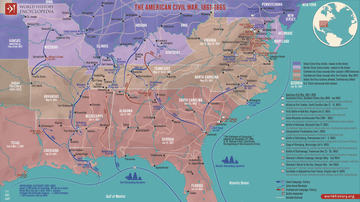


James Buchanan (1791-1868) was an American politician who served as the fifteenth president of the United States. He took office during a time of great crisis, when the country was divided along sectional lines over the issue of slavery; his unwelcome involvement in the Dred Scott decision and the alleged corruption of his administration only caused more division and led to his unpopularity. He did little to preserve the Union during the Secession Crisis of 1860-61, which led to the American Civil War. As such, he is often regarded as one of the worst presidents in US history.
Early Life
Buchanan was born on 23 April 1791 in a one-room log cabin near Mercersville, Pennsylvania. He was one of eleven children born to James Buchanan, Sr., who had emigrated from Ireland in 1783 and was now the wealthiest resident of Mercersville, running a successful mercantile business. His mother, Elizabeth Speer Buchanan, embraced a "modest Christian life"; she would often read to her sons, discussing politics and poetry with them, and quoting from the works of William Shakespeare (Hamilton, 121).
In 1807, 16-year-old Buchanan was enrolled in Dickinson College. Although he was initially a diligent student, he soon started partying more in an effort to become popular, and neglected his studies in favor of "smoking, carousing, and drinking heavily" (ibid). He was nearly expelled from the college in 1808 for disorderly conduct, but, after promising to behave, he was given a second chance and graduated with honors the following year.
He began studying law and passed the Pennsylvania bar in 1812. That same year, the United States declared war on Britain, and the young Buchanan, ambitious and hungry for glory, was eager to fight. He enlisted in a volunteer regiment and headed south to defend Baltimore; however, he never saw any action, and his only notable contribution to the War of 1812 was confiscating horses for use by the US Army.
After the war, he returned home and ran for the Pennsylvania House of Representatives on the Federalist Party ticket. He was elected, becoming the youngest member in the state legislature. He served two terms but gave up his seat in 1816 in order to focus on his budding law career. By 1818, he had amassed considerable wealth and was earning nearly $11,000 per year (close to $200,000 today).
That same year, he met Anne Caroline Coleman at a ball in Lancaster, Pennsylvania. He was apparently smitten and started courting her, but her father, a wealthy iron-mill owner, disapproved of the match. When Buchanan proposed marriage, Anne happily accepted – it was not long, however, before her father convinced her that Buchanan was only interested in her for her money, and she broke off the engagement. She then slid into a depression and died shortly thereafter; according to the town gossip, she had committed suicide, but this was never proven.
In any case, her parents blamed Buchanan for her death and refused to let him attend the funeral. The experience was undoubtedly traumatic for Buchanan as well, who said that "I feel happiness has fled from me forever" (Dunn, 37). Buchanan, who would remain a lifelong bachelor, would cite Anne's death as the reason he never married.
In the Age of Jackson
In 1820, Buchanan returned to politics, winning election to a seat in the US House of Representatives. Any sense of elation at his victory was soon sullied, however, as his father was killed in a carriage accident around the same time. By the time of his election to Congress, Buchanan was still a Federalist, at least on paper. But due to its opposition to the War of 1812, the Federalist Party had become unpopular nationwide and was dying a slow, drawn-out death.
The ambitious Buchanan, realizing that his career would be at an end unless he made a change, switched to the flourishing Democratic-Republican Party. He initially supported Henry Clay in the intense, four-way US presidential election of 1824. But upon realizing his Pennsylvania constituents preferred the populist General Andrew Jackson, Buchanan threw his own support behind Jackson, too. In the end, both Clay and Jackson lost the election to John Quincy Adams.
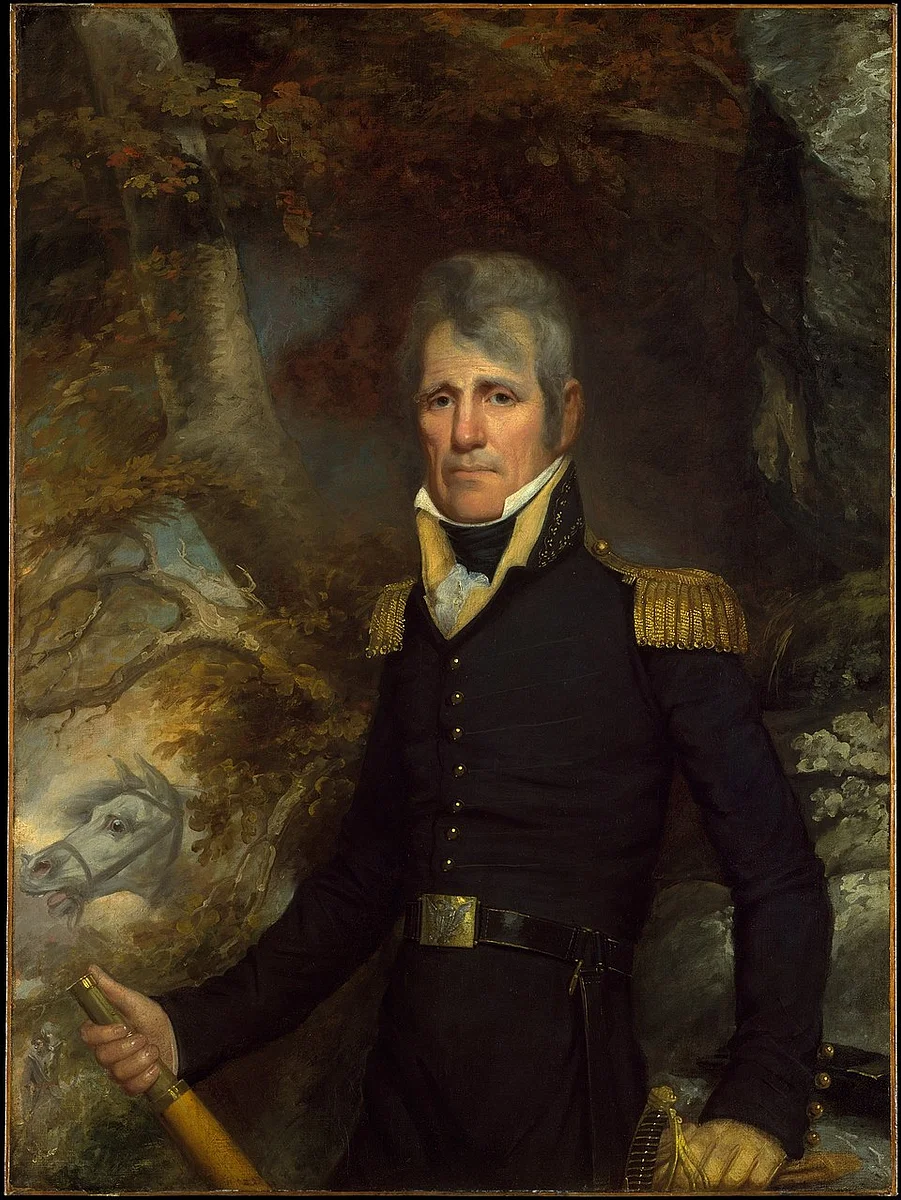
Despite Jackson's loss, Buchanan realized that the popular old general was the future of American politics. He aligned himself with some Jacksonian ideals, including the broad concept of states' rights, and organized an 'amalgamation faction' in Pennsylvania of former Federalists and current Democratic-Republicans to further the Jacksonian agenda in that state.
In the US presidential election of 1828, Buchanan campaigned hard for Jackson, denouncing President Adams as despotic and corrupt. Buchanan even helped block Adams's programs in Congress, hoping to paint the Adams administration as ineffective, thereby boosting Jackson's prospects. Despite Buchanan's outspoken support for Jackson, some could not help but question whether he had only attached himself to the general in the hopes of furthering his own political ambitions. Historian Neil A. Hamilton writes:
His support for Jackson, who won the presidency that fall, made for a case of strange bedfellows. The two politicians differed on several issues. Buchanan, for example, wanted a high protective tariff, a policy Jackson never subscribed to…further, the Jacksonians appealed to the masses, while the Federalists distrusted them. Yet both men believed in a vigorous executive branch. Buchanan also often disregarded issues in finding a vehicle that would advance his career. Some called him a blatant opportunist, moving in whatever direction the political weather vane pointed.
(122)
When Jackson was inaugurated on 4 March 1829, Buchanan undoubtedly hoped for an office in the new government. He was in for a long wait – it was not until 1832 that he received an appointment from the Jackson administration, which was as minister to Russia. This came as a disappointment; Buchanan had been hoping for a more prestigious office within the administration itself and had maybe even been eyeing the vice presidency, since that office had become vacant after the departure of John C. Calhoun.
Nevertheless, Buchanan dutifully set sail for his new post in Saint Petersburg, writing how he was reluctant to "leave the most free and happy country on earth for a despotism more severe than any which exists in Europe" (ibid). Yet despite his unenthusiasm, Buchanan would prove a worthy diplomat, negotiating the first trade agreement between the US and Russia.
Political Rise
Buchanan returned from Russia in 1833 and, the following year, was selected by the Pennsylvania legislature to serve in the US Senate. He went to Washington, D.C., to take his seat and moved into a boarding house with another politician, William R. King. King was a Southern Democrat who was soon to serve as a US senator from Alabama; he and Buchanan had much in common and quickly became close friends. They lived together for ten years and frequently attended social functions together. Though this kind of living arrangement was not exactly uncommon, the fact that both men were lifelong bachelors fueled rumors that they may have been more than friends.
Indeed, President Jackson mockingly referred to them as 'Miss Nancy' and 'Aunt Fancy', with other Washington socialites joking about King being Buchanan's 'better half' or his 'wife'. Buchanan's close friendship with King has led some scholars to contend that he was gay, although his lack of demonstrated romantic interest – with the exception of Anne Coleman – has caused others to think that he was either asexual or simply unconcerned with the idea of love or marriage.
In the Senate, Buchanan continued to support Jacksonian policies; he opposed the rechartering of the Second Bank of the United States, towing the Democratic Party line that the Bank was an elitist and undemocratic institution. He loudly championed the idea of 'manifest destiny,' arguing for the westward expansion of the United States. These ideas turned Buchanan into a major player within the Democratic Party, and he used his influence to help elevate the expansionist James K. Polk to the presidency in 1844.
In recognition of Buchanan's support, Polk appointed him secretary of state, a prestigious office that, at the time, was considered a stepping stone to the presidency itself. Buchanan once again proved himself a competent diplomat. He successfully negotiated the acquisition of the Oregon Territory from Britain, establishing the 49th parallel as the boundary between the US and Canada in the Pacific Northwest. He wholeheartedly supported the Mexican-American War (1846-1848), in which the US wrested 520,000 square miles (1,370,000 km²) of western lands away from vanquished Mexico. Buchanan, in fact, was disappointed in the result, believing the US should have taken even more land.

Buchanan was undoubtedly successful as secretary of state and, indeed, viewed himself as the heir apparent to Polk, who had vowed to only serve one term. He was, therefore, greatly dismayed when he lost the Democratic nomination in 1848. He removed himself to Wheatland, his country estate outside Lancaster, Pennsylvania, where he bided his time, waiting for his next shot at the presidency. During Buchanan's respite from politics, the country became engulfed in renewed debates about slavery – the Southern slaveocracies demanded that the 'peculiar institution' be allowed to expand into the newly conquered Western territories, while the 'free-soil' Northern states opposed this.
Buchanan himself criticized abolitionists as 'fanatics' and believed that slavery should be left to the states to decide. In 1852, he sought the Democratic presidential nomination for a second time, announcing his support for the recent Compromise of 1850. However, he yet again lost the nomination, this time to Franklin Pierce. Spurned once again, Buchanan would have only been mollified by the fact that his best friend, King, was chosen as Pierce's running mate.
Pierce won the election, and, after taking office in March 1853, he appointed Buchanan as his minister to the United Kingdom. Buchanan set sail that spring with a heavy heart; not only was he once again leaving the country and vacating the stage of US politics, but he was also burdened by the knowledge that King had died in April after a battle with tuberculosis – Buchanan lamented the death of his former roommate, who he said was one of the "purest and most consistent public men I have known" (Watson, 247).

However, in this instance, Buchanan's absence from the political arena proved beneficial. The sectional crisis over slavery only worsened in the next four years, leading to outbursts of violence such as in Bleeding Kansas. Buchanan's absence from the country allowed him to emerge untainted by the unpopularity that stained the Pierce administration. In June 1856, Buchanan once again sought the Democratic nomination for president. His views closely aligned with the party platform, which included support for the Fugitive Slave Act of 1850 and opposition to antislavery agitation. This time, Buchanan won the nomination after 17 ballots, with John C. Breckinridge of Kentucky chosen as his running mate.
Presidency
Buchanan faced a tough general election, which pitted him against two candidates: former President Millard Fillmore, running as the candidate of the anti-immigrant Know Nothing Party, and John C. Frémont, the candidate of the newly formed antislavery Republican Party. Buchanan ended up winning the election with 174 electoral votes and 45% of the popular vote. He carried every slave state except Maryland and even won five 'free' states, including his home state of Pennsylvania.
In his victory speech, Buchanan attacked the Republican Party as dangerous, and vowed to "restore harmony to the Union under a national and conservative government" (Klein, 261-262). After his inauguration on 4 March 1857, Buchanan set about building his cabinet, which he filled with 'yes-men' who would simply rubber-stamp his views.

Shortly before taking office, Buchanan's attention was grabbed by an ongoing US Supreme Court case – an enslaved man named Dred Scott was suing for his freedom, arguing that, since his master had taken him to free soil in Illinois, he was legally free. Buchanan was deeply interested in the outcome, believing that a decision against Scott would confirm the legality of slavery in the Western territories. Five Southern justices were prepared to rule against Scott but were reluctant to do so without support from a Northern justice, lest they be accused of sectionalism.
To solve this, Buchanan secretly contacted Justice Robert C. Grier of Pennsylvania, urging him to side with his Southern colleagues. This violation of ethics helped tip the scales; two days after Buchanan's inauguration, Chief Justice Roger B. Taney delivered the Dred Scott decision, ruling not only that Scott could not sue because he was not a US citizen but also that Congress had no constitutional power to limit the expansion of slavery. The decision caused an uproar throughout the country, worsening the sectional divide between North and South.
Although Buchanan's complicity in the Dred Scott decision was not yet known, he would soon become unpopular for other reasons. The year he took office, the country was hit by an economic downturn known as the Panic of 1857 – 1,400 banks and 5,000 businesses went bankrupt in a single year. The economic crisis hit the North harder than the South, only further heightening tensions.
Buchanan also had to deal with the continuing crisis in the Kansas Territory – by this point, proslavery settlers had established a government in Lecompton, while antislavery settlers had organized their own government at Topeka. Faced with these two conflicting governments, Buchanan decided to accept the proslavery Lecompton government.
On 2 February 1858, he submitted their constitution to Congress, which, if accepted, would bring Kansas into the Union as a slave state. In his message to Congress, Buchanan recommended the acceptance of the Lecompton constitution and denounced the rival Topeka government as a 'revolutionary' organization. In Congress, Buchanan's own party was split over the issue – Northern Democrats, led by Senator Stephen A. Douglas of Illinois, opposed the Lecompton constitution, believing that it did not represent the will of the majority of Kansas settlers. Due to their opposition, the Lecompton constitution was defeated, and Buchanan never forgave Douglas for this perceived betrayal.

The failure of the Lecompton constitution was a major blow to Buchanan's administration. Southerners found him weak, castigating him for letting "Yankee politicians" like Douglas outmaneuver him, while Northerners condemned him for taking the proslavery side. Buchanan's position worsened in the 1858 midterm elections, in which the Republican Party gained more seats in Congress. With his administration basically paralyzed, Buchanan could do little except veto key pieces of Republican legislation, such as an early version of the Homestead Act.
In March 1860, the House of Representatives began investigating his administration for corruption, alleging that he had committed impeachable offenses such as bribery and extortion. Buchanan's supporters condemned the investigation as a witch hunt, spurred on by the president's political foes. Though the House was unable to find sufficient evidence to charge Buchanan, the corruption scandal shocked the nation and contributed further to his unpopularity.
Secession Crisis & Later Life
Buchanan chose not to run for re-election in the contentious US presidential election of 1860. The Democratic Party was unable to unite behind a candidate and, once again, split in two; Northern Democrats nominated Douglas, Buchanan's nemesis, while Southern Democrats nominated Buchanan's vice president, Breckinridge. In the end, both Democratic candidates were defeated by the Republican nominee, Abraham Lincoln.
The election of an antislavery 'Black Republican' terrified the slave-holding South – although Lincoln promised that he had no intention of ending slavery in places where it already existed, the Southern states believed that he would weaponize the power of the federal government against the institution. On 20 December 1860, South Carolina voted to secede from the Union. At that moment, all eyes turned to Buchanan; what would he do to prevent the Secession Crisis from growing and keep other states from leaving the Union?

In the end, he did very little. He denounced secession as illegal and spoke with politicians about ways to handle the crisis, but he took no concrete actions to preserve the Union. Nor did he take steps to reinforce federal forts, like Fort Sumter, which were being contested by the secessionists. Partially as a result of his inaction, six more states would leave the Union before the end of his term on 4 March 1861. Buchanan has long been criticized for allowing these states to leave the Union, with many blaming him for the scale and destruction of the resultant Civil War. Indeed, one Northerner expressed the views of many when he wrote that "Buchanan is…as truly a traitor as was Benedict Arnold himself" (Hamilton, 126).
After leaving the White House, Buchanan returned to Wheatland, where he spent the remaining years of his life defending his actions and blaming the war on the abolitionist 'fanatics.' He died shortly after contracting a cold on 1 June 1868 at the age of 77. Shortly before his death, he had written that he had "no regret for any public act of my life, and history will vindicate my memory" (ibid). In this, he was wrong, as he is consistently ranked as one of the worst US presidents.