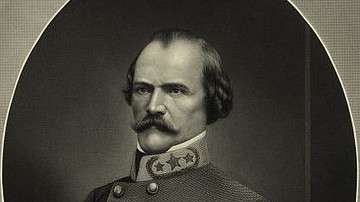

Ulysses S. Grant's victory at the Battle of Fort Donelson (11-16 February 1862) during the American Civil War elevated him to national fame, opened the Cumberland River to Union traffic, captured 12,000-15,000 Confederate soldiers, including officers, and led directly to the fall of the Confederate industrial center and state capital of Nashville, Tennessee, and the withdrawal of Confederate troops from Columbus, Kentucky.

The Fort Donelson campaign was a stunning achievement, and the first battle Grant was personally responsible for winning, as his earlier victory at the Battle of Fort Henry (6 February 1862) was wholly due to the bombardment of the fort by Flag Officer Andrew H. Foote. Fort Henry had surrendered to Foote before Grant arrived at the position.
At Fort Donelson, however, the plan of attack was wholly executed by Grant, and concluded with this exchange between Confederate Brigadier General Simon Bolivar Buckner, Fort Donelson's commander, and Union Brigadier General Ulysses S. Grant on the morning of the fort's surrender:
Headquarters, Fort Donelson, February 16, 1862.
Sir: In consideration of all the circumstances governing the present situation of affairs at this station, I propose to the commanding officers of the Federal forces the appointment of commissioners to agree upon terms of capitulation of the forces and post under my command, and in that view suggest an armistice until 12 o'clock to-day.
I am, sir, very respectfully, your obedient servant,S. B. BUCKNER,
Brigadier- General, C. S. Army.[Grant and Buckner had been friends before the war – Buckner had even once loaned Grant money when he was struggling – and so he hoped his former friend would be generous in the terms of surrender. He was famously disappointed by Grant's reply.]
Headquarters Army in the Field,
Camp near Fort Donelson, February 16, 1862.Sir: Yours of this date, proposing armistice and appointment of commissioners to settle terms of capitulation, is just received. No terms except unconditional and immediate surrender can be accepted. I propose to move immediately upon your works.
I am, sir, very respectfully, your obedient servant,
U. S. GRANT,
Brigadier- General, Commanding.[With the fort surrounded, and the other two commanding officers – Brigadier General John B. Floyd and Brigadier General Gideon J. Pillow – having fled to avoid capture – Buckner had no choice but to accept Grant's demand]
Headquarters,
Dover, Tenn., February 16, 1862.Sir: The distribution of the forces under my command incident to an unexpected change of commanders and the overwhelming force under your command compel me, notwithstanding the brilliant success of the Confederate arms yesterday, to accept the ungenerous and unchivalrous terms which you propose.
I am, sir, your very obedient servant,
S. B. BUCKNER,
Brigadier- General, C. S. Army.(Gott, 254-257)
Grant's reply to Buckner was quickly picked up by the Northern press, giving him the nickname "Unconditional Surrender" Grant, playing off his initials in numerous articles. When Confederate Brigadier General Lloyd Tilghman surrendered to Foote at Fort Henry and asked what the terms would be. Foote replied, "No, sir – your surrender will be unconditional" – but this never caught the attention of the Northern media, no doubt because Foote did not have the right initials.
On the morning of 16 February 1862, Grant wrote his action report on the Fort Donelson engagement, to be sent to his superior officer in the West, Henry W. Halleck. The report has since become a valuable primary source on the Battle of Fort Donelson, and excerpts are given below.
Lessons of Fort Donelson
Grant's victories at Fort Henry and Fort Donelson serve as an important lesson in paying attention to details and the danger inherent in assumption. At the start of 1862, Confederate General Albert Sidney Johnston had his defensive lines stretched thinly across Kentucky, with the left anchored at Columbus under Major General Leonidas Polk and the right at Bowling Green under Brigadier General Simon Bolivar Buckner.
At the center of that line stood Fort Henry and Fort Donelson under the command of Brigadier General Lloyd Tilghman. These forts guarded the Tennessee River and Cumberland River, respectively, and were clearly important positions for the Confederacy to hold and the Union to capture.
Confederate General P. G. T. Beauregard understood this – and so did Ulysses S. Grant – but they seemed to be the only ones who did. When Beauregard urged Johnston to reinforce Forts Henry and Donelson to strengthen the center of his line, he was dismissed because it was assumed that any Union attack would be against Columbus or Bowling Green.
Grant recognized that both these positions were too heavily fortified to take without immense losses – but noticing the details of the Confederate line – he believed a joint venture between the US Army and the US Navy against what appeared to him to be a weak center of that line would succeed. Neither fort seemed to be heavily garrisoned, and both were on rivers that would allow an attack by the army from the land with support from the navy on the water.

Grant was right, of course. He seriously underestimated the strength of the garrison at Fort Donelson because, after the fall of Fort Henry, Johnston heavily reinforced Donelson – but his initial estimation of the weakness of both positions at the beginning of February 1862 was correct.
The only reason Johnston seems to have dismissed Beauregard's suggestion to reinforce both forts earlier is that he never considered a Union attack on either position to be even a remote possibility. It is unclear why he, or anyone else in the Confederacy's high command, would have assumed this.
Grant's Advantage
In addition to his attention to detail, Grant also had the significant advantage of a good memory. Many of the generals of the American Civil War, on both sides, had first seen combat during the Mexican-American War (1846-1848) – including Confederate leaders such as Robert E. Lee, James Longstreet, Braxton Bragg, Simon Bolivar Buckner, and Gideon J. Pillow.
Scholar Kendall D. Gott comments on how Grant made use of the knowledge of his opponents at Fort Donelson:
Grant then gathered up his staff and, with part of a cavalry regiment, rode to within a mile of two of the outer defenses of Fort Donelson on a personal reconnaissance. He recalled years later that he knew his advance would be a safe journey:
I had known General Pillow in Mexico, and judged that with any force, no matter how small, I could march up to within gunshot of the entrenchments he was given to hold. I said this to the officers and staff at the time. I knew that Floyd was in command, but that he was no soldier, and I judged that he would yield to Pillow's pretensions.
I met, as I expected, no opposition in making the reconnaissance and, besides learning the topography of the country on the way, and around Fort Donelson, found that there were two roads available for marching; one leading to the village of Dover, the other to Fort Donelson.
(116)
Indeed, not only did the Confederate command at Fort Donelson allow Grant's reconnaissance, but they also did nothing to impede his march on their position over 12 miles (19 km) from Fort Henry on 11-12 February 1862. They felled no trees, set up no ambush, and prepared no skirmishes. The only resistance Grant met with on his approach to Donelson was the cavalry of Lieutenant Colonel Nathan Bedford Forrest, which was more of a nuisance than a threat.

Grant executed his battle plan between 13 and 15 February, and Fort Donelson fell on the 16th. Forrest, Floyd, and Pillow, as noted, escaped before the fort fell, but Buckner and over 12,000 others became Grant's prisoners and were sent to camps throughout the North, some of them later released through prisoner exchanges.
Text
Grant's action reports – as well as those of many others during the Civil War, on both sides – are preserved in the Official Records of the Union and Confederate Armies in the War of the Rebellion. Grant's account of Fort Donelson is found in Series I, Volume 7.
The following excerpt is taken from the article General Ulysses S. Grant's Report on the Battle and Capture of Fort Donelson by Mark (no last name given) from the site Iron Brigader: Civil War Info and Resources.
Fort Donelson, February 16, 1862.
General: I am pleased to announce to you the unconditional surrender this morning of Fort Donelson, with 12,000 to 15,000 prisoners, at least forty pieces of artillery, and a large amount of stores, horses, mules, and other public property.
I left Fort Henry on the 12th instant with a force of about 15,000 men, divided into two divisions, under the command of Generals McClernand and Smith. Six regiments were sent around by water the day before, convoyed by a gun boat, or rather started one day later than one of the gunboats, and with instructions not to pass it.
The troops made the march in good order, the head of the column arriving within 2 miles of the fort at 12 o'clock m. At this point the enemy's pickets were met and driven in. The fortifications of the enemy were from this point gradually approached and surrounded, with occasional skirmishing on the line.
The following day, owing to the non-arrival of the gunboats and re-enforcements sent by water, no attack was made, but the investment was extended on the flanks of the enemy and drawn closer to his works, with skirmishing all day.
The evening of the 13th the gunboats and re-enforcements arrived. On the 14th a gallant attack was made by Flag-Officer Foote upon the enemy's works with the fleet. The engagement lasted probably an hour and a half and bid fair to result favorably to the cause of the Union, when two unlucky shots disabled two of the armored boats so that they were carried back by the current. The remaining two were very much disabled, also having received a number of heavy shots about the pilothouses and other parts of the vessels.
After these mishaps, I concluded to make the investment of Fort Donelson as perfect as possible, and partially fortify and await repairs to the gunboats. This plan was frustrated, however, by the enemy making a most vigorous attack upon our right wing, commanded by General J. A. McClernand, with a portion of the force under General L. Wallace.
The enemy were repelled after a closely contested battle of several hours, in which our loss was heavy. The officers, and particularly field officers, suffered out of proportion. I have not the means yet of determining our loss even approximately, but it cannot fall far short of 1,200 killed, wounded, and missing. Of the latter I understand through General Buckner about 250 were taken prisoners. I shall retain enough of the enemy to exchange for them, as they were immediately shipped off and not left for recapture.
About the close of this action, the ammunition in cartridge-boxes gave out, which, with the loss of many of the field officers, produced great confusion in the ranks, and, seeing that the enemy did not take advantage of it, convinced me that equal confusion and possibly greater demoralization existed with him.
Taking advantage of this fact, I ordered a charge upon the left (enemy's right) with the division under General C. F. Smith, which was most brilliantly executed, and gave to our arms full assurance of victory. The battle lasted until dark, giving us possession of part of the intrenchments.
An attack was ordered from the other flank after the charge by General Smith was commenced by the divisions under Generals McClernand and Wallace, which, notwithstanding the hours of exposure to a heavy fire in the forepart of the day, was gallantly made, and the enemy further repulsed. At the points thus gained, night having come on, all the troops encamped for the night, feeling that a complete victory would crown their labors at an early hour in the morning.
This morning at a very early hour a note was received from General S. B. Buckner, under a flag of truce, proposing an armistice, &c. A copy of the correspondence which ensued is herewith accompanying.
I cannot mention individuals who specially distinguished themselves, but leave that to division and brigade commanders, whose reports will be forwarded as soon as received. To division commanders, however, Generals McClernand, Smith, and Wallace, I must do the justice to say that each of them were with their commands in the midst of danger, and were always ready to execute all orders, no matter what the exposure to themselves.
At the hour the attack was made on General McClernand's command I was absent, having received a note from Flag-Officer Foote requesting me to go and see him, he being unable to call, in consequence of a wound received the day before.
My personal staff, Col. J. D. Webster, chief of staff; Col. J. Riggin, jr., volunteer aide; Capt. J. A. Rawlins, assistant adjutant- general; Capts. C. B. Lagow and W. S. Hillyer, aides, and Lieut. Col. J. B. McPherson, chief engineer, all are deserving of personal mention for their gallantry and service.
For full details see reports of engineers, medical directors, and commanders of brigades and divisions, to follow.
I am, general, very respectfully, your obedient servant,
U. S. GRANT,
Brigadier- General.