



James Longstreet (1821-1904) was a Confederate general in the American Civil War, serving chiefly under Robert E. Lee in the Eastern theater. He was regarded as one of the most effective commanders in the Confederate Army, was severely wounded by friendly fire in 1864, but returned to active duty and was present when Lee surrendered to Ulysses S. Grant at Appomattox Court House in April 1865.
After the war, however, beginning around 1872, Longstreet's reputation came under fire – primarily from former Confederate generals Jubal Early and William Pendleton – both proponents of the "Lost Cause" myth, the claim that the war had nothing to do with slavery, was fought over states' rights, and the South only lost because of the overwhelming industrial superiority and manpower of the North.
Longstreet, who rejected the "Lost Cause" myth, was heavily criticized for disagreeing with Robert E. Lee over Pickett's Charge at the Battle of Gettysburg in July 1863, for joining the Republican Party and supporting the presidency of his long-time friend Ulysses S. Grant, and was branded a "race traitor" for his support of Reconstruction and equal rights for African Americans.
Historians in the late 19th and 20th centuries, largely Southern writers, perpetuated the "Lost Cause" myth and the claims of Longstreet's ineptitude during service and how he "lost the war" for the South at Gettysburg. It has only been since the late 20th century that these claims, along with the "Lost Cause" myth, have been debunked.
Today, James Longstreet is regarded as one of the greatest Civil War generals on either side and, like former Confederates P. G. T. Beauregard and William Mahone – who also advocated for civil rights and embraced Reconstruction policies – a victim of the "Lost Cause" ideology.
Early Life & West Point
James Longstreet was born on 8 January 1821 in Edgefield District, South Carolina, the fifth child of James Longstreet and Mary Ann Longstreet (née Dent). The family owned a cotton plantation and held several slaves. As a boy, Longstreet enjoyed horseback riding, hunting, and target shooting, all of which he excelled at. Scholar Jeffry D. Wert comments:
He grew tall, strong, and rugged with a love of the outdoors and of physical activity. From his lineage, he inherited independence of thought and self-confidence; from his surroundings, self-reliance, tirelessness, and a work ethic…He possessed little refinement or education.
(21)
Longstreet was not fond of schoolwork but was an avid reader of military history, especially fascinated by books on Alexander the Great, Julius Caesar, George Washington, and Napoleon. His father, who had little trust in the abilities of local schoolteachers, sent him to live with his aunt and uncle in Augusta, Georgia, when he was nine years old, where he attended the Academy of Richmond County. From his uncle, Augustus Baldwin Longstreet, he picked up an appreciation for seizing on any opportunity for having fun, for alcohol, and for playing card games.
He had always wanted to become a soldier and was admitted to West Point Military Academy in 1838. His father had nicknamed him Peter because, like Saint Peter, he was a "rock" in disposition, and his classmates knew him as Pete or Old Pete. He was roommates with the future Union general William Rosecrans and was a popular cadet. Among his close friends were George H. Thomas, George Pickett, and John Pope, but he became especially close to Ulysses S. Grant.
He excelled at having fun but not so much at academics, as Wert notes:
Longstreet was a poor to mediocre student at West Point. He never enjoyed the strictures or demands of the classroom; he relished physical activities. When he graduated in 1842, he ranked fifty-fourth in a class of fifty-six.
(30)
After graduation, he was stationed at Jefferson Barracks, Missouri, as Grant would be one year later. Here, Longstreet met his future wife, Maria Louisa Garland, daughter of his commanding officer, and would also introduce Grant to his future wife, Julia Dent, who was related to Longstreet through his mother's side.
Mexican-American War & Between Wars
In 1845, Longstreet was transferred to Texas and served in the Mexican-American War (1846-1848), at first under General Zachary Taylor. He was promoted to the rank of first lieutenant after the Battle of Monterey and was then placed under the command of General Winfield Scott for the assault on Mexico City.

He saw action in the Battle of Churubusco and was wounded in the thigh carrying the regimental colors at the Battle of Chapultepec. His wound was treated at the home of a local family and, when he was well enough to travel, he went back to Missouri where he married Maria Louisa Garland on 8 March 1848. The couple would eventually have ten children.
Throughout the 1850s, tensions increased between the North and the South over the issue of slavery and states' rights concerning that institution. Longstreet did not support secession and hoped that the regional differences could be resolved, but after the Battle of Fort Sumter in April 1861, any peaceful resolution was no longer possible.
Having been raised by his uncle to support the supremacy of states' rights and loyalty to one's home state, Longstreet resigned his commission in the US Army in May of that year and accepted a commission as a lieutenant colonel in the army of the Confederate States of America.
American Civil War
In June 1861, Longstreet met with Confederate President Jefferson Davis and was appointed a brigadier general based on his service record during the Mexican-American War. He was sent to serve under Brigadier General P. G. T. Beauregard at Manassas Junction, Virginia.

Longstreet's headquarters became famous for its lively social life, including card-playing, drinking, and music, but he drilled his brigade relentlessly in preparation for the coming battle and was a strict disciplinarian.
Blackburn's Ford & First Bull Run
His brigade first saw action at the Battle of Blackburn's Ford (18 July 1861) when, along with Jubal Early, Longstreet repulsed an advance under Union Brigadier General Daniel Tyler. Longstreet's tactics forced Tyler to retreat and convinced the Union's commanding general, Irvin McDowell, that a frontal assault was untenable and a flanking maneuver would be more effective, thus setting the stage for the First Battle of Bull Run (First Manassas).
At the First Battle of Bull Run, Beauregard's headquarters were in a state of confusion, and orders were sent out to brigade commanders that were never received. Longstreet had received orders to wait in position but never received the follow-up to move south to support General Richard S. Ewell. Consequently, he missed most of the battle.

When the Union Army retreated in a rout, Longstreet began to pursue, but this action was called off by commanding general Joseph E. Johnston, enraging Longstreet – as it had Stonewall Jackson. The failure of the Confederates to pursue the fleeing Union soldiers is famously criticized in E. P. Alexander's Losing an Opportunity at Bull Run.
Longstreet was promoted to the rank of major general in October 1861 and spent time with his family in Richmond. In January 1862, an outbreak of scarlet fever struck the city, and four of his children died. Longstreet became withdrawn afterwards, and for a long time, his headquarters were no longer the lively social hub they had been.
Peninsula Campaign
During the Peninsula Campaign of Union General George B. McClellan, Longstreet served as a division commander under Joseph E. Johnston, orchestrating an effective rearguard action at the Battle of Williamsburg (5 May 1862). During the Battle of Seven Pines (31 May to 1 June 1862), Longstreet seems to have confused his orders and performed poorly. Johnston was wounded during the battle and was replaced at first by General G. W. Smith and then by Robert E. Lee.
Lee expanded Longstreet's command, and, during the Seven Days' Battles (25 June to 1 July 1865), he commanded almost half of the army. Longstreet performed well, redeeming himself for his errors at Seven Pines, and turned back McClellan's troops following the Union victory at the Battle of Malvern Hill (1 July 1862). Wert writes:
Longstreet emerged from the campaign as Lee's most reliable subordinate commander. At Gaines' Mill and at Glendale he had handled his command with a confidence and calmness that became a hallmark of his battlefield leadership.
(152)
Second Battle of Bull Run (Second Manassas)
At the Second Battle of Bull Run (Second Manassas, 28-30 August 1862), Longstreet ignored Lee's order to attack as soon as he arrived on the field on 29 August, choosing instead to properly deploy his troops and perform his own reconnaissance. The Union Army, under the command of Major General John Pope, was unaware of Longstreet's preparations and focused its attack on Stonewall Jackson's men.
On the afternoon of 30 August, Longstreet unleashed his troops in a 28,000-man counterattack, among the largest assaults of the entire war, that crashed into the Union left flank, breaking the lines and scattering the troops. Just as at First Bull Run, the Union army fled in a rout back toward Centreville and Washington, D.C. Longstreet gave credit for the victory to Lee, but if he had followed Lee's orders on the 29th, the battle might have gone in another direction.
Antietam & Fredericksburg
During the Battle of Antietam (17 September 1862), Longstreet commanded the Right Wing of Lee's army and held the defensive line on the west side of the field. He personally manned cannon batteries along with his senior staff to halt a Union advance and steadied the morale of the troops through his composure and deliberate command.
When the battle concluded as a draw (though a tactical Union victory), Lee greeted Longstreet, calling him "my old war-horse" for the first time – an epithet he would be known by throughout the rest of the war, meaning someone Lee could always depend on. Longstreet's performance led to his promotion to lieutenant general.

At the Battle of Fredericksburg (11-15 December 1862), Longstreet again made careful preparations in deploying his troops, entrenching them behind a stone wall at the top of Marye's Heights. The Union Army under General Ambrose Burnside charged Longstreet's position, which held firmly, inflicting 1,000 casualties in under 30 minutes.
Longstreet's deployment included positioning his men four-to-five deep behind the wall so that those in the rear could load weapons and pass them to the front, allowing for a nearly continuous barrage of fire on the Union troops. Burnside withdrew on 15 December, and Fredericksburg was a stunning Confederate victory.
Gettysburg
The Battle of Gettysburg (1-3 July 1863) is the engagement Longstreet is most famous for. By this time, Lee and Longstreet had formed a close relationship, and Lee often positioned his headquarters near Longstreet's so that he could visit and unwind in the convivial atmosphere that was encouraged.
This being so, it seems strange that Lee should have ignored Longstreet's suggestions to disengage and choose a better ground for battle (on the evening of Day 1) and to call off the frontal assault known as Pickett's Charge on Day 3.

The Battle of Gettysburg was, essentially, an accident. Neither the Union nor the Confederacy planned to fight the bloodiest battle of the Civil War there. The Union held the high ground, was heavily entrenched, and it would have made better sense for Lee to have disengaged after the first day and follow Longstreet's advice to find more favorable ground.
Lee famously rejected these suggestions, however. The Confederate troops were beaten back on the first and second days, and on the third, believing the Union center was weak, Lee ordered Longstreet to orchestrate a frontal assault of 15,000 men focusing on that point. Longstreet said:
General, I have been a soldier all my life. I have been with soldiers engaged in fights by couples, by squads, companies, regiments, divisions, and armies, and should know, as well as anyone, what soldiers can do. It is my opinion that no fifteen thousand men ever arranged for battle can take that position.
(Wert, 283)
Lee insisted the charge would succeed, and Longstreet, knowing it would fail, gave the order to proceed with a nod and gesture. The charge failed, and Gettysburg was a decisive Union victory.
Chickamauga to Appomattox
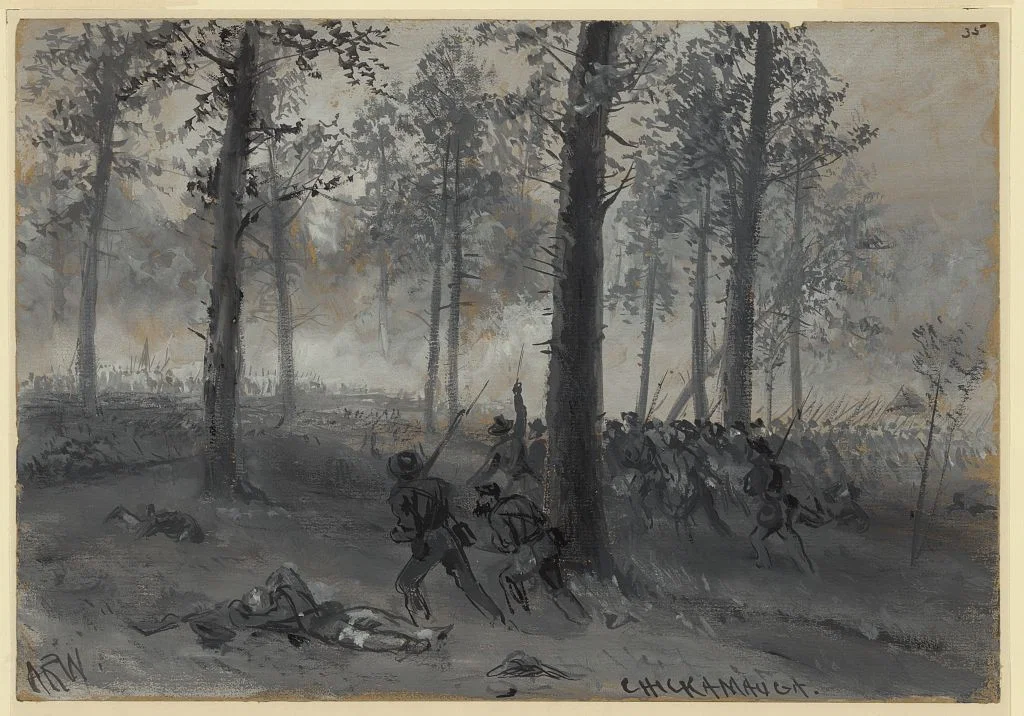
After Gettysburg, Longstreet requested transfer to the Western theater, serving under Braxton Bragg. During the Battle of Chickamauga (18-20 September 1863), he commanded the Confederate left wing, facing his former West Point roommate Rosecrans and, noticing a gap in the Union lines, sent an assault column that shattered the Union right wing and sent Rosecrans's forces reeling in retreat.
Longstreet did not perform as well during the Knoxville Campaign of November 1863 to April 1864, and in the spring, he returned to the Eastern theater. During the Battle of the Wilderness (6 May 1864), he was wounded by friendly fire in the neck and right shoulder and spent the next five months recovering.
He returned to active duty for the defense of Richmond at the Siege of Petersburg, and, after Richmond fell, he joined Lee in retreat and was with him at the surrender at Appomattox Court House on 9 April 1865, when he saw his old friend Grant again.
Post-War Life
After the assassination of Abraham Lincoln (14 April 1865), Andrew Johnson became president and pressed for the indictment of Confederate generals, notably Lee and Longstreet, on charges of treason. Grant interceded, however, and the proceedings were dropped.
Longstreet and his family moved to New Orleans, where he worked for an insurance company and became notorious among his former Confederate colleagues for supporting the policies of Reconstruction and joining the Republican Party, which was considered the "Northern War Party" by many Southerners. He also supported initiatives for granting Black people citizenship and voting rights and endorsed Grant in the 1868 presidential election.
Although he became a popular figure in the North, attacks against him in the South began in 1872 – two years after Lee's death – when Jubal Early blamed him for losing the war by not fully committing his command at Gettysburg. Early's attack was continued by Pendleton the following year, and when Longstreet led an African American corps of militia against White supremacists in 1873 in Louisiana, his reputation suffered further.

The "Lost Cause" myth was gaining ground, and Longstreet increasingly became a target of writers who presented Lee as the greatest general of the war and Longstreet as the reason for Southern defeat. Longstreet defended himself, but finally, he left New Orleans for Gainesville, Georgia, and became a popular speaker in the North, eventually serving under the presidents William McKinley and Theodore Roosevelt.
Conclusion
His wife, Maria, died in Gainesville in 1889, and he married Helen Dortch in 1897. His health began to fail, and he died of pneumonia on 2 January 1904 at the age of 82. Helen Dortch Longstreet continued the defense of her husband, but by this time, the "Lost Cause" myth was accepted as history. Wert comments:
History, however, is artificial, a creation framed and defined by participants in the events and by historians. Once wrought, history can be a tenacious muse, with a shadow that envelops decades, even centuries. The history of the Civil War, notably the struggle in Virginia, was fashioned in the early postwar decades amid the formulation of the "Lost Cause" myth.
By the 1890's, the tenets of the myth…became entrenched, its arguments delineating much of the military historiography of the Civil War…A significant – if not the most significant – victim of the "Lost Cause" interpretation of the conflict was James Longstreet.
(13-14)
Longstreet continued to be vilified throughout the 20th century, and the dim view of him did not really begin to turn around until after the publication of Michael Shaara's Gettysburg novel The Killer Angels (1974) and the movie Gettysburg (1993), based on that book, in which Longstreet is played by Tom Berenger.
Critical reassessment of Longstreet has continued, from Wert's General James Longstreet: The Confederacy's Most Controversial Soldier (1993) through Longstreet: The Confederate General Who Defied the South (2023) by Elizabeth Varon. Today, James Longstreet is viewed far more favorably than he was even 50 years ago. His doubts about Lee's command at Gettysburg have been vindicated by many historians, and his skills as a general and courage as a civil rights advocate are widely recognized.


