
Featured

Definition
Nefertiti
Nefertiti (c. 1370 - c. 1336 BCE) was the wife of the pharaoh Akhenaten of the 18th Dynasty of Egypt. Her name means, `the beautiful one has come' and, because of the world-famous bust created by the sculptor Thutmose (discovered in 1912 CE), she is the most recognizable queen of ancient Egypt. She grew up in the royal palace at Thebes, probably the daughter of the vizier to Amenhotep III, a...
Featured

Article
The 1918 Armistice with Germany - Allied Victory on WWI's Western Front
The armistice that ended the First World War (1914-18) on the Western Front was signed between Germany and the Allies on 11 November 1918. The...
Featured

Image
The Four Intact Pharaoh Burials of Ancient Egypt - Tutankhamun and the Royal Treasures of Tanis
Ancient Egyptian royal burials were designed to preserve the pharaoh's body, identity, and status for the afterlife. Coffins...
Featured

Image
12 Royal Princes Who Never Reached the Throne - From Germanicus to the Black Prince & Franz Ferdinand
Royal heirs and princes expected to succeed to a throne occupied an unusually precarious position: close enough to power...
Latest Content

Article
Stuart's Ride Around McClellan - J. Esten Cooke's Account of the Famous Expedition
Toward the end of Union Major General George B. McClellan's Peninsula Campaign (17 March to 1 July 1862) during the American Civil War...

Article
Stalin's Great Purge - State Oppression in the USSR
Joseph Stalin's Great Purge, also known as the Great Terror of 1936-8, was the most manic part of a decade of state oppression in the USSR. The purges saw the...

Definition
Peninsula Campaign - The Invasion Crippled by Fear
The Peninsula Campaign (17 March to 1 July 1862; operation completely ended by 26 August 1862) was the first large-scale Union offensive operation launched in...

Definition
Pax Mongolica - Trade and Cultural Exchange in the Mongol Empire
The Mongol Empire was the largest land empire in world history, at about 22,000,000 square kilometers (850,000 square miles). The term Pax Mongolica...

Definition
James A. Garfield - The Unlikely Rise and Tragic Assassination of a President
James A. Garfield (1831-1881) was an American politician from Ohio who served as the 20th president of the United States from 4 March 1881...

Article
A History of Modern Time - From Railroad Time to Atomic Clocks
The rapidly expanding 19th-century rail network not only 'annihilated space,' in the parlance of the day, but also altered the definition, use, and perception...
Free for the World, Supported by You
World History Encyclopedia is a non-profit organization. Please support free history education for millions of learners worldwide for only $5 per month by becoming a member. Thank you!
Become a MemberHistory should be free for everyone!
If you find World History Encyclopedia helpful, a $10 contribution helps keep trusted history free and accessible to millions of readers and students worldwide. Thanks for making a difference!
Donate $10Maps

Image
Map of the Roman Republic and the Mediterranean, c. 90 BCE - On the Eve of the Mithridatic Wars
By c. 90 BCE, the Roman Republic had become the dominant power in the Mediterranean following its victories over Carthage and...

Image
Map of the Western Front in World War I, 1914–1918 - Trench Warfare, Major Battles, and the Allied Victory
The Western Front (1914–1918) was the principal battlefield of the First World War in Western Europe, emerging from...

Image
Map of the Fertile Crescent and the Origins of Agriculture - Early Farming and Domestication in the Ancient Near East
The Fertile Crescent, a term coined in 1916 by Egyptologist James Henry Breasted, describes an arc of Southwest...
For You

Definition
Johann Eck
Johann Eck (l. 1486-1543) was a Catholic theologian and writer best known for his disputations with Martin Luther (l. 1483-1546) beginning in 1517 and continuing until his death in 1543. Eck...

Article
Truths Wrapped in Fiction: Mesopotamian Naru Literature - Originality in Writing Ancient Bestsellers
Originality in literary compositions in the ancient world did not carry the same weight and value as it does today. In...

Definition
Macedon - Birthplace of Alexander the Great
Macedon was an ancient kingdom located in the north of the Greek peninsula first inhabited by the Mackednoi tribe whose identity was challenged by some southern Greeks...

Image Gallery
Faces of Roman Emperors: Imperial Crisis & the Barracks Emperors
A series of facial reconstructions of Roman emperors during the Crisis of the Third Century (235-284 CE), including the Gordian Emperors. These so-called...
Book Reviews

Book Review
The Army of Alexander the Great
The Army of Alexander the Great (2025) is a highly detailed and insightful examination of one of the most influential military forces in history. Rather than presenting Alexander...

Book Review
From Cyrus to Alexander: A History of the Persian Empire
Pierre Briant’s From Cyrus to Alexander: A History of the Persian Empire is widely considered the definitive modern history of the Persian Empire. The book...

Book Review
Creating the Qur’an: A Historical-Critical Study
Stephen J. Shoemaker’s Creating the Qur’an: A Historical-Critical Study is, in brief, an argument for placing the “closure” of the Qur’an, its development into...
Statistics
| 2,996 | definitions |
| 1,776 | articles |
| 19,902 | illustrations |
| 2,647 | videos |
| 415 | 3D images |
| 16,529 | translations |
| 48 | languages |
| 1,349 | contributors |
| 15,687 | keywords |
| 64,176 | registered users |
Ancient Period

Article
Ancient Greek Society
Although ancient Greek Society was dominated by the male citizen, with his full legal status, right to vote, hold public office, and own property, the social groups which made up the...

Definition
Copan
Copán (in modern Honduras) is located on the floodplain of the river of the same name. It was the most southerly of the Classic Maya centres and, at an altitude of 600 metres, the highest. Copán...

Definition
Hwarang
The hwarang was a state-sponsored organisation for the education of elite young males in the ancient kingdom of Silla, Korea. Variously translated as the 'Flower Boys,' 'Flowering Youth,' or 'Elite...
Definition
Pindar
Pindar (c. 518 to c. 448/7 BCE) was an ancient Greek lyric poet, probably the greatest of his time. His works have been divided into 17 books of different types of poetry, but only those containing...

Article
A Roman Boy's Rite of Passage
A Roman boy's rite of passage, a ceremony or ritual marking a transitional period in life from childhood to adulthood, was the assuming of the toga virilis, the adult toga. The...

Definition
Andromeda
Andromeda is a princess in Greek mythology. She is the daughter of Cepheus, the king of Aethiopia (Ethiopia), and his wife, Cassiopeia. The most famous myth associated with Andromeda is the story...

Definition
Melissus of Samos
Melissus of Samos (l. c. 5th century BCE) was a Greek philosopher of the Eleatic School, considered the third great proponent of that philosophy's claim that reality is One, after Parmenides...

Image Gallery
A Gallery of Ancient Egyptian Tombs, Coffins, and Grave Goods
Ancient Egyptian burial practices were observed as early as the Predynastic Period in Egypt (c. 6000 to c. 3150 BCE) and continued through the Ptolemaic...
Medieval Period

Definition
Rashidun Government
The Rashidun Caliphate (632-661 CE) was responsible for setting up the basis of the Islamic empire and expanding its borders beyond the Arabian soil. These leaders were selected by the...

Article
Persian Miniature Painting
Persian miniature painting is a courtly and aristocratic art, with exquisite colors, balanced compositions, and meticulous attention to detail. Although its origins can be difficult...

Definition
Saint Patrick
Saint Patrick (5th century) is the best-known patron saint of Ireland and one of the most successful Christian missionaries in history. He is credited with expanding literacy in Ireland through...

Definition
James II of Scotland
James II of Scotland ruled as king from 1437 to 1460. Succeeding his murdered father James I of Scotland (r. 1406-1437), James inherited the throne as a child. The first part of his...

Definition
Totila
Totila (birth name, Baduila-Badua r. 541-552 CE) was the last great king of the Ostrogoths in Italy. He was the nephew of the Gothic king Ildibad who was succeeded by Eraric the Rugian (d. 541 CE...
Definition
Tughlaq Dynasty
The Tughlaq dynasty (also spelt Tughluq), ruled the Delhi sultanate from 1320 to 1413. Followed by the Khalji dynasty and preceded by the Sayyids, the Tughlaq dynasty formed an important...

Definition
Greek Fire - The Byzantines' Seceret Weapon
Greek Fire was an incendiary weapon first used in Byzantine warfare in 678 CE. The napalm of ancient warfare, the highly flammable liquid was made of secret ingredients...

Definition
Viking Art
Art made by Scandinavians during the Viking Age (c. 790-1100 CE) mostly encompassed the decoration of functional objects made of wood, metal, stone, textile and other materials with relief carvings...
Early Modern Period
Article
Pirate Havens in the Golden Age of Piracy
The buccaneers who roamed the Spanish Main and the pirates who plundered the Caribbean and the Indian Ocean during the Golden Age of Piracy (1690-1730) needed a place...
Article
Battle of Plassey
The Battle of Plassey on 23 June 1757 saw Robert Clive's East India Company army defeat a larger force of the Nawab of Bengal. Victory brought the Company new wealth and marked the beginning...

Definition
French and Indian War - The Final Clash of Empires in North America
The French and Indian War (1754-1763) was the last great colonial conflict waged between Great Britain and France in North America. Often considered...

Article
Zwingli's On Rejecting Lent and Protecting Christian Liberty
Although Huldrych Zwingli (l. 1483-1531) began his Reformation efforts in Zürich in 1519, his first break with the Church came in 1522 when he defended...

Definition
Roanoke Colony - The Colony that Disappeared
The Roanoke Colony was England's first colony in North America, located in what is today North Carolina, USA. Established in 1585 CE, abandoned and then resettled in...

Definition
US Presidential Election of 1796
The US presidential election of 1796 was the first contested presidential election in the history of the United States. John Adams, the candidate of the Federalist Party, won...

Article
Parisian Salons & the Enlightenment
The salon was a notably French cultural event, a private social gathering where a mixture of guests openly discussed art, literature, philosophy, music, and politics. Salons...

Definition
Encomienda
The encomienda was a system where Spanish adventurers and settlers were granted the legal right to extract forced labour from indigenous tribal chiefs in the Americas colonies of the Spanish...
Modern Period

Definition
Franz Schubert
Franz Schubert (1797-1828) was an Austrian composer of Romantic music best known for his songs, symphonies, piano music, and chamber music. Schubert's career lasted only 15 years, but he...

Article
The Steel Industry in the British Industrial Revolution
The production of steel during the British Industrial Revolution became cheaper and more reliable thanks to the Bessemer converter, a type of blast furnace...

Definition
French Consulate
The French Consulate was the government of the First French Republic from 10 November 1799 to 18 May 1804, spanning the last four years of the Republic's existence. Headed by Napoleon Bonaparte...

Article
Yellow Hair: George Armstrong Custer
Yellow Hair: George Armstrong Custer is the Cheyenne and Arapaho account of Lt. Colonel George Armstrong Custer (l. 1839-1876), his interaction with the Southern Cheyenne...

Image Gallery
10 Maps on European History
In this gallery of 10 maps on European history, we explore the dynamic borders and the fragile quest for peace on the continent. Witness the shifting borders and the persistent...

Definition
Robert Schumann
Robert Schumann (1810-1856) was a German composer of Romantic music, particularly piano and orchestral works, as well as over 250 songs or lieder. He was also a musical critic and founded...

Article
First Days in the Union Army - Recruitment and Training in the Civil War
Recruitment and training practices during the American Civil War varied according to the year, the commanding officer, and between the opposing...
Article
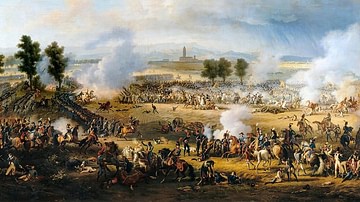
Battle of Marengo
The Battle of Marengo (14 June 1800) was one of the most important battles in the career of Napoleon Bonaparte (1769-1821). It not only helped bring the French Revolutionary Wars to an...
Prehistoric Period
Definition
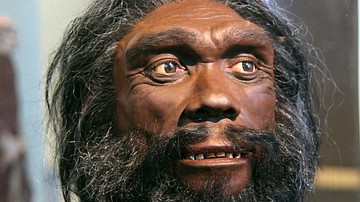
Homo Heidelbergensis
Homo heidelbergensis is an extinct species of human that is identified in both Africa and western Eurasia from roughly 700,000 years ago onwards until around 200,000 years ago – fitting...

Article
Prehistoric Alpine Stilt Houses
Alpine stilt houses are a unique and fascinating aspect of prehistoric architecture in the Alps, which provide valuable insights into the lives and culture of the ancient communities...

Definition
Barnhouse Settlement
The Barnhouse Settlement is a Neolithic village located in Antaness, Orkney, Scotland, which was inhabited between c. 3300 and 2600 BCE. The present designation of 'Barnhouse' comes...

Definition
Paleolithic
The Palaeolithic ('Old Stone Age') makes up the earliest chunk of the Stone Age – the large swathe of time during which hominins used stone to make tools – and ranges from the first known tool...

Image Gallery
Paleolithic Art
The first non-functional human-made objects that could be clearly classified as art date back to the Upper Paleolithic (c. 50,000 to c. 12,000 years ago) in Europe. Although Upper Paleolithic...
Definition
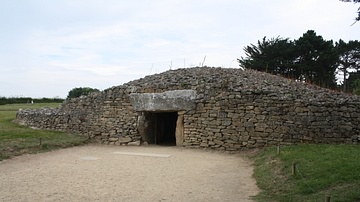
Locmariaquer
Locmariaquer is a Stone Age site in north-west France distinguished by its two large stone tombs and massive granite standing stone or menhir. The monumental structures, all built within metres...

Article
Early Human Migration
Disregarding the extremely inhospitable spots even the most stubborn of us have enough common sense to avoid, humans have managed to cover an extraordinary amount of territory on this...

Definition
Migration Age
The Migration Period, also called the Barbarian Invasions or German: Völkerwanderung (wandering of the peoples), was a period of human migration that occurred roughly between 300 to 700 CE...
