
AP World History Unit 6

Consequences of Industrialization (c. 1750–1900)
Jan van der Crabben
by
published on
bookmark_addbookmark_addedSave Curriculum Collection

With industrialization, a small number of states gained the ability to project power across the globe. Steamships, railroads, machine guns, and anti-malaria drugs allowed European powers, along with the United States and Japan, to seize territory in places they had previously traded with. Philosophers justified the land grab with ideas about civilization and racial hierarchy. By 1900, European powers controlled large parts of the globe, while colonized people resisted around the world as industrial economies reshaped societies.

This collection collates articles, definitions, and maps covering Unit 6: Consequences of Industrialization of the AP® World History: Modern curriculum, which accounts for 12–15% of the exam and around 12–15 class periods. It offers an overview for teachers and students alike, providing the materials needed to explore how industrial power reshaped empires, economies, and the movement of people around the world.

Unit 6 covers eight topics: 6.1 Rationales for Imperialism · 6.2 State Expansion from 1750 to 1900 · 6.3 Indigenous Responses to State Expansion from 1750 to 1900 · 6.4 Global Economic Development from 1750 to 1900 · 6.5 Economic Imperialism · 6.6 Causes of Migration in an Interconnected World · 6.7 Effects of Migration · 6.8 Causation in the Imperial Age

⬇️ Scroll down to see the collection!

Ideas for Teachers

  • Partition roleplay: Have students read the Berlin Conference 1884-5 and Scramble for Africa articles, alongside the Map of the Scramble for Africa. Then ask them to list the arguments Europeans used to justify partitioning large parts of the world. Also discuss who was absent from these negotiations.
  • Company to crown: Based on the East India Company and Fall of the East India Company articles, alongside the two East India Company maps, have your students trace how one trading company became a territorial government, and why the British state took direct control in 1858.
  • Global resistance: Assign reading of the Battle of Isandlwana article and ask your students to explain how this account presents Zulu tactics versus British assumptions. Then compare it to the Sepoy Mutiny article to identify commonalities between the two rebellions.
  • Rebellion over prices: Have your students read the Indigo Revolt article. Ask them to discuss how a dispute over a crop's price turned into a mass uprising.
  • Diamond profits: Using the articles How Diamonds Transformed Southern Africa and Witwatersrand Gold & the Creation of South Africa, ask your students to trace the wealth from the mineshaft outward. Discuss in groups how mineral discoveries redrew the political map of the region.
  • Competing empires: Read The Great Game and Fashoda Incident articles side by side. Have your students determine why imperial rivalries between European powers were so often fought in Asia and Africa rather than in Europe.

Browse the collection below to find materials that fit your teaching style, and feel free to adapt them to your students. Note that our articles are print-friendly, and there is a PDF export button on each article page.

AP® and Advanced Placement® are trademarks registered by the College Board, which is not affiliated with, and does not endorse, this collection.

Articles & Definitions

Scramble for Africa
Definition

Scramble for Africa - How European Empires Took Over a Continent

The Scramble for Africa describes the competition between European imperial powers to first...
Berlin Conference 1884-5
Definition

Berlin Conference 1884-5 - Establishing the Rules of the Scramble for Africa

The Berlin Conference, also known as the Berlin West Africa Conference, was held...
East India Company
Definition

East India Company

The English East India Company (EIC or EEIC), later to become the British East India Company, was founded in 1600 as a trading...
Fall of the East India Company
Article

Fall of the East India Company

The British East India Company (1600-1874) was the largest and most successful private enterprise ever created. All-powerful...
Anglo-Mysore Wars
Definition

Anglo-Mysore Wars

The Four Anglo-Mysore Wars (1767-1799) were fought between the British East India Company (EIC) and the state of Mysore. Haidar...
First Anglo-Sikh War
Definition

First Anglo-Sikh War

The First Anglo-Sikh War (1845-6) was a short and bloody conflict won by the British East India Company (EIC) against the...
Indian Princely States
Definition

Indian Princely States

The Indian Princely states (aka Native States or Princely India) were those states in the Indian subcontinent the British...
The Great Game
Definition

The Great Game - Britain and Russia's Imperial Rivalry

The Great Game describes the rivalry between the British and Russian empires through the 19th century...
Fashoda Incident
Definition

Fashoda Incident - When Britain and France Almost Went to War in Africa

The Fashoda Incident of 1898 occurred in Sudan and caused a diplomatic crisis between...
Belgian Congo
Definition

Belgian Congo - One of Africa's Most Notorious Colonies

Belgian Congo was a colony of Belgium from 1908 until 1960. Prior to that, the region had been...
German East Africa
Definition

German East Africa

German East Africa (Deutsch-Ostafrika) was a colony of Imperial Germany from 1885 until 1918. The territory, much larger than...
Italian Colonialism in Eritrea
Article

Italian Colonialism in Eritrea

Eritrea, located on the Red Sea coast of the Horn of Africa, was the ‘firstborn’ colony of Italy. The potential of...
Boer War
Definition

Boer War - Imperialism v. Nationalism in Southern Africa

The Boer War (aka Second Anglo-Boer War, South Africa War, and Second War of Freedom, 1899-1902...
Meiji Period
Definition

Meiji Period

The Meiji period refers to the period in Japanese history from 1868 to 1912 during which the Meiji Emperor reigned. Following the...
Sepoy Mutiny
Definition

Sepoy Mutiny

The 1857-8 Sepoy Mutiny (aka Sepoy Rebellion, Indian Mutiny, The Uprising or First Indian War of Independence) was a failed rebellion...
Indigo Revolt
Definition

Indigo Revolt

The Indigo Revolt (aka Indigo Riots or Blue Mutiny) of 1859-60 in Bengal, India, involved indigo growers going on strike in protest...
Zulu Kingdom
Definition

Zulu Kingdom - Southern Africa's Dominant Power

The Zulu Kingdom was one of the most powerful states in Southern and Central Africa during its peak in...
Battle of Isandlwana
Article

Battle of Isandlwana - The Zulu Victory over the British Empire

The Battle of Isandlwana on 22 January 1879 was the opening encounter of the Anglo-Zulu War...
Mahdist War
Definition

Mahdist War - Holy War in Sudan, 1881-99

The Mahdist War (1881-99) in Sudan was led by the inspirational Muhammad Ahmad, an Islamic holy man who declared...
Italo-Ethiopian Wars
Definition

Italo-Ethiopian Wars

Italy occupied Ethiopia for five years, from 1935 to 1941, following a mass-scale invasion launched by the fascist dictator...
Ghost Dance
Definition

Ghost Dance

The Ghost Dance (Spirit Dance) is an expression of rebirth and renewal using the traditional Native American circle dance, first practiced...
Trail of Tears: Memorial and Protest of the Cherokee Nation by John Ross
Article

Trail of Tears: Memorial and Protest of the Cherokee Nation by John Ross

The Trail of Tears was the forced relocation of the "Five Civilized Tribes" – Cherokee...
Ivory & the Colonization of Africa
Article

Ivory & the Colonization of Africa

European colonising powers sought to exploit Africa's resources from the 15th century onwards. Arab traders had...
How Diamonds Transformed Southern Africa
Article

How Diamonds Transformed Southern Africa - Kimberley's Blood, Sweat & Segregation

The discovery of diamonds in 1867 in Griqualand ultimately transformed the...
Witwatersrand Gold & the Creation of South Africa
Article

Witwatersrand Gold & the Creation of South Africa

The discovery of gold at Witwatersrand in Transvaal in 1886, coupled with that of diamonds at Kimberley...
Britain and the Suez Canal
Article

Britain and the Suez Canal - 75 Years of Colonialism & Crisis

The Suez Canal in Egypt, which links the Mediterranean to the Red Sea, was taken over by the...

Maps & Infographics

Map of the Scramble for Africa after the Berlin Conference
Image

Map of the Scramble for Africa after the Berlin Conference

The Berlin Conference (1884–1885), also known as the Congo Conference, marked a defining moment...
Map of the East India Company's Rise to Power, c. 1765
Image

Map of the East India Company's Rise to Power, c. 1765 - Robert Clive and the Making of Company Power in India

The British East India Company's (EIC) rise to power...
Map of the East India Company Trade, c.1800
Image

Map of the East India Company Trade, c.1800

The English East India Company (EIC) was established by Royal Charter on 31 December 1600 under Queen Elizabeth...
Map of the British Conquest in India c. 1857
Image

Map of the British Conquest in India c. 1857

This map illustrates the rapid and often chaotic expansion of British control in India between the Battle...
Map of the Indian Rebellion (Sepoy Mutiny) of 1857
Image

Map of the Indian Rebellion (Sepoy Mutiny) of 1857

The Indian Rebellion of 1857 was a transformative uprising that shook British rule in South Asia...
Map of the Zulu Kingdom and British Imperial Expansion
Image

Map of the Zulu Kingdom and British Imperial Expansion - The Anglo-Zulu War - Conquest & the Struggle for Power

The Zulu Kingdom emerged in the early 19th century...
Map of the First Anglo-Boer War, 1880–1881
Image

Map of the First Anglo-Boer War, 1880–1881 - Resistance, Imperial Overreach & the Limits of British Power

The First Anglo-Boer War (1880-1881) emerged from growing...
Map of the Second Anglo-Boer War, 1899–1902
Image

Map of the Second Anglo-Boer War, 1899–1902 - The Remaking of South Africa

The Second Anglo-Boer War (1899–1902) was a major conflict between the British Empire...
Map of the Suez Canal at its Opening, c. 1869
Image

Map of the Suez Canal at its Opening, c. 1869 - Engineering, Empire, and the Remaking of Global Trade

The opening of the Suez Canal on 17 November 1869 marked a...
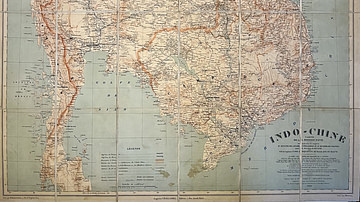
Map of Indochina by the Pavie Mission
Image

Map of Indochina by the Pavie Mission

This antique map of Indochina, dated 1909, was produced under the direction of Auguste Pavie and based on surveys...
Map of Japanese Expansion in Asia & the Pacific, 1875–1942
Image

Map of Japanese Expansion in Asia & the Pacific, 1875–1942 - Japanese Empire at Its World War II High-Water Mark

Japan’s imperial expansion developed over several...
Map of Westward Exploration and Settlement of the USA c.1855
Image

Map of Westward Exploration and Settlement of the USA c.1855

The Louisiana Purchase (1803), negotiated during the presidency of Thomas Jefferson (reign...
Subscribe to this author

About the Author

Free for the World, Supported by You

World History Encyclopedia is a non-profit organization. Please support free history education for millions of learners worldwide for only $5 per month by becoming a member. Thank you!
Become a Member  

History should be free for everyone!

If you find World History Encyclopedia helpful, a $10 contribution helps keep trusted history free and accessible to millions of readers and students worldwide. Thanks for making a difference!

Support Us Remove Ads