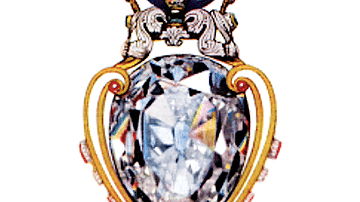


The discovery of diamonds in 1867 in Griqualand ultimately transformed the entire region of Southern Africa. Huge European financial investment and significant immigration followed. The diamonds led to Britain taking over Griqualand and the Boer republic of Transvaal, and to the conquest of the Zulu Kingdom. When the riches of the Kimberley diamond mines were added to by the discovery of massive gold deposits in Witwatersrand in 1886, Britain went to war with the Boers and proceeded to annex African territories in order to ensure their total dominance of the region. The diamond and gold mines, which demanded an insatiable supply of cheap labour, also transformed local economies and cultures, laying the foundations for a system of racial segregation that would not be abolished until the late 20th century.

In the early 19th century, Southern Africa had only really been of strategic interest to the British, the Cape Colony (founded 1806) and Cape of Good Hope acting as an important stopping point for ships sailing to and from Britain and its possessions in Asia, particularly British India. The British had competition, not only from indigenous Africans but also from the Boers. The Boers were White settlers in Southern Africa who had Dutch or French ancestry. The name Boer means "farmer." They were also known as Afrikaners because they spoke Afrikaans. Through the 1830s, as the British outlawed slavery and population growth applied too much pressure to land and resources around the Cape, over 14,000 Boers migrated to find land elsewhere. Andries Waterboer was one such Boer, and he claimed the Griqua territory, which was located above the Orange River. His claim for this land was recognised by the British in 1834 but disputed by local Tlhaping chiefs.
The British founded another colony, Natal, in 1843. The Boers, meanwhile, created two republics, Transvaal in 1852 and Orange Free State in 1854. Up to this point, these White colonies saw only a modest source of income from agriculture and trade. This all changed in 1867. Diamonds were discovered in Griqualand in that year. The very first large rough diamond was, appropriately enough, found in a place called Hopetown and was used by children as a pretty marble until it was sent off to Grahamstown (Makhanda) and identified for what it was. The colonial secretary to the Cape government, Richard Southey, got his hands on the stone and confidently declared: "Gentlemen, this is the rock on which the future success of South Africa will be built" (Fage, 359). In terms of White investors, colonialists, and workers, he was absolutely right. Black Africans would have rather less to cheer over the discovery of diamonds.
More diamonds were found in 1870 at what would be called Kimberley (named after the Earl and colonial secretary). The first diamond-bearing rock deposits were discovered on the farm of one Johannes Nicolas de Beer. The diamond discoveries along the Orange, Harts, and Vaal rivers led to massive British financial investment in Griqualand and a huge influx of immigrants. There were wizened prospectors from Australia and California, hard-nosed British entrepreneurs, hopeless dreamers, and not a few criminals. "Within five years of the discovery in Griqualand, more than £1.6 million-worth (£170 million today) of diamonds were being annually exported." (Boahen, 183)

Kimberley was the site of a massive human-made crater known simply as the Big Hole. The author Anthony Trollope (1815-1882) visited in 1877 and described it as follows:
It is as though you were looking into a vast bowl, the sides of which are as smooth as should be the sides of a bowl, while round the bottom are various marvellous incrustations among which ants are working with the usual energy of the ant-tribe…You look down and see the swarm of black ants busy at every hole and corner with their picks moving and shovelling the loose blue soil.
(Jackson, 12-13)
Gradually, the precious stones found themselves in fewer and fewer hands as men like Alfred Beit and Barney Barnato bought out their competitors. In 1871, there had been 3,588 claims, but by 1881, these had been consolidated to just 71. The biggest winner of all was one Cecil John Rhodes (1853-1902). Rhodes was the son of a British vicar who first came to South Africa in 1870 when he worked on his brother's cotton farm. Rhodes arrived in Kimberley in 1871 and quickly built his fortune on diamonds, shrewdly cornering the market for the pumps, which were so essential to prevent the mines from flooding. Rhodes created the company De Beers Consolidated Mines Ltd. By 1890, South Africa was by far the world's largest producer of diamonds, easily outstripping such traditional sources as Brazil. In fact, Rhodes and De Beers had gained control of around 90% of the world's diamonds. The De Beers monopoly in Kimberley allowed the company to do two things: control the output of the diamonds to maintain prices and to drive down the costs of labour. In order to reduce theft, workers were obliged to live in compounds with wire meshes, but, in the first step towards segregation, this only applied to Black Africans, not White miners.
Now that the interior seemed to offer valuable resources, the British government also took a more active role in this area of Africa. Griqualand, renamed West Griqualand by the British, was made a Crown Colony in 1871 but then annexed by Cape Colony in 1873. The blatant British takeover of the diamond mines at Kimberley was bitterly resented by the Transvaal and Orange Free State Boers. It was also resented by the Griqua chiefs whose land it was that everyone was digging up, now with machines, as the mines became vast open pits that scarred the region permanently. A land court had even ruled the Griqua did indeed own the land, but this did not stop the colonial rulers from grabbing it anyway. The mines were now dominated by big businesses, the only ones that could afford the expensive machinery required to dig ever deeper into the earth.

Consequences of the Mining Boom
The "effects of this mining boom in South Africa were truly phenomenal and all-embracing" (Boahen, 183). Exports rose dramatically, with diamonds accounting for one-third. The mines provided a source of jobs – albeit hard and unsafe ones – with 50,000 people finding employment in the diamond industry in the 1870s. The combination of capital and cheap labour reaped huge rewards, but only for the few at the top of the capitalist pyramid. As the historian R. Reid notes, the need to ensure a permanent supply of cheap labour had long-lasting consequences since it "…shaped social and economic policy in South Africa through the twentieth century, and around which much racial ideology was formed" (183).
Another consequence of the mines was a massive growth in the town of Kimberley, which quickly boasted over 50,000 residents. A huge influx of new settlers came from across Southern Africa and beyond. This boom provided a ready and lucrative market for locally grown foodstuffs, and so some African peasant farmers prospered. However, it also created unwanted competition for arable land, and the prosperity proved temporary since White settlers, privileged by colonial laws, soon began to take over and farm on a larger scale.
As Southern Africa developed economically, railways and roads were built, again using cheap African labour. Such developments in urbanisation and infrastructures were unusual in other African colonies, at least in terms of rapidity and scale. In 1860, Southern Africa had a mere 3 kilometres (1.8 mi) of railway and no roads at all suitable for wheeled vehicles. By 1889, there were 3,300 km (2,050 mi) of railway. By 1914, there were 75,000 km (46,600 mi) of roads. These transport systems were a further disruption to traditional farming communities and only increased the urbanisation process. Urbanisation and the growth in the mines were now badly affecting the environment, notably in terms of severe deforestation, as tremendous quantities of wood were required as fuel. All in all, the Griqua people probably wished nobody had ever stumbled on that first milky-white stone back in 1867.

The British, particularly the new Colonial Secretary Sir Michael Hicks Beach, were now keen to unify the Cape Colony and Natal with the two Boer republics into some sort of federation, but the latter were suspicious of what that would mean for their own independence. A loss by the Boers to a Pedi attack gave the British the excuse to annex Transvaal in January 1877, claiming that only a British military presence would guarantee security. The British were determined to create a federation of South Africa that could protect its lucrative diamond mines. This plan took another step forward when the British defeated the Zulu Kingdom in 1879. Zululand became a crown colony in 1887 and was absorbed into Natal in 1897. In the meantime, the British acquired both the Basutoland Protectorate (modern Lesotho) in 1884 and the Bechuanaland Protectorate (modern Botswana) in 1885. Swaziland and Pondoland were added to Britain's motley collection of southern African states in 1893 and 1894, respectively.
British rivalry continued with the Boer Republics and intensified after the discovery of gold at Witwatersrand in Transvaal in 1886. "By 1890, £10 million-worth of gold was being exported, which made gold the leading South African export; this had risen to £25 million by 1905 and to between £45 and £50 million [£5,000 million today] by 1910" (Boahen, 183). By 1915, South Africa was producing 40% of the world's gold. The diamonds and gold mines inspired imperialist adventurers like Rhodes to move north of the Limpopo River in the (what turned out to be mistaken) belief that similar riches must surely be found there, too.
Rather shabbily dressed, the only extravagant thing about Rhodes was his desire for British domination of the world. Kimberley became the headquarters of the British South Africa Company, founded by Rhodes in 1889. Rhodes became the prime minister of the Cape Colony in 1890. With tremendous wealth and now political clout, Rhodes set about empire-building after gaining a royal charter to colonise what he would be called Rhodesia (today's Zimbabwe, Zambia, and Malawi). Rhodes ruled his namesake state, which was formed at the expense of the Mashona and Matabele people, as a virtual dictator.
As the 19th century came to a close, Britain had to defend its acquisitions from the Boers in two wars: the First Anglo-Boer War (1880-81) and the Second Anglo-Boer War (1899-1902). Britain was victorious in the second conflict, and so, at last, the British colonial dream was realised, and the Union of South Africa was formed in 1910. This colony was composed of Cape Colony, Natal, Transvaal, and Orange Free State, and included what had been Zululand, Tongaland, and Griqualand.

Gold and diamonds, which together accounted for 75% of South Africa's exports, had, then, not only led to the British colonising almost the entire region of Southern Africa, but they had also completely altered the relations between settlers and indigenous Africans and laid the seeds for later policies of racial segregation that lasted into the late 20th century. White miners, on average, received more than ten times the wage of a Black miner. Various acts were passed, such as the Mines and Works Act of 1911, which excluded Africans from certain skilled mining jobs, and the Natives Land Act of 1913, which removed land from Africans to force them to become labourers in the mines. As Reid notes:
These finds would dramatically alter the balance of power, transforming southern African history and bringing about a veritable economic revolution which would ultimately destroy African self-sufficiency and lead to the creation of a capitalist economy by the end of the nineteenth century. It would lead, too, to the destruction of African political independence, at least temporarily.
(75)
The diamond mines of South Africa continue to produce sparkling gems today, but none have ever been more impressive than the 3,000-plus carat Cullinan Diamond, discovered in Cullinan in 1905. Cut to create two huge stones, the 530-carat Cullinan I, also known as the Star of Africa, now sits in the royal sceptre of the British Crown Jewels in the Tower of London. It is the largest colourless cut diamond in the world. The second largest stone, Cullinan II, the 317-carat Second Star of Africa, was set into the front of the Imperial State Crown, which is used at coronations of British monarchs.