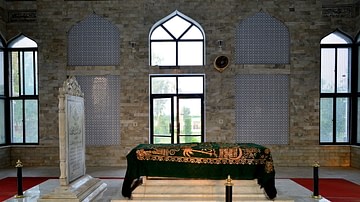


The Mahdist War (1881-99) in Sudan was led by the inspirational Muhammad Ahmad, an Islamic holy man who declared himself the Mahdi (the Messiah). The Mahdists wanted to overthrow Ottoman-Egyptian rule in Sudan and spread a new form of Islam both in Sudan and elsewhere. Famously laying siege to Khartoum and killing the British national hero General Gordon, the Mahdists were finally defeated by an Anglo-Egyptian army led by General Kitchener, victor of the Battle of Omdurman in 1898.
Ottoman Egypt
In 1881, Egypt was under the nominal control of the crumbling Ottoman Empire. The ruler of Egypt, Khedive Ismail, also called Isma'il Pasha of Egypt (reign 1863-1879) and essentially the Ottoman viceroy, had imperial ambitions to the south and Sudan, despite having to already contend with both Britain and France hovering in the wings and ready to take over Egypt and its vital Suez Canal. An imperialist campaign to acquire ivory, slaves, and soldiers in Sudan in 1881 (and others elsewhere) bankrupted the pasha.
The British had two objectives in this part of Africa: to control the canal and preserve the vital sea route between Europe and British India, and to control Sudan since the Nile River runs right through that country and was vital to Egypt's welfare. Britain stepped in to quash a nationalist revolt in Egypt led by Ahmed Urabi in September 1882. The British then took the opportunity to rule Egypt themselves as a protectorate in all but name. This still left the problem of Sudan, where a revolt had broken out in the Kordofan province following the pasha's attacks there. The Sudanese had rallied around a single inspirational figure, one Muhammad Ahmad Ibn 'Abdallah.
The Mahdi
Muhammad Ahmad (1844-1885) was born the son of a boat builder, and he became a Muslim cleric of the Samaniya order. Muhammad Ahmad claimed he had experienced a series of visions, which identified him as the Mahdi, a figure in Islamic tradition also known as 'the redeemer' or 'one who is guided,' a person who is "a divinely guided restorer of justice and equity" (Fage, 609). There had been several claimants to the role of Mahdi, whom Muslims believed, as a messiah figure, would free Africans from colonial rule and bring a new and prosperous Islamic state into fruition.

Muhammad Ahmad's followers were known as the Mahdists or ansars, and their leader called for all Muslims to join him and rid Sudan of foreign rulers. The followers were inspired both by religious beliefs and anger against the repression of the lucrative slave trade, high taxes, and general interference of the Egyptians and British in Sudanese affairs. Such affronts to Islam as the appointment of a Christian governor-general and the establishment of a large Catholic mission in the Sudanese capital Khartoum would no longer be tolerated.
Muhammad Ahmad also called for a return to a simpler and what he called purer form of Islam, a faith which he said should be "purged of heresies and accretions" (Boahen, 39), and he believed this version of the religion should be spread across the entire world by any means. Muhammad Ahmad insisted that his followers wear the jibba, a robe of patched material which symbolised a rejection of worldly goods. When the army went into battle, it rode its horses and camels before red, green, and black flags inscribed with quotations from the Quran.
After defeating a number of woefully small Turkish-Egyptian forces sent from Egypt to repress the revolt, the Mahdist revolution spread from 1882. New followers, even non-Muslims, joined the revolt with each victory. El Obeid was besieged and captured, along with a useful horde of guns and ammunition, in January 1883. An Egyptian force of 3,000 men sent to relieve El Obeid was then wiped out.

The Mahdist army next annihilated an even larger Egyptian army under the command of British Colonel William Hicks at Omdurman in September 1883. The Mahdists won another victory against Hicks two months later at the Battle of Shaykan (aka Shoykan) on 5 November. Hicks had been drawn further and further into the desert, and his army, ill-disciplined and short of water, was ultimately obliterated. Hicks himself was either killed in action or captured and executed. The victory brought the added bonus of hundreds of modern rifles for the Mahdists, although acquiring the skill to use them well was not so easy.
A Mahdist state was established in the provinces of Kordofān, Dārfūr, and Bahr al-Ghazāl in western Sudan. The Mahdi appointed emirs as regional governors, notably Osman Digna, who won several battles against the Egyptians in the east of Sudan. Osman Digna defeated yet another Egyptian army, this time led by British general Valentine Baker, at the First Battle of El Teb in February 1884. This victory brought the Mahdists another 3,000 rifles, machine guns, and several field guns. A British relief force under the command of General Gerald Graham then defeated the Mahdists at the Second Battle of El Teb at the end of the same month. This victory failed to convince the British government that the only sensible policy was to withdraw from Sudan.
Muhammad Ahmad's movement was now gaining international attention, and several global Muslim leaders sent their congratulations to the Mahdi. The Mahdist "administrative, financial and judicial institutions and its legislation were based strictly on the dual foundations of the Kuran and the Sunna" (Boahen, 41). The heavy and unpopular tax system of the Egyptian-Ottoman regime was replaced by a new, more practical one. Sudanese now paid 2.5% tax on any money held and 10% on any livestock and grain owned. The slave trade resumed, and non-Muslims were forcibly converted. Muhammad Ahmad established his headquarters in the Nuba Mountains at Djabal Kādīr.

The Fall of Khartoum
In 1884, the official British government's policy was not to involve itself in Sudanese affairs, but it did send General Charles Gordon (1833-1885) to attempt some sort of orderly withdrawal of the Egyptian forces still in the country. Gordon was already a British hero from his escapades in China, where he helped put down the Taiping Rebellion in 1863-4, and for his role in having helped end the slave trade in Sudan while he served there as governor-general in the late 1870s. Once back in Sudan, Gordon decided to try to hold Khartoum, the capital, principally because he wanted to see a successor government established rather than simply quit the country as the British prime minister, William Gladstone, wished. The general declared, "I come without soldiers but with God on my side, to redress the evils of the Sudan" (James, 85). Gordon believed that if he could hold Khartoum, the British government would be obliged sooner or later, and despite Gladstone's reluctance, to send an imperial relief force.
The Mahdists, led by the Mahdi himself, laid siege to Khartoum for ten months, beginning on 12 March. Gordon was able to fortify the city, already protected on two sides by the Blue and White Nile rivers. Gordon also built a large perimeter ditch and parapet outside the southern and most exposed side of the city, defence works which connected the two rivers. Gordon also fitted out eight vessels to act as gunboats on the rivers, and he sent out raiding parties to gather in food for the besieged city. The Mahdists, meanwhile, were prepared to wait for the waters of the two Nile rivers to fall before attacking the city directly.
With public opinion fuelled to a fever pitch by regular press reports calling for the government to act, a British relief force was reluctantly sent to Khartoum, a city with a population of 50,000. This army of 10,500 men was led by General Garnet Wolseley (1833-1913), and he proceeded along the Nile with extreme caution, mindful of the disaster that had befallen Hicks. As a result of Wolseley's leisurely pace, the vanguard of the relief force arrived in Khartoum two days too late. Wolseley's expedition had started too late in the first place, which was the dithering government's fault, but the general was to blame for choosing a slow route to Khartoum. Wolseley had both underestimated the Mahdists and overestimated Gordon's ability to hold out in a lengthy siege.
Khartoum had fallen, and General Gordon had been killed on 26 January 1885. At least 4,000 civilians in the city were massacred. Women and girls were made slaves of the victors. Gordon's head was put on a pole, his body unceremoniously left in the palace garden. These outrages and the death of a national hero could not be ignored. The British government felt it had to be seen to strike revenge against the Mahdists, who now controlled virtually all of Sudan except its frontier regions. Indeed, the death of Gordon and the rather slow efforts to prevent it were one of the reasons William Gladstone's government fell that summer. Queen Victoria wrote in her diary: "The Government alone is to blame" (Wilkinson-Latham, 29). However, yet another crisis in Afghanistan – where the Great Game of Asian imperialism was being played out between Britain and Russia – delayed British military intervention in Sudan for several years.

Muhammad Ahmad, meanwhile, died, probably from typhus, in June 1885, but the Mahdist state continued to rule Sudan. Muhammad Ahmad's successor was his second-in-command, Khalifa 'Abdullah (also 'Adallahi). Now, the Mahdists were ambitious to spread their particular brand of Islam outside Sudan. The Mahdist army attacked Egypt in 1889 but lost the battle of Toski (aka Tushki). Ethiopia in the east proved equally difficult to invade, although the Mahdists killed the Ethiopian emperor Yohannes IV (reign 1871-1889) at the Battle of Gallabat (aka Metema) in March 1889. Christian Ethiopia and Muslim Sudan could have been allies in their respective fights against European colonialism, but they could not overcome their religious differences, and the war between them did nothing but weaken their common cause through the 1890s. In 1895, a Mahdist attack in the far south against the Congo Free State (the precursor of Belgian Congo) failed.
Omdurman: British Revenge
The British government, realising the Mahdist state could threaten the entire region, still worried about the Nile not being blocked before it reached Egypt, but it was even more concerned that France might seek to exert influence on Sudan. The British began to take a more proactive role in 1896. Horatio Herbert Kitchener (1850-1916) was made governor-general of eastern Sudan and appointed commander of a large Anglo-Egyptian army tasked with finally ending the Mahdist rebellion. Kitchener methodically led his army of 19,000 men up the Nile, building a railway as he went. One member of this force, then a mere lieutenant, was Winston Churchill.
Kitchener's army, equipped with the latest long-range rifles, machine guns, and artillery pieces, defeated the Mahdists at the Battle of Atbara on 8 April 1898. The Mahdists, who had insisted on head-on charges, suffered 3,000 dead and 4,000 wounded. Kitchener's army then inflicted an even bigger defeat on the Mahdists at the Battle of Omdurman on 2 September. 11,000 Sudanese were killed, and 16,000 were wounded. Men charging machine guns were effectively committing suicide. The British-Egyptian-Sudanese killed numbered fewer than 50. It is curious that this fact was not better noted by a certain Major Haig at Omdurman. Later, in the First World War (1914-18) and by then a field marshal, Haig stubbornly and repeatedly ordered troops to attempt equally futile charges against German machine guns.

Khartoum was recaptured and looted. Kitchener's policy of leaving the wounded enemy unattended on the battlefield did not interfere with his replacing Gordon as the new British military national hero. The British government was rather less enamoured with Kitchener over stories of post-battle brutality, executions without trial, and the story that he had exhumed the Mahdi's bones and thrown them into the Nile (except the skull, which was converted into an inkwell). The disgrace was such that one group of MPs in the British parliament refused to endorse the plan to pay Kitchener a cash prize for his success in the Sudanese campaign. In the end, Kitchener got his prize of £30,000 and was made a baronet; his chosen title was Kitchener of Khartoum.
Khalifa 'Abdullah was not captured, though, and, with his 10,000 remaining followers, he continued the rebellion from the eastern province of Kordofan. The Mahdist War finally came to an end in November 1899 when Khalīfa 'Abdullah's army was defeated at the Battle of Umm Diwaykarat (aka Um Debreikat). Khalīfa 'Abdullah was found dead in his tent.
After seeing off a rival French expeditionary force at Fashoda (an episode known as the Fashoda Incident and which nearly started a war between the two colonial powers), Kitchener was made military governor of all of Sudan, and then governor-general. A modern administrative government was established, and Sudan was ruled as a British protectorate in all but name. Egypt was officially declared a British protectorate in 1914. Sudan gained independence in 1956, Egypt in 1922 (although Britain continued to control the Suez Canal until 1956). Meanwhile, the Mahdist dream did not completely die out, and several more Mahdist rebellions against colonial rule would continue to trouble British rule through the first two decades of the 20th century.