


Japan’s imperial expansion developed over several decades rather than from a single fixed plan. Modernization during the Meiji era transformed Japan into an industrial and military power competing within an international system already shaped by European and American imperialism. Victories over Qing China (1894–1895) and Russia (1904–1905) strengthened Japanese influence in East Asia, while colonial acquisitions and annexations created an increasingly extensive overseas empire. Under Emperor Hirohito (reign 1926–1989), the seizure of Manchuria (1931), establishment of the Japanese-backed state of Manchukuo (1932), and full-scale war with China from 1937 marked a significant shift toward sustained military occupation and continental conquest. Japanese expansion reflected overlapping concerns about security, resources, national prestige, economic self-sufficiency, and the growing political influence of the armed forces rather than any single cause.
By 1940–1942, Japanese leaders increasingly presented regional expansion through the idea of a Greater East Asia Co-Prosperity Sphere, claiming to challenge Western colonialism and create an Asian-led order while in practice establishing a Japanese-dominated political and economic system. Expansion into French Indochina intensified confrontation with the United States and other colonial powers; asset freezes, trade restrictions, and Japan’s growing dependence on imported strategic resources contributed to the crisis that culminated in the attack on Pearl Harbor (7 December 1941). Japan then rapidly conquered or occupied large areas of Southeast Asia and the western Pacific, although authority varied greatly between colonies, military occupations, puppet governments, and allied states. By August 1942 the advance was reaching its high-water mark: the Battle of the Coral Sea (May 1942), Battle of Midway (4–7 June 1942), and Allied landings in the Guadalcanal Campaign (from August 1942) signaled a transition from rapid expansion toward an increasingly contested defensive war.
About the Author
Related Images

Japanese Troops Enter French Indochina, 1940

Damaged US Navy Battleships, Pearl Harbor
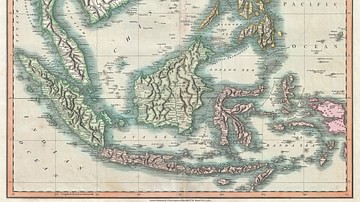
Map of the East Indies and Southeast Asia

Map of the Coral Sea

Aerial View of Midway Atoll, 1941
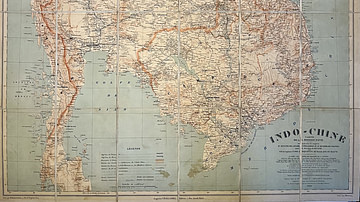
Map of Indochina by the Pavie Mission
Cite This Work
APA Style
Netchev, S. (2026, August 20). Map of Japanese Expansion in Asia & the Pacific, 1875–1942: Japanese Empire at Its World War II High-Water Mark. World History Encyclopedia. https://www.worldhistory.org/image/21959/map-of-japanese-expansion-in-asia--the-pacific-187/
Chicago Style
Netchev, Simeon. "Map of Japanese Expansion in Asia & the Pacific, 1875–1942: Japanese Empire at Its World War II High-Water Mark." World History Encyclopedia, August 20, 2026. https://www.worldhistory.org/image/21959/map-of-japanese-expansion-in-asia--the-pacific-187/.
MLA Style
Netchev, Simeon. "Map of Japanese Expansion in Asia & the Pacific, 1875–1942: Japanese Empire at Its World War II High-Water Mark." World History Encyclopedia, 20 Aug 2026, https://www.worldhistory.org/image/21959/map-of-japanese-expansion-in-asia--the-pacific-187/.

