
Search
Remove Ads
Advertisement
Search Results
Image
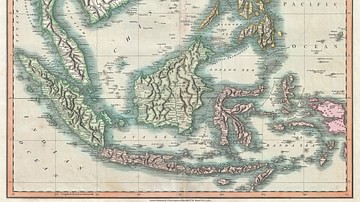
Map of the East Indies and Southeast Asia
An 1801 map of the East Indies and Southeast Asia ( Singapore, Borneo, Sumatra, Java, Philippines).

Article
Plagues of the Near East 562-1486 CE
Disease has been a part of the human condition since the beginning of recorded history – and no doubt earlier – decimating populations and causing widespread social upheaval. Among the worst infections recorded...

Article
The English and Dutch East India Companies' Invasions of India
In the early 17th century, the Dutch and English East India Companies turned their eyes towards India, as part of their grand schemes to develop extensive trade networks across the Indian and...

Article
Trade Goods of the East India Company
The English East India Company (EIC) was founded in 1600, and it came to control both trade and territories in India, as well as a trade monopoly with China. Goods the EIC traded included spices, cotton cloth...

Article
Family Planning in the Ancient Near East
The ancient Near East was home to a multitude of civilizations, across Egypt, Mesopotamia, and the Levant, each with unique views on medicine, conception, and women’s role in society. Attitudes towards contraception...
Article
Middle Eastern Power Shifts & the Trade of Pepper from East to West
Pepper has long been the king of spices and for almost 2,000 years dominated world trade. Originating in India, it was known in Greece by the 4th century BCE and was an integral part of...

Image
Map of Japanese Expansion in Asia & the Pacific, 1875–1942 - Japanese Empire at Its World War II High-Water Mark
Japan’s imperial expansion developed over several decades rather than from a single fixed plan. Modernization during the Meiji era transformed Japan into...

Article
Eyes on the East: Chronicles of the Indian Ocean Spice Trade
As the 15th century ended, Europeans were still mostly in the dark about the Eastern world. Early travelers like Marco Polo had given the West tidbits of information, but these accounts were...

Article
The Armies of the East India Company
The East India Company (EIC) was first England's and then Britain's tool of colonial expansion in India and beyond. Revenue from trade and land taxes from territories it controlled allowed the EIC to build up its...

Article
The Portuguese in East Africa
The Portuguese first took an interest in East Africa from the beginning of the 16th century as their empire spread eastwards across the Indian Ocean. Trade in the region was already well-established and carried out...
