
Search
Remove Ads
Advertisement
Search Results
Image
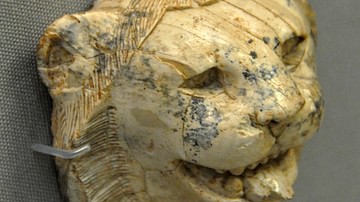
Ivory Head of a Lion from Nimrud
Ivory head of a lion, part of the so-called "Nimrud Ivories" that decorated chariots, high-status furniture, and horse trappings. They were covered with thin gold leaf or ornamented with semiprecious stones. From Nimrud (ancient Kalhu) northern...

Image
Ishtar Gate (Artist's Impression)
An artist's depiction of Ishtar Gate as it may have appeared around the time it was constructed in Babylon c. 575 BCE. From the game Old World.
![Lion of Babylon [Detail]](https://www.worldhistory.org/img/c/p/360x202/293.jpg?v=1767843967-1727082436)
Image
Lion of Babylon [Detail]
Detail of glazed tiles depicting a lion, from the gates of ancient Babylon (modern-day Iraq). The lion is the symbol of Babylon, and represents Ishtar, the goddess of fertility, love and war. Meant not only to symbolise Babylon, but to...

Image
Sam'al Lion
A lion-shaped statue made of dolerite, standing at 1.9 meters high, 2.9–3.05 meters long, and 0.85–0.9 meters wide. The lion come from Sam'al, modern Zincirli, dates between the 10th and 8th centuries BCE, and was located with another lion...

Image
Brandenburg Gate, Berlin, 1945
A June 1945 photograph of the ruined Brandenburg Gate in Berlin after the battle for th at city at the close of the German-Soviet War, the Eastern Front of the Second World War (1939-45). (German Federal Archives)
Image
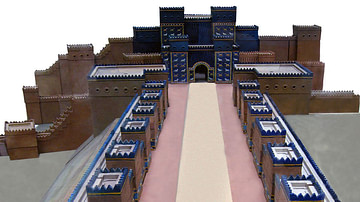
Model of the Ishtar Gate
A model of the Ishtar Gate built in c. 575 BCE by Nebuchadnezzar II in Babylon, displayed at the Pergamon Museum in Berlin.
Image
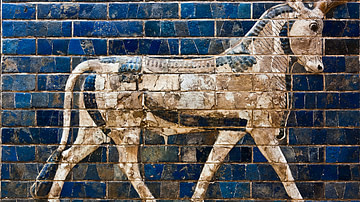
Aurochs from Ishtar gate
Aurochs from Ishtar Gate at Babylon, constructed in about 575 BCE by order of King Nebuchadnezzar II.
On display in Istanbul Archaeology Museum in Istanbul, Turkey.

Image
Hadrian's Wall Gate
The North Gate of Housesteads Fort on Hadrian's Wall. Passport control, immigration control and customs check all in one place. The wall was a checkpoint for taxing cross-border trade as well as a defence.

Image
Lions Gate Detail (Mycenae)
Detail photo of the Lions Gate in Mycenae, Argolis, Greece.
Image
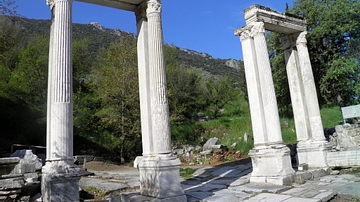
Hadrian’s Gate at Ephesus
This gate, located at the end of Curetes Street in Ephesus (Turkey), was dedicated to Hadrian in honour of the Emperor's visit to the city (in 124 or 129 CE).
