
Search
Remove Ads
Advertisement
Search Results

Image
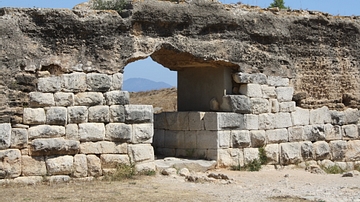
Hellenistic Gate, Butrint
A gate entrance in the Hellenistic fortification walls of Butrint (modern Albania), 2nd century BCE. Constructed using large ashlar blocks with angled joins designed to minimise earthquake damage. Despite this precaution the large cracks...
Image
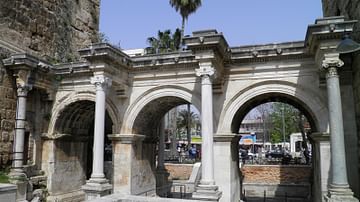
Gate of Hadrian, Antalya
Hadrian's Gate in Antalya (Turkey) was built in honor of the Roman emperor Hadrian, who visited the Roman city (Attaleia) in 130 CE.
Image
City Gate, Empuries
A gate in the Roman wall of Empuries, Spain. 1st century BCE. The base of the wall was made using calcareous rock while the upper portion is of Roman concrete (opus caementicium).

Image
South Gate, Mycenae
The south gate of the citadel (1200 BCE) with foundations of two houses (A & B) visible on the left.
Image
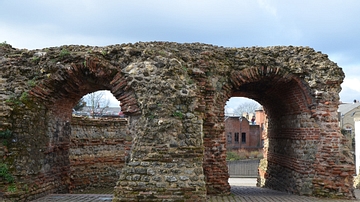
Roman Gate of Camulodunum (Colchester, UK)
The Balkerne Gate, a 1st-century CE Roman gateway in Camulodunum (modern-day Colchester in Great Britain). It is the largest surviving gateway in Roman Britain.
Image
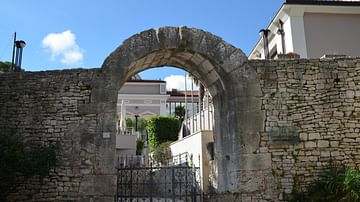
Gate of Hercules, Pula
The so-called Gate of Hercules is the oldest city gate in Pula (Croatia). Architecturally modest, it stands as a single-arched stone gate with, at the top, a worn carving relief of the head of Hercules with his club. The gate was built during...
![Lion of Babylon [Detail]](https://www.worldhistory.org/img/c/p/360x202/293.jpg?v=1767843967-1727082436)
Image
Lion of Babylon [Detail]
Detail of glazed tiles depicting a lion, from the gates of ancient Babylon (modern-day Iraq). The lion is the symbol of Babylon, and represents Ishtar, the goddess of fertility, love and war. Meant not only to symbolise Babylon, but to...

Image
Sam'al Lion
A lion-shaped statue made of dolerite, standing at 1.9 meters high, 2.9–3.05 meters long, and 0.85–0.9 meters wide. The lion come from Sam'al, modern Zincirli, dates between the 10th and 8th centuries BCE, and was located with another lion...

Image
Achaemenid Lion Weight
One side of this heavy weight is inscribed in Aramaic with "correct according to the stater of silver". This probably refers to the use of a weight standard based on the silver coins known as staters. This object weighs just over 31 kg, which...
Image
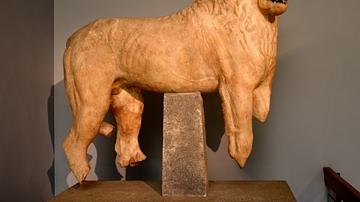
Marble Lion, Mausoleum at Halicarnassus
This is the most complete of the surviving lions from the Mausoleum at Halicarnassus, also known as the Tomb of Mausolus. The lions probably stood at the base of the stepped-pyramid roof, acting as both protective and royal symbols. There...
