
Search
Remove Ads
Advertisement
Search Results

Definition
Medieval Castle
Medieval castles were built from the 11th century CE for rulers to demonstrate their wealth and power to the local populace, to provide a place of defence and safe retreat in the case of attack, defend strategically important sites like river...

Image
The Lion of Knidos
This colossal marble lion was found at a tomb within the ancient cemetery of Knidos (a coastal city in the south-west Turkey). The marble itself was brought from the Aegean Sea from mountain Pentelikon near the city of Athens. The lion's...
Image
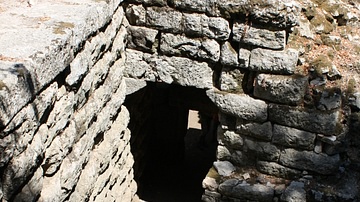
Interior Gate, Butrint
The inside steps descending to the 'lion gate' of Butrint, 2nd century BCE (modified 2nd century CE). The steep incline immediately after a fortification gate was an added defence to restrict access in case of attack.
Image
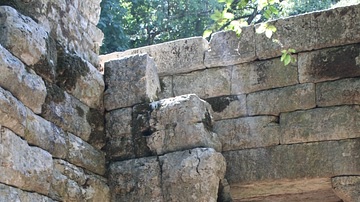
Fortification Gate, Butrint
A gate in the fortification walls of Butrint (modern Albania), 2nd century BCE. The lintel shows a lion devouring a bull carved in relief and was probably reused from an earlier 6th century BCE building. The gate was lowered in height in...
Image
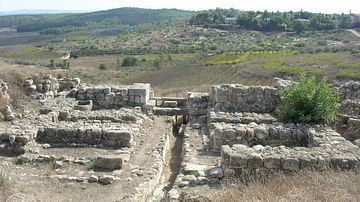
Six-Chambered Gate at Tel Gezer
The six-chambered gate at Tel Gezer in modern-day Israel. This Iron Age gate was once thought built by King Solomon, however recent scholarship has cast doubt on this idea, with some scientific evidence pointing to a later date of construction...
Image
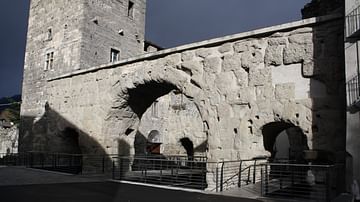
Praetorian Gate, Aosta
The interior gate of the 25 BCE double Praetorian Gate of Aosta in northern Italy. The two gates stand 12 m apart and each has three arched entrances - one central gateway for wheeled vehicles and two smaller passages positioned either side...
Image
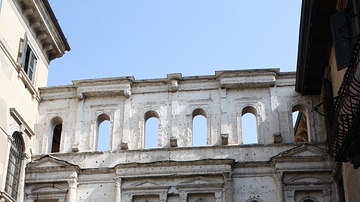
Borsari Gate, Verona
The Borsari Gate, Verona, 1st century CE. The gate is built from white Valpolicella stone and was the city's main gate in Roman times.

Image
MB Canaanite Gate at Tel Gezer
A Middle Bronze Age Canaanite gate at the site of Tel Gezer in modern-day Israel. This gate is believed to have been built—along with other fortifications—by the city's Canaanite inhabitants in the Middle Bronze Age II ca. 1850 BCE when the...

Image
Assyrian Lion Hunt Relief
Frieze depicting a lion hunt, from the royal palace of Ashurbanipal, Nineveh, modern-day Iraq. Neo-Assyrian Empire, 668-631 BCE. The king's role was to protect his people from enemies. In ancient Assyria, this was symbolized in the lion...
Image
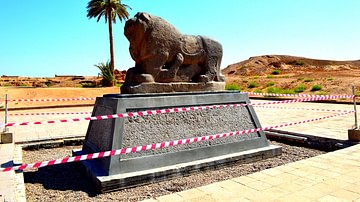
Lion of Babylon Statue, Babylonia
In June/July 2013 CE, an archaeological team started a mission to reconstruct the lion of Babylon statue and its surrounding. The platform of the statue has been reconstructed with cement. The lion itself was untouched.
