
Search
Remove Ads
Advertisement
Search Results

Definition
Roger Williams
Roger Williams (l. 1603-1683 CE) was a Puritan separatist minister best known for his conflict with both the Plymouth Colony and Massachusetts Bay Colony in 1633-1635 CE, resulting in his banishment and founding of the colony of...

Article
Architects of France's 1901 Law of Associations
The Law of Associations was adopted by the French Parliament on 3 July 1901 to limit the influence of Catholic teaching orders as the first step toward the formal separation of church and state that would...

Image
Church of the Holy Cross, Warsaw
A 1778 oil-on-canvas painting, Church of the Holy Cross in Warsaw, by Bernardo Bellotto. (Royal Castle, Warsaw)

Definition
Cathars
The Cathars (also known as Cathari from the Greek Katharoi for “pure ones”) were a dualist medieval religious sect of Southern France which flourished in the 12th century and challenged the authority of the Catholic Church. They were...
Article
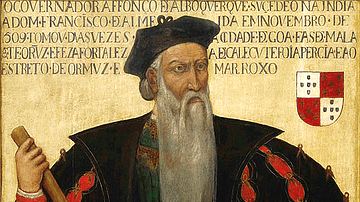
Bangkok's Portuguese Past
Any itinerary for a visit to Bangkok, Thailand would include some of the city's must-see historical and cultural sights: - The 24-hour flower market (Pak Khlong Talat) filled to the brim with jasmine-scented garlands...

3D Image
Church of the Holy Sepulchre in Jerusalem - 3D View
The site of the Church of the Holy Sepulchre in Jerusalem is identified as the place both of the crucifixion and the tomb of Jesus of Nazareth. The church has long been a major pilgrimage center for...

Image
The Seven Prince-Electors of the Holy Roman Empire - The Golden Bull and the Election of the King of the Romans
The Holy Roman Empire (962–1806) was a decentralized political order in which authority was shared among the monarch, territorial princes, ecclesiastical...

Definition
Puritans
The Puritans were English Protestant Christians, primarily active in the 16th-18th centuries CE, who claimed the Anglican Church had not distanced itself sufficiently from Catholicism and sought to 'purify' it of Catholic practices...

Article
Saladin's Conquest of Jerusalem (1187 CE)
Jerusalem, a holy city for the adherents of all three great monotheistic religions (Judaism, Christianity, and Islam) was conquered by the armies of the First Crusade in 1099 CE. The Muslims failed to halt...
Article
Napoleonic Concordat of 1801 & Religious Pluralism
The Napoleonic Concordat of 1801 defined France's relationship with the Catholic Church for over 100 years. The Organic Articles were added in 1802 and provided state recognition of the Reformed and...
