
Search
Remove Ads
Advertisement
Search Results
Image
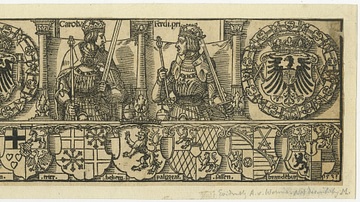
Holy Roman Emperors Charles V & Ferdinand I
Illustration of the Holy Roman Emperor Charles V (r. 1519-1556 CE) and Ferdinand I. The illustration depicts the Habsburg brothers Charles V (left) sitting by the imperial coat of arms, while Ferdinand (right...

Definition
Ignatius of Loyola
Ignatius of Loyola (l. 1491-1556) was a Basque soldier who became a Catholic priest and theologian after a mystical experience convinced him he was called to the service of Christ. He founded the Society of Jesus (Jesuits) to...

Definition
Augustine of Hippo
Aurelius Augustinus Hipponensis (354-430), better known as Augustine of Hippo, is extolled as the greatest of the Christian Church Fathers. More than any other writer, he developed what would become known as systematic theology...

Definition
Thomas Aquinas
Saint Thomas Aquinas (l. 1225-1274, also known as the "Ox of Sicily" and the "Angelic Doctor") was a Dominican friar, mystic, theologian, and philosopher, all at once. Although he lived a relatively short life, dying at age 49...
Image
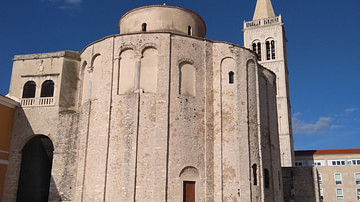
Church of St. Donatus, Zadar
The round church of St. Donatus in Zadar (ancient Iader) in modern-day Croatia was built on top of the ancient Roman forum in the 9th century. It was originally dedicated to the Holy Trinity, but in the 15th century...

Definition
Thirty Years' War
The Thirty Years’ War (1618-1648) was the last major European conflict informed by religious divisions and one of the most devastating in European history resulting in a death toll of approximately 8 million. Beginning as a local...
Definition
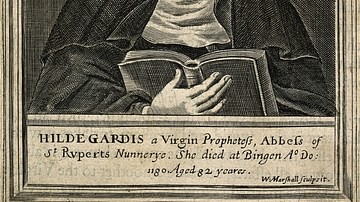
Hildegard of Bingen
Hildegard of Bingen (also known as Hildegarde von Bingen, l. 1098-1179) was a Christian mystic, Benedictine abbess, and polymath proficient in philosophy, musical composition, herbology, medieval literature, cosmology, medicine...

Article
The Differences Between Byzantine & Armenian Christianity
Although both the Byzantines and the Armenians were Christian, the types of Christianity they professed had important differences that led to a lack of recognition and tensions between the two...

Article
The Printing Press & the Protestant Reformation
The printing press, credited to the German inventor and printer Johannes Gutenberg (l. c. 1398-1468) in the 1450s, became the single most important factor in the success of the Protestant Reformation by...

Image
Runes in the Lom Stave Church
Runes left from the construction of Lom Stave Church. The church has been standing since the last half of the 12th century CE, and the runes spell out "I was here, all the way up in the corner”.
