
Search
Remove Ads
Advertisement
Search Results

Definition
Kosrau I
Kosrau I (r. 531-579 CE) was the greatest king of the Sassanian Empire (224-651 CE) in virtually every aspect of his reign. He reformed the military, the Persian government, expanded his territories, engaged in large-scale building...

Definition
Mehmed II
Mehmed II (1432-1481 CE), also known as Mehmed the Conqueror, was the seventh and among the greatest sultans of the Ottoman Empire. His conquests consolidated Ottoman rule in Anatolia and the Balkans, and he most famously triumphed...
Definition
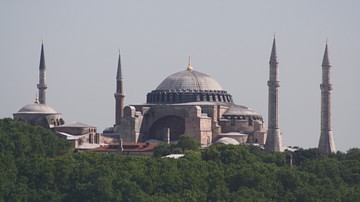
Hagia Sophia
Hagia Sophia in Istanbul, constructed 532-537, continues to be revered as one of the most important structures in the world. Hagia Sophia (Greek Ἁγία Σοφία, for 'Holy Wisdom') was designed to be the major basilica of the Byzantine...

Definition
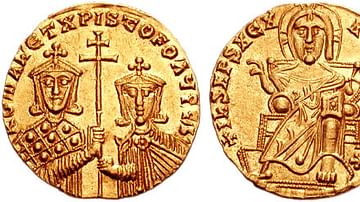
Constantine V
Constantine V, also known as Constantine the Dung-named by his enemies, was emperor of the Byzantine empire from 741 to 775 CE. He enjoyed military successes in the Middle East and Balkans but his reign is chiefly remembered for...
Definition
Romanos I
Romanos I Lekapenos (“the Ignorant”) was emperor of the Byzantine Empire from 920 to 944 CE. Of Armenian descent, he was a military commander who usurped the throne to rule as co-emperor with the rightful heir, but still minor, Constantine...

Definition
Constantine IV
Constantine IV ruled as emperor of the Byzantine empire from 668 to 685 CE. His reign is best remembered today for the five-year Arab siege of Constantinople from 674 CE, which the Byzantines resisted thanks to their strong fortifications...

Definition
Leo VI
Leo VI was emperor of the Byzantine empire from 886-912 CE. He was the second emperor of the Macedonian dynasty and is sometimes known as “Leo the Wise” in reference to his prolific literary output which ranged from orations to law codes...

Definition
Corpus Juris Civilis - The Justinian Law Code
The Justinian Code or Corpus Juris Civilis (Corpus of Civil Law) was a major reform of Byzantine law created by Emperor Justinian I (r. 527-565 CE) in 528-9 CE. Aiming to clarify and update the old Roman...

Definition
Empress Theodora
Theodora reigned as empress of the Byzantine Empire alongside her husband, Emperor Justinian I, from 527 CE until her death in 548 CE. Rising from a humble background and overcoming the prejudices of her somewhat disreputable...

Definition
Fourth Crusade
The Fourth Crusade (1202-1204 CE) was called by Pope Innocent III (r. 1198-1216 CE) to retake Jerusalem from its current Muslim overlords. However, in a bizarre combination of cock-ups, financial constraints, and Venetian trading...
