
Search
Remove Ads
Advertisement
Search Results

Definition
Eustathios Rhomaios - Judge and Jurist of the Byzantine Empire
Eustathios Rhomaios was a prominent Byzantine judge and jurist during the late-10th and early- to mid-11th century. He studied Roman Law and began his career under Basil II (reign 976 to 1025...

Definition
Leo I
Leo I was emperor of the Byzantine Empire from 457 to 474 CE. He was also known as “Leo the Butcher” (Makelles) for the assassination of his patron and rival Aspar. Although his reign was lacklustre and included a serious defeat to the...

Article
1453: The Fall of Constantinople
The city of Constantinople (modern Istanbul) was founded by Roman emperor Constantine I in 324 CE and it acted as the capital of the Eastern Roman Empire, or Byzantine Empire as it has later become known, for well...

Image
Byzantine Ivory Diptych Panel
This is one of the largest surviving ivories from the Byzantine Empire. It comes from a hinged 2-leaf diptych, possibly used as a writing table. It shows an archangel holding an orb and sceptre. The style of his drapery...

Definition
Basil I
Basil I was emperor of the Byzantine Empire from 867 to 886 CE and he founded the "Macedonian" dynasty which lasted for over 200 years. Basil was an Armenian from a humble background who had risen to become the second most powerful man...

Image
Byzantine Jeweled Bracelet
Gold bracelet decorated with silver, pearls, amethyst, sapphire, glass, and quartz, 500-700. 3.8 x 8.2 cm.
Metropolitan Museum of Art, New York.

Image
Map of the Byzantine Empire, c.520 - 1204
This map illustrates the shifting frontiers of the Byzantine Empire from the accession of Justinian I (reign circa 527 - 565) to the Fourth Crusade's sack of Constantinople in 1204, showing how the Greek-speaking...

Image
Map of Byzantine Constantinople
Topographical map of Constantinople during the Byzantine period. Main map source: R. Janin, Constantinople Byzantine. Developpement urbain et repertoire topographique. Road network and some other details based on Dumbarton...
Image
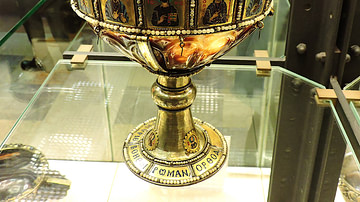
Byzantine Chalice
A Byzantine chalice, c. 1070 CE. Made with a semi-precious stone body and gold stem, the cup is decorated with enamel plaques. (Treasury of Saint Mark’s, Venice)

Image
Byzantine Empire c. 626 CE
A map of the Byzantine empire c. 626 CE.
