
Search
Remove Ads
Advertisement
Search Results

Definition
Belisarius
Flavius Belisarius (l. 505-565 CE) was born in Illyria (the western part of the Balkan Peninsula) to poor parents and rose to become one of the greatest generals, if not the greatest, of the Byzantine Empire. Belisarius is listed...

Article
The Isaurians and the End of Germanic Influence in Byzantium
Germanic influence reigned in the Roman Empire from the end of the 4th century CE through the 5th. Germanic individuals took important posts in the government and the military, and Germanic...

Definition
Michael IV the Paphlagonian
Michael IV the Paphlagonian was Byzantine emperor from 1034 to 1041 CE. He had an affair with Empress Zoe, then married her and was crowned emperor after the death of her first husband, Romanos III. He ran a competent...

Definition
Thessaly and the Duchy of Neopatras
Thessaly was an independent state in medieval Greece from 1267 or 1268 to 1394 CE, first as the Greek-ruled Thessaly and later as the Catalan and Latin-ruled Duchy of Neopatras. Under its sebastokrators, Thessaly...
Definition
Justinian II
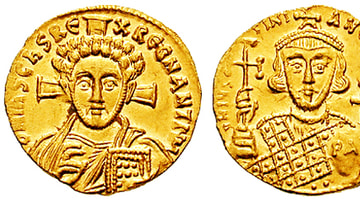
Justinian II “the Slit-nosed” ruled as emperor of the Byzantine Empire in two spells: from 685 to 695 CE and then again from 705 to 711 CE. It was after his first reign and prior to his exile that his nose was cut off by the usurper...

Definition
Emperor Zeno
Zeno was Byzantine emperor from 474 until 491 CE. An ethnic Isaurian, Zeno was repeatedly criticized as an outsider during his reign, which was full of rebellions and attacks by the Ostrogoths. He is best known for his failed attempt...

Article
Battle of Tricamarum
The Battle of Tricamarum (533 CE) was the second and last major battle of the Vandalic War (533 – 534 CE). The battle was fought between the forces of the Byzantine Empire under the leadership of the general Belisarius (500...

Definition
Duchy of Athens
The Duchy of Athens was a Latin or Frankish state in Greece that existed from 1205 to 1458 CE. It was created in the aftermath of the Fourth Crusade (1202-1204 CE) and would be ruled for the majority of its history by the Burgundian...

Article
The Great Palace of Constantinople
The Great Palace of Constantinople was the magnificent residence of Byzantine emperors and their court officials which included a golden throne room with wondrous mechanical devices, reception halls, chapels, treasury...

Definition
Kosrau I
Kosrau I (r. 531-579 CE) was the greatest king of the Sassanian Empire (224-651 CE) in virtually every aspect of his reign. He reformed the military, the Persian government, expanded his territories, engaged in large-scale building...
