
Search
Remove Ads
Advertisement
Search Results

Article
The Banquet Stele of Ashurnasirpal II
When he came to the throne in 884 BCE, Ashurnasirpal II had to attend to revolts which broke out across the empire. He ruthlessly put down all rebellions, destroyed the rebel cities and, as a warning to others...

Video
A Short History of Assyria and the Neo-Assyrian Empire
Assyria has a long history, beginning in northern Mesopotamia and then expanding during the Neo-Assyrian Empire from Mesopotamia through Asia Minor, and down through Egypt. The empire began in the...

Article
History of Assyria
The foundation of the Assyrian dynasty can be traced to Zulilu, who is said to have lived after Bel-kap-kapu (c. 1900 BCE), the ancestor of Shalmaneser I. The city-state of Ashur rose to prominence in northern Mesopotamia, founding...
Image
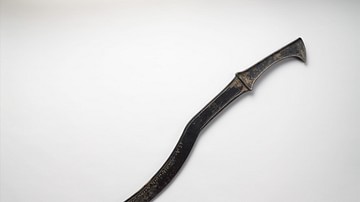
Assyrian Sickle Sword
A bronze Assyrian sickle sword that is believed to have belonged to the Assyrian king Adad Nirari I (r. 1307-1275 BCE), made in northern Mesopotamia, c. 13th century BCE. The blade bears the cuneiform inscription: "Palace...

Definition
Ishtar Gate
The Ishtar Gate was constructed by the Babylonian King Nebuchadnezzar II circa 575 BCE. It was the eighth gate of the city of Babylon (in present-day Iraq) and was the main entrance into the city. The Ishtar Gate was part of Nebuchadnezzar's...

Definition
Baal
Baal (also given as Ba'al) is a Canaanite-Phoenician god of fertility and weather, specifically rainstorms. The name was also used as a title, however, meaning "Lord" and was applied to a number of different deities throughout the ancient...

Definition
Enlil - Mesopotamian Keeper of the Tablets of Destiny
Enlil (also known as Ellil and Nunamnir) was the Sumerian god of the air in the Mesopotamian pantheon, but he was more powerful than any other elemental deity and eventually was worshiped as King of...

Definition
Ancient Syria
Syria is a country located in the Middle East on the shore of the Mediterranean Sea and bordered, from the north down to the west, by Turkey, Iraq, Jordan, Israel, and Lebanon. It is one of the oldest inhabited regions in the world...

Definition
Tiglath Pileser III
Tiglath Pileser III (745-727 BCE) was among the most powerful kings of the Neo-Assyrian Empire and, according to many scholars, the founder of the empire (as opposed to the claims for Adad Nirari II (912-891 BCE) or Ashurnasirpal...
Definition
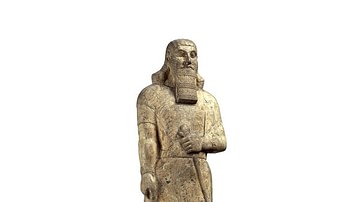
Ashurnasirpal II
Ashurnasirpal II (r. 884-859 BCE) was the third king of the Neo-Assyrian Empire. His father was Tukulti-Ninurta II (r. 891-884 BCE) whose military campaigns throughout the region provided his son with a sizeable empire and the...
