
Search
Remove Ads
Advertisement
Search Results
Definition
Ancient Israelite Technology
Technology enabled ancient Israel, the Northern Kingdom excluding Judah, to be economically prosperous and establish itself as a major political power as early as the 10th century BCE, steadily growing until its destruction...

Definition
Sargon II
Sargon II (r. 722-705 BCE) was one of the most important kings of the Neo-Assyrian Empire as founder of the Sargonid Dynasty which would rule the empire for the next century until its fall. He was a great military leader, tactician...

Definition
Armenian Mythology
The mythology of ancient Armenia is a rich blend of indigenous traditions with imported ideas from neighbouring cultures and migrating peoples added over the centuries. The legends and stories helped to explain natural phenomena...
Definition
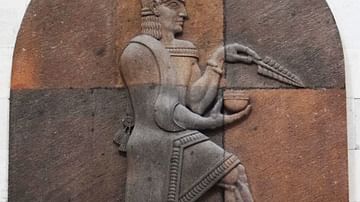
Urartu Religion
The religion of the Urartu civilization, which flourished principally in ancient Armenia from the 9th to 6th century BCE, was a unique mix of indigenous, Hurrian and Mesopotamian gods and symbolism. The pantheon was headed by...
Image
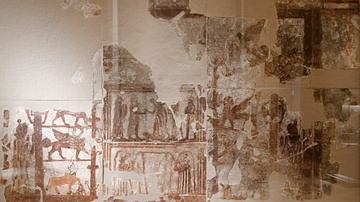
The Investiture of Zimri-Lim
This fresco mural depicts Zimri-Lim, the last king of Mari. It was likely created c. 1775 BCE when Zimri-Lim regained the throne of Mari for the Amorite "Lim Dynasty" from Shamsi-Adad's son, Yasmakh-Adad. The mural depicts...

Article
The Nimrud Dogs - The Security System of Ancient Mesopotamia
The Nimrud Dogs, five clay canine figurines found at the ancient Mesopotamian city of Nimrud, were only a few of the many startling finds in the region in the 20th century. During the 19th century...

Article
Mesopotamian Effects on Israel During the Iron Age
The Iron Age in the traditional Ancient Near Eastern chronology ranges from somewhere around 1200 BCE to 333 BCE. It begins from the era when it was first thought iron came to be used up to the ascendency...

Article
The Nimrud Ivories - Their Discovery & History
The Nimrud Ivories are a vast collection of figures, panels, and plaques, carved from ivory, dated to the 9th to 7th centuries BCE, discovered in the ruins of the ancient city of Nimrud. Today, they are...

Article
The Mutual Destruction of Sennacherib & Babylon
The reign of Assyrian king Sennacherib (705-681 BCE) was chiefly characterized by his difficulties with Babylon. Throughout the history of the Assyrian Empire, Babylon had caused problems and had even...

Image Gallery
A Gallery of Neo-Assyrian Kings
The Neo-Assyrian kings are among the best-known of the Assyrian Empire and include Tiglath Pileser III, Shalmaneser III, Sargon II, Sennacherib, Esarhaddon, and Ashurbanipal. The term Neo-Assyrian is a modern-day designation...
