
Search
Remove Ads
Advertisement
Search Results

Definition
Tukulti-Ninurta I
Tukulti-Ninurta I (reigned 1244-1208 BCE) was a king of the Assyrian Empire during the period known as the Middle Empire. He was the son of Shalmaneser I (reigned 1274-1245 BCE) who had completed the work of his father, Adad...

Definition
Tiglath Pileser I
Tiglath Pileser I (reigned 1115-1076 BCE), an Assyrian king of the period known as the Middle Empire, revitalized the economy and the military that had been suffering, more or less, since the death of the king Tukulti Ninurta...
Image
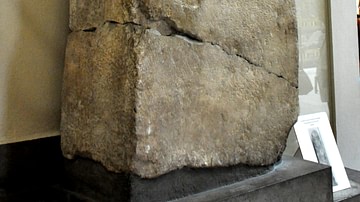
Stela of Queen Sammu-Ramat
Stela of Queen Sammu-Ramat from Assur (Ashur), northern Mesopotamia, modern-day Iraq. Neo-Assyrian Empire, c. 809 BCE. The cuneiform inscriptions on the upper part of the stela say that Sammu-ramat (or Shammuramat) is...

Article
The Greatest Party Ever Thrown: Ashurnasirpal II’s Kalhu Festival
The greatest party ever thrown in antiquity is the inaugral event thrown by Ashurnasirpal II (r. 884-859 BCE) in 879 BCE at the completion of his new city of Kalhu which was attended by...

Image
Map of the Rise and Expansion of the Neo-Assyrian Empire - Conquest and Imperial Power Across the Near East
The Neo-Assyrian Empire emerged from renewed Assyrian state-building in northern Mesopotamia during the early first millennium BCE. Under Adad-nirari II (reign...

Image
Assyrian Door-sill
The cuneiform inscription gives the name and genealogy of Adad-nirari III (reigned 810-783 BCE) and was written in doorways of a palace built during his reign. Assyrian, 9th-8th centuries BCE. From Nimrud (ancient Kalhu, Mesopotamia...

Image
Auroch at the Processional Way of Babylon
This is an Auroch (or bull), the symbol of the god Adad, at the processional way (or street) of the ancient city of Babylon, in modern-day Iraq. Neo-Babylonian period, reign of Nebuchadnezzar II, 6th century...

Image
Map of Mesopotamia, 2000-1600 BCE
A general map of Mesopotamia and its neighbouring territories which roughly covers the period from 2000-1600 BCE reveals the concentration of city states in Sumer, in the south. This is where the first true city-states...
Image
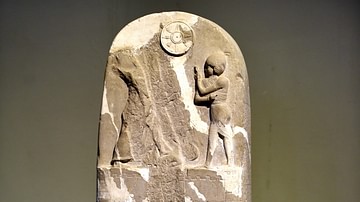
Stele of Dadusha, King of Eshnunna
The stele is an elongated stone monument which originally stood at the Temple of Adad at Eshnunna. The front side is carved with four registers while the narrow sides were inscribed with 220 lines of a cuneiform...
Image
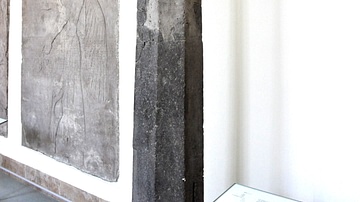
Basalt Column from Ashur
A number of basalt columns and their fragments were uncovered during archaeological excavations at the "Row of Stelae" at the city of Ashur. These were brought to the city as part of an important booty. The cuneiform inscriptions...
