
Search
Remove Ads
Advertisement
Search Results

Image
Mesopotamian Eye Idol
Gypsum alabaster eye idol from the Middle Uruk period, c. 3700-3500 BCE, Tell Brak, Syria. Many similar artifacts have been found at Tell Brak; they were likely amuletic objects honoring the Mesopotamian goddess Ningal, wife...

Definition
Nanna - Mesopotamian God of the Moon and Wisdom
Nanna (also known as Nannar, Nanna-Suen, Sin, Asimbabbar, Namrasit, Inbu) is the Mesopotamian god of the moon and wisdom. He is one of the oldest gods in the Mesopotamian pantheon and is first mentioned...

Definition
Tiamat - The Great Mesopotamian Goddess of Chaos
Tiamat is the Mesopotamian goddess associated with primordial chaos and the salt sea, best known from the Babylonian epic Enuma Elish. In all versions of the myth, following the original, Tiamat always...

Article
The Hymn to Ninkasi, Goddess of Beer - A Praise Song and Ancient Beer Recipe
The Hymn to Ninkasi is at once a song of praise to Ninkasi, the Sumerian goddess of beer, and an ancient recipe for brewing (though this claim has been challenged). Written down...

Article
The Legend of Cutha - A How-To on the Proper Relationship with One's God
The Legend of Cutha (also known as the Cuthean Legend of Naram-Sin, Cutha Legend, and Kutha Legend) is a fictional work dated to the 17th century BCE belonging to the genre known as...

Definition
Ancient Syria
Syria is a country located in the Middle East on the shore of the Mediterranean Sea and bordered, from the north down to the west, by Turkey, Iraq, Jordan, Israel, and Lebanon. It is one of the oldest inhabited regions in the world...

Article
Festivals in Ancient Mesopotamia - Courting the Goodwill of the Gods
Festivals in ancient Mesopotamia honored the patron deity of a city-state or the primary god of the city that controlled a region or empire. The earliest, the Akitu festival, was first...
Image
Mesopotamian Beer Rations Tablet
The temples issued workers with daily rations of barley beer, the staple drink of Mesopotamia. The tablet was impressed with five different types of numerical symbol. From Mesopotamia, Iraq. Late Uruk Period, 3100-3000...

Image
Mesopotamian Record of Barley
On this clay tablet, barley appears 4 times, depicted as a single stalk with ears at the top. Emmer wheat is different from barley, by writing numbers with extra strokes. Three different types of numerical symbol were...
Image
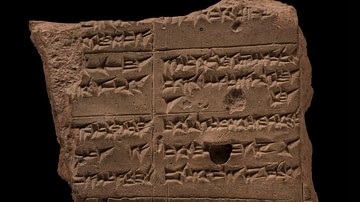
Mesopotamian Tablet with Proverbs
Fragment of a Neo-Assyrian clay tablet, with 8 lines of bilingual text, including proverbs and riddles, from the Library of Ashurbanipal, Kouyunjik, Iraq.
The British Museum, London.
