
Search
Remove Ads
Advertisement
Search Results

Definition
Enlil - Mesopotamian Keeper of the Tablets of Destiny
Enlil (also known as Ellil and Nunamnir) was the Sumerian god of the air in the Mesopotamian pantheon, but he was more powerful than any other elemental deity and eventually was worshiped as King of...

Definition
Naram-Sin - The God-King of Akkad
Naram-Sin (reign 2254-2218 BCE) was the last great king of the Akkadian Empire and the grandson of Sargon the Great (reign 2334-2279 BCE), who founded the empire. He is considered the most important Akkadian king...

Article
Enki's Journey to Nippur - A Celebration of Life
Enki's Journey to Nippur (circa 2000 BCE) is a Sumerian origin myth explaining the creation of the temple at Eridu by the god Enki and how musical instruments were ordained for use in festivals in ancient...
Image
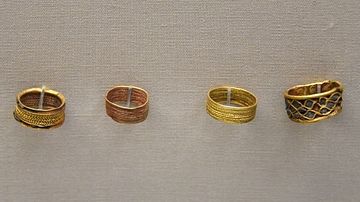
Mesopotamian Finger Rings
These rings were found on the fingers of a woman named Puabi, inside her grave. Puabi was a Semitic Akkadian woman from Ur, c. 2600 BCE, possibly a queen or priestess. Two rings were made of gold wire that was twisted...
Image
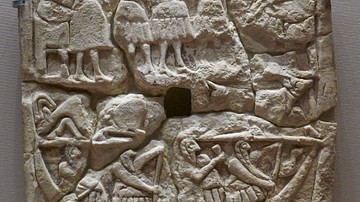
Mesopotamian Banquet Scene
Perforated votive plaque with a banquet scene, Mesopotamia, modern-day Iraq, c. 2700-2600 BCE.
Louvre, Paris.
Image
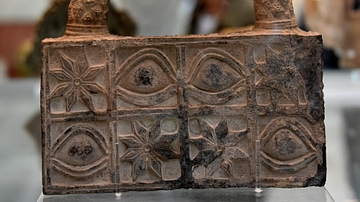
Mesopotamian Carved Stone with Integral Handle
This carved grey stone has an integral handle. It was possibly a weight. There are eight compartments decorated with the shapes of eyes and rosettes. The handle imitates basketry and is ornamented with...

Image
Seven Mesopotamian Agate Duck-weights
These weights are in the range of 8.7 to 24.7 grams, roughly between 1 and 3 Babylonian shekels. Weights had been made in this characteristic duck-shape since around 2000 BCE. From Southern Mesopotamia, Iraq...
Image
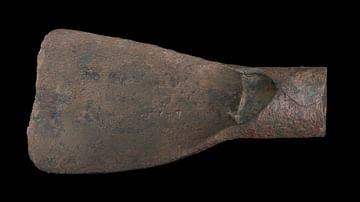
Mesopotamian Hoe
Copper alloy hoe blade with socket, from Ur, Early Dynastic III, 2600-2300 BCE.
The British Museum, London.
Image
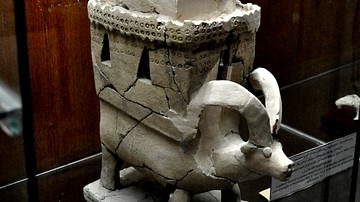
Mesopotamian Incense Container
A pottery incense container found at layer 5 of the altar platform of the central temple of Basmosian Hill, Mesopotamia, Hurrian period, 2nd millennium BCE.
Sulaimaniya Museum, Iraq.
Image
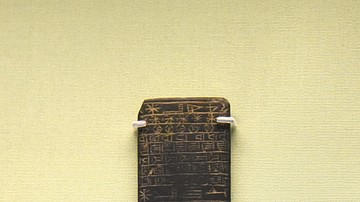
Mesopotamian Amulet Against Ghosts
Stone inscribed with an incantation that has 7 signs, repeated 7 times. It is much worn through use. From Mesopotamia, modern-day Iraq, c. 800-550 BCE.
The British Museum, London.
