
Search
Remove Ads
Advertisement
Search Results

Definition
Chogha Zanbil - The "Basket Mound" of the Gods
Chogha Zanbil (literally "basket mound") is an ancient Elamite temple complex located in the modern-day province of Khuzestan, Iran. It is also known as Dur-Untash (Fortress/City/Town of Untash), Tchogha...

Definition
Kish - The First City of Political Prominence in History
Kish was one of the most significant and politically prestigious city-states in ancient Mesopotamia. According to the Sumerian King List, it was the first city to be given divine kingship after...

Definition
Ereshkigal - Mesopotamian Queen of the Dead
Ereshkigal (also known as Irkalla and Allatu) is the Mesopotamian Queen of the Dead, who rules the underworld. Her name translates as "Queen of the Great Below" or "Lady of the Great Place." She was responsible...
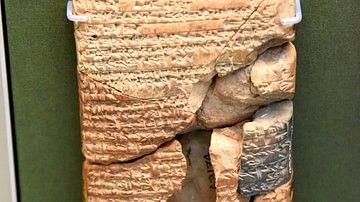
Image
A Mesopotamian Tablet with Gynaecological Treatments
Recipes were written in cuneiform inscriptions. They concern conditions such as infertility and pregnancy. Probably from Babylon, Mesopotamia, Iraq. Circa 600-400 BCE. (The British Museum, London)
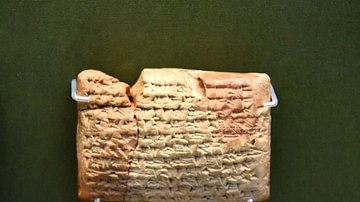
Image
A Mesopotamian Tablet with Gynaecological Recipe Against Miscarriage
A medical recipe was written on this clay tablet to prevent miscarriage. It recommends that a women should wear for 3 days a particular species of dried edible mouse which has been stuffed...
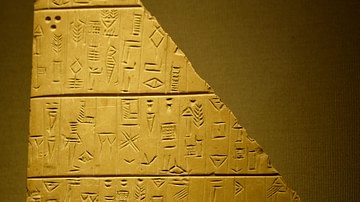
Image
Mesopotamian Tablet with Puchase Details from Dilbat
This tablet lists purchases of land by a man named Tupsikka, with payments made in baskets of barley. One transaction reads "The price of the field is 90 gur-sag-gal 16 quarts of oil". Stone tablet...

Image
Mesopotamian Epic of Creation Tablet
Mesopotamian clay tablet with the episodes of the epic of creation. It narrates how the god Anshar summons the gods together for a banquet. They celebrate Marduk's appointment as champion; Marduk defeated Tiamat...

Image
Mesopotamian Male Worshiper Votive Figure
Mesopotamian male worshiper votive figure, from Eshnunna, Mesopotamia (modern-day Tell Asmar), 2750-2600 BCE.
Metropolitan Museum of Art, New York.

Image
Mesopotamian Tablet on Marduk
Babylonian tablet, a scholar speculating on how powerful, independent Mesopotamian gods can be seen as aspects of the god Marduk. From Babylon, Southern Mesopotamia, Iraq. Neo-Babylonian Period, reign of Nebuchadnezzar...

Image
Mesopotamian Eye Idol
Gypsum alabaster eye idol from the Middle Uruk period, c. 3700-3500 BCE, Tell Brak, Syria. Many similar artifacts have been found at Tell Brak; they were likely amuletic objects honoring the Mesopotamian goddess Ningal, wife...
