
Search
Remove Ads
Advertisement
Search Results

Definition
Religion in the Ancient World - Order and the Spiritual Experience
Religion (from the Latin Religio, meaning "restraint," or Relegere, according to Cicero, meaning "to repeat, to read again," or, most likely, Religionem, "to show respect for what is sacred"...

Collection
Mesopotamian Gods - A Brief Survey of Some Great Mesopotamian Deities
The gods of Mesopotamia are first evidenced during the Ubaid Period (circa 6500-4000 BCE) when temples were raised to them, but their worship developed during the Uruk Period (circa 4000-3100...

Video
Ancient Chinese Inventions
This video describes the many inventions of ancient China extending to the Early Middle Ages, and how these innovations impacted other aspects of Chinese history.

Definition
Ishtar
Ishtar (Inanna in Sumerian sources) is a primary Mesopotamian goddess closely associated with love and war. This powerful Mesopotamian goddess is the first known deity for which we have written evidence. While largely unknown in the modern...

Video
8 Interesting Inventions by Native Americans
All the fun you had climbing up into bunk beds at summer can be traced back to the Iroquois in Northeast U.S.
Collection
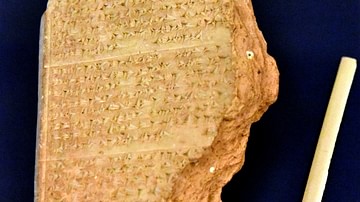
Twelve Stories from the Mesopotamian Scribal School
Sumerian schools (known as edubba, “House of Tablets”) trained the scribes of ancient Mesopotamia in reading, writing, interpretation of texts, general knowledge, and the specifics of whatever field...

Article
Trade in Ancient Mesopotamia - How Commerce Encouraged Civilization
Local trade in ancient Mesopotamia began in the Ubaid period (circa 6500-4000 BCE), had developed into long-distance trade by the Uruk period (circa 4000-3100 BCE), and was flourishing by...

Collection
Mesopotamia: Agriculture & Innovations
Ancient Mesopotamia, located in the Fertile Crescent between the Tigris and Euphrates rivers, witnessed the emergence of cities and empires primarily due to the vital role of agriculture. The rich alluvial soil...

Definition
Sumerians - Inventors of Civilization
The Sumerians were the people of southern Mesopotamia (modern-day southern Iraq) whose civilization flourished between circa 4000 and 1750 BCE. Their name comes from the region, which is frequently – and incorrectly...

Definition
Elam - The Ancient High Country
Elam was a region in the Near East corresponding to the modern-day provinces of Ilam and Khuzestan in southern Iran (though it also included part of modern-day southern Iraq) whose civilization spanned thousands of...
