
Search
Remove Ads
Advertisement
Search Results

Definition
Etruscan Architecture
The architecture of the Etruscan civilization, which flourished in central Italy from the 8th to 3rd century BCE, has largely been obliterated both by the conquering Romans and time, but the very influence of the Etruscans...

Definition
Vinland
Vinland (Old Norse Vínland, 'Wine Land') is the name given to the lands explored and briefly settled by Norse Vikings in North America around 1000 CE, particularly referring to Newfoundland, where a Viking site known as L'Anse aux Meadows...

Definition
Parthian Religion
Parthian religion might be best described with two words: inclusive and evolving. As Parthia's empire held within it a variety of cultures, the Parthians wisely left each to their own beliefs and traditions, like the Seleucid...

Definition
Tushpa
Tushpa, later known as Van, was the capital of the Urartu kingdom of ancient Armenia, eastern Turkey, and western Iran from the 9th to 6th century BCE. Located on the eastern shore of Lake Van in modern Turkey, the city was a fortress...

Definition
Silver in Antiquity
Silver had great value and aesthetic appeal in many ancient cultures where it was used to make jewellery, tableware, figurines, ritual objects and rough-cut pieces known as hacksilver which could be used in trade or to store...

Definition
Osman I
Osman I, also known as Osman Gazi (c. 1258 - c. 1323 CE), was the founder and first Sultan of the Ottoman Beylik, which would rise to eventually become the Ottoman Empire. He was the ruler of a small Turkic principality among many in...

Definition
Acropolis
An acropolis is any citadel or complex built on a high hill. The name derives from the Greek akro, "high" or "extreme/extremity" or "edge", and polis, "city", translated as "high city", "city on the edge" or "city in the air", the...

Definition
Chandragupta Maurya
Chandragupta Maurya (c. 321 - c. 297 BCE), known as Sandrakottos (or Sandrokottos) to the Greeks, was the founder of the Maurya Dynasty (4th-2nd century BCE) and is credited with the setting up of the first (nearly) pan-Indian...

Definition
Konarak Sun Temple
The Konark or Konarak Sun temple is dedicated to the Hindu sun god Surya, and, conceived as a giant stone chariot with 12 wheels, it is the most famous of the few sun temples built in India. It is located about 35 km northeast...
Definition
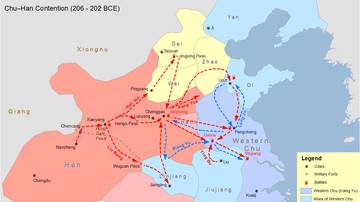
Battle of Gaixia
The Battle of Gaixia (202 BCE, also known as Kai-Hsia) was the decisive engagement of the Chu-Han Contention (206-202 BCE) at which Liu Bang (l. c. 256-195 BCE), from the State of Han, defeated Xiang Yu (l. 232-202 BCE) of the...
