
Search
Remove Ads
Advertisement
Search Results
Definition
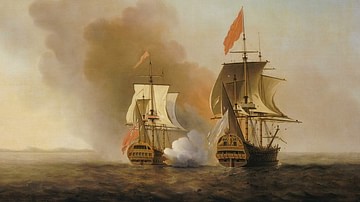
Galleon
The galleon (Spanish: galeón, French: galion) was a type of sailing ship used for both cargo carrying and as a warship. Galleons dominated the seas in the second half of the 16th century, and with their lower superstructures, they were...

Definition
Pezhetairoi
The pezhetairoi (foot companions) were part of the imposing army that accompanied the Macedonian commander Alexander the Great (r. 336-323 BCE) when he crossed the Hellespont to face the Persian king Darius III in 334 BCE. Armed with...

Definition
Xenophon
Xenophon of Athens (l. 430 to c. 354 BCE) was a contemporary of Plato and a fellow student of Socrates. He is best known for his Anabasis (The March Up Country) detailing the retreat of the Ten Thousand Greek mercenaries after the defeat...

Definition
Roman Religion
In many societies, ancient and modern, religion has performed a major role in their development, and the Roman Empire was no different. From the beginning Roman religion was polytheistic. From an initial array of gods and spirits...
Definition
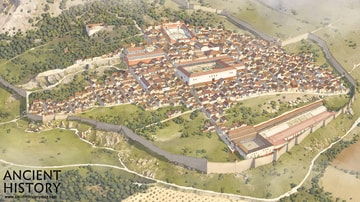
Ionia
Ionia was a territory in western Anatolia (modern-day Turkey) populated by the Ionians (Greeks who spoke the Ionian dialect) in c. 1150 BCE. It is best known as the birthplace of Greek philosophy (at Miletus) and the site of the Ionian...

Definition
Antinous
Antinous (l. c. 110-130 CE) was a youth of Bithynia who became the beloved of the Roman emperor Hadrian (l. 76-138 CE, r. 117-138 CE) from around the age of 13 until his death at nearly 20. His year of birth is unknown as are any details...

Definition
Persian Wars
The Persian Wars refers to the conflict between Greece and Persia in the 5th century BCE which involved two invasions by the latter in 490 and 480 BCE. Several of the most famous and significant battles in history were fought during...

Definition
Battle of Gaugamela
The Battle of Gaugamela (1st October 331 BCE, also known as the Battle of Arbela) was the final meeting between Alexander the Great of Macedon and King Darius III of Persia. After this victory, Alexander was, without question...

Definition
Byzantium
The ancient city of Byzantium was founded by Greek colonists from Megara around 657 BCE. According to the historian Tacitus, it was built on the European side of the Strait of Bosporus on the order of the “god of Delphi” who said to...

Definition
Constans II
Constans II (aka Konstans II) was emperor of the Byzantine Empire from 641 to 668 CE. Sometimes known as Constans Pogonatos (“the Bearded”), he came to the throne by a series of unlikely events and his empire was immediately challenged...
