
Search
Remove Ads
Advertisement
Search Results

Definition
Nara Period
The Nara Period (Nara Jidai) of ancient Japan (710-794 CE), so called because for most of that time the capital was located at Nara, then known as Heijokyo, was a short period of transition prior to the significant Heian Period. Despite...

Definition
Gupta Empire
The Gupta Empire stretched across northern, central and parts of southern India between c. 320 and 550 CE. The period is noted for its achievements in the arts, architecture, sciences, religion, and philosophy. Chandragupta I (320...

Definition
Sukhothai
Sukhothai or Sukhothai Historical Park was the former capital of the Kingdom of Sukhothai (1248-1438 CE), which was founded by King Si Inthrathit (r. 1238-1270 CE) and was the first in a series of independent polities that would eventually...

Definition
Sun-Tzu
Sun Tzu (l. c. 500 BCE) was a Chinese military strategist and general best known as the author of the work The Art of War, a treatise on military strategy (also known as The Thirteen Chapters). He was associated (formally or as an inspiration...

Article
The History of Japanese Green Tea
The history of green tea in Japan goes back to the 8th century when it was a popular stimulant for meditating monks. In this article, we examine tea's origins and cultivation, how it became an integral part of Japanese...

Definition
Claude Monet
Claude Monet (1840-1926) was a French impressionist painter who transformed modern art with his emphasis on light brushstrokes, bright colours, and uncluttered nature. Famed for his landscapes and series of paintings that captured...

Definition
Pierre-Auguste Renoir
Pierre-Auguste Renoir (1841-1919) was a French impressionist painter. Capable of painting in many different styles, even in the same painting, Renoir was certainly prolific, creating over 6,000 paintings in a long career...

Definition
Jan van Eyck
Jan van Eyck (c. 1390-1441 CE) was a Netherlandish Renaissance painter who was famous in his own lifetime for his mastery of oil painting, colouring, naturalistic scenes, and eye for detail. Amongst his masterpieces are the 1432...

Definition
Camille Pissarro
Camille Pissarro (1830-1903) was an impressionist painter based in France who focussed on landscapes but frequently changed his style and subjects. He was an instrumental figure in the new art movement of the 19th century, organising...
Article
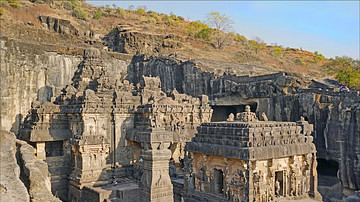
Ellora Caves
Ellora (also known as Elura and, in ancient times, as Elapura) is a sacred site in Maharastra, central India. The Ellora Caves are listed by UNESCO as a World Heritage Site and is celebrated for its Hindu, Buddhist, and Jain temples...
