
Search
Did you mean: Midas?
Remove Ads
Advertisement

 This answer was generated by
 Search Results
Definition
Adad Nirari I
Adad Nirari I (r. 1307-1275 BCE) was the king of the Assyrian Empire who initiated the first major expansion of the Assyrian kingdom from the city of Ashur throughout the region of Mesopotamia. He also instituted what would become standard...

Definition
Assyria
Assyria was the region located in the ancient Near East which, under the Neo-Assyrian Empire, reached from Mesopotamia (modern-day Iraq) through Asia Minor (modern Turkey) and down through Egypt. The empire began modestly at the city of Ashur...

Definition
Semiramis
Semiramis is a legendary queen thought to based on the historical Sammu-Ramat (r. 811-806 BCE) the queen regent of the Assyrian Empire who held the throne for her young son Adad Nirari III until he reached maturity. She is also known as Shammuramat...

Image
Stela of King Shamshi-Adad V
Stela of the Assyrian king Shamshi-Adad V (r. 824-811 BCE), from Nimrud (ancient Kalhu), modern-day northern Iraq, Neo-Assyrian Empire, 824-811 BCE. It depicts the king, before the symbols of his principal gods. He extends his right hand...
Image
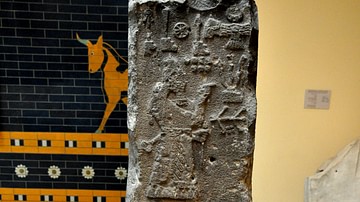
Stela of the Assyrian King Adad Nirari III
Stela of Adad Nirari III, erected by one of the king's local governors, Nergal-Eres, found in Saba, Neo-Assyrian Empire, 810-783 BCE. The stela features the Assyrian King Adad Nirari III praying in front of god symbols, and the inscriptions...
Image
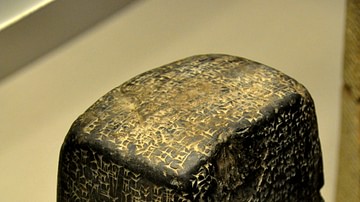
Stone Foundation Document of King Adad-Nirari I
Rectangular stone foundation document of the Assyrian king Adad-Nirari I. It recounts the king's victories over the Mitanni, who had failed to gain Hittite support, and the extension of Assyrian rule west to the Euphrates. The stone appears...

Image
Stela of Shamshi-Adad V
The limestone Stela of Shamshi-Adad V. Neo-Assyrian, 815-811 BCE. The king is shown giving a gesture of blessing before five divine symbols: Anu's three-horned crown (top), a winged-disk, disk and crescent, fork, and Ishtar's 8-pointed star...
Image
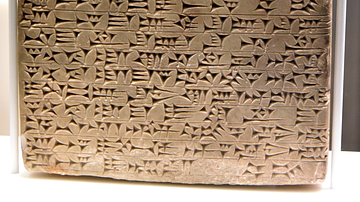
Foundation Inscription of Adad-nirari I
During the renovation work of the temple of Ishtar, the Assyrian king Tukulti-Ninurta I (r. 1243–1207 BCE) found a stone tablet among the foundations with an inscription by his grandfather Adad-nirari I (1295–1264 BCE). On the inscription...
Image
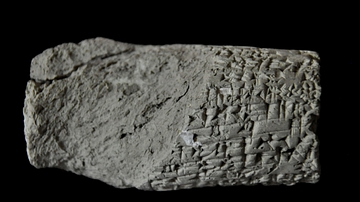
Tablet of King Nur-Adad
This partially broken document mentions the name of King Nur-Adad, king of Larsa, 1921-1905 BCE. (The Sulaimaniya Museum, Iraq).

Article
Sammu-Ramat and Semiramis: The Inspiration and the Myth
Sammu-Ramat (r. 811-806 BCE) was the queen regent of the Assyrian Empire who held the throne for her young son Adad Nirari III (r. 811-783 BCE) until he reached maturity. She is also known as Shammuramat, Sammuramat, and, most notably, as...
