
Search
Did you mean: Midas?
Remove Ads
Advertisement
Search Results

Definition
Kalhu / Nimrud
Kalhu (also known as Caleh, Calah, and Nimrud, in modern-day northern Iraq) was a city in ancient Mesopotamia that became the capital of the Assyrian Empire under Ashurnasirpal II (r. 884-859 BCE) who moved the central government there from...

Definition
Assur - The Supreme God of the Ancient Assyrians
Assur (also Ashur, Anshar) is the god of the ancient Assyrians who was elevated from a local deity of the city of Ashur to the supreme god of the Assyrian pantheon. His attributes were drawn from earlier Sumerian and Babylonian deities, and...
Article
The Mesopotamian Pantheon - The Ancient Gods and Goddesses of the Near East
The gods of the Mesopotamian region were not uniform in name, power, provenance or status in the hierarchy. Mesopotamian culture varied from region to region and, because of this, Marduk should not be regarded as King of the Gods in the same...

Definition
Nineveh - The Great Cultural Center That Became the "City of Sin"
Nineveh (modern-day Mosul, Iraq) was one of the oldest and greatest cities in antiquity. It was originally known as Ninua, a trade center, and would become one of the largest and most affluent cities in antiquity. It was regarded highly by...

Definition
Mitanni
The Kingdom of Mitanni, known to the people of the land, and the Assyrians, as Hanigalbat and to the Egyptians as Naharin and Metani, once stretched from present-day northern Iraq, down through Syria and into Turkey and was among the greatest...

Article
The Myth of Etana
The Myth of Etana is the story of the Sumerian antediluvian King of Kish who ascends to heaven on an eagle to request the Plant of Birth from the gods so that he might have a son. Etana is named as the first king of Kish in the Sumerian King...

Definition
Mesopotamian Literature - The Earliest Works of the Imagination
Ancient Mesopotamian literature developed circa 2600 BCE after scribes, who had formerly been record-keepers, began composing original works in the region of Sumer. The Sumerians invented writing circa 3600/3500 BCE, refined the script circa...

Article
The Banquet Stele of Ashurnasirpal II
When he came to the throne in 884 BCE, Ashurnasirpal II had to attend to revolts which broke out across the empire. He ruthlessly put down all rebellions, destroyed the rebel cities and, as a warning to others, impaled, burned, and flayed...
Image
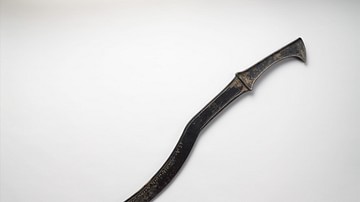
Assyrian Sickle Sword
A bronze Assyrian sickle sword that is believed to have belonged to the Assyrian king Adad Nirari I (r. 1307-1275 BCE), made in northern Mesopotamia, c. 13th century BCE. The blade bears the cuneiform inscription: "Palace of Adad-nirari...

Definition
Baal
Baal (also given as Ba'al) is a Canaanite-Phoenician god of fertility and weather, specifically rainstorms. The name was also used as a title, however, meaning "Lord" and was applied to a number of different deities throughout the ancient...
