
Search
Did you mean: Midas?
Remove Ads
Advertisement
Search Results

Definition
Ishtar Gate
The Ishtar Gate was constructed by the Babylonian King Nebuchadnezzar II circa 575 BCE. It was the eighth gate of the city of Babylon (in present-day Iraq) and was the main entrance into the city. The Ishtar Gate was part of Nebuchadnezzar's...

Definition
Enlil - Mesopotamian Keeper of the Tablets of Destiny
Enlil (also known as Ellil and Nunamnir) was the Sumerian god of the air in the Mesopotamian pantheon, but he was more powerful than any other elemental deity and eventually was worshiped as King of the Gods. He is featured in a number of...

Definition
Ancient Syria
Syria is a country located in the Middle East on the shore of the Mediterranean Sea and bordered, from the north down to the west, by Turkey, Iraq, Jordan, Israel, and Lebanon. It is one of the oldest inhabited regions in the world with archaeological...
Definition
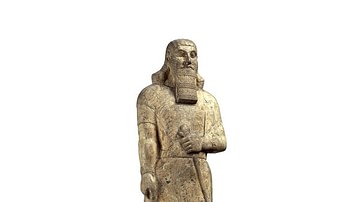
Ashurnasirpal II
Ashurnasirpal II (r. 884-859 BCE) was the third king of the Neo-Assyrian Empire. His father was Tukulti-Ninurta II (r. 891-884 BCE) whose military campaigns throughout the region provided his son with a sizeable empire and the resources to...

Definition
Tiglath Pileser I
Tiglath Pileser I (reigned 1115-1076 BCE), an Assyrian king of the period known as the Middle Empire, revitalized the economy and the military that had been suffering, more or less, since the death of the king Tukulti Ninurta I (1244-1208...

Definition
Tiglath Pileser III
Tiglath Pileser III (745-727 BCE) was among the most powerful kings of the Neo-Assyrian Empire and, according to many scholars, the founder of the empire (as opposed to the claims for Adad Nirari II (912-891 BCE) or Ashurnasirpal II (884-859...

Definition
Tukulti-Ninurta I
Tukulti-Ninurta I (reigned 1244-1208 BCE) was a king of the Assyrian Empire during the period known as the Middle Empire. He was the son of Shalmaneser I (reigned 1274-1245 BCE) who had completed the work of his father, Adad Nirari I, in...

Article
The Greatest Party Ever Thrown: Ashurnasirpal II’s Kalhu Festival
The greatest party ever thrown in antiquity is the inaugral event thrown by Ashurnasirpal II (r. 884-859 BCE) in 879 BCE at the completion of his new city of Kalhu which was attended by almost 70,000 people who were served, among other treats...

Article
Ten Great Ancient Mesopotamian Women - Monarchs, Generals, and Scribes
The lives of women in ancient Mesopotamia were regulated by a patriarchal hierarchy, but within this social structure, there were many who distinguished themselves and some who were able to assume positions traditionally held by men. Women...

Image
Map of the Neo-Assyrian Empire
The Neo-Assyrian Empire emerged out of a renewed phase of Assyrian state-building in northern Mesopotamia, transforming an earlier regional kingdom into a powerful, expansionist empire. Beginning with rulers such as Adad-nirari II (reign...
