
Search
Did you mean: Midas?
Remove Ads
Advertisement
Search Results

Article
The Nimrud Dogs - The Security System of Ancient Mesopotamia
The Nimrud Dogs, five clay canine figurines found at the ancient Mesopotamian city of Nimrud, were only a few of the many startling finds in the region in the 20th century. During the 19th century, expeditions were sent to the Near East to...

Article
History of Assyria
The foundation of the Assyrian dynasty can be traced to Zulilu, who is said to have lived after Bel-kap-kapu (c. 1900 BCE), the ancestor of Shalmaneser I. The city-state of Ashur rose to prominence in northern Mesopotamia, founding trade...

Article
Mesopotamian Effects on Israel During the Iron Age
The Iron Age in the traditional Ancient Near Eastern chronology ranges from somewhere around 1200 BCE to 333 BCE. It begins from the era when it was first thought iron came to be used up to the ascendency of Alexander the Great as the major...

Article
The Mutual Destruction of Sennacherib & Babylon
The reign of Assyrian king Sennacherib (705-681 BCE) was chiefly characterized by his difficulties with Babylon. Throughout the history of the Assyrian Empire, Babylon had caused problems and had even been destroyed by the Assyrian king Tukulti-Ninurta...

Image Gallery
A Gallery of Neo-Assyrian Kings
The Neo-Assyrian kings are among the best-known of the Assyrian Empire and include Tiglath Pileser III, Shalmaneser III, Sargon II, Sennacherib, Esarhaddon, and Ashurbanipal. The term Neo-Assyrian is a modern-day designation; the Assyrians...

Image
Map of Mesopotamia, 2000-1600 BCE
A general map of Mesopotamia and its neighbouring territories which roughly covers the period from 2000-1600 BCE reveals the concentration of city states in Sumer, in the south. This is where the first true city-states arose, although...

Image
Map of the Assyria in the Middle Assyrian Period - Campaigns and Rival Powers in the Late Bronze Age
The Middle Assyrian period (c. 1365–1000 BCE) emerged from the shifting balance of power in the Late Bronze Age Near East. After earlier subordination to Mitanni, Assyria reasserted its autonomy under Ashur-uballit I (reign c. 1365–1330 BCE...

Image
Stela from Babylonian Marduk Temple
This stela came from the Temple of Marduk in Babylon. It is a commemorative monument set up in honour of a private individual called Adad-Etir. He was an official in the temple, known as 'the dagger bearer', and this stela was erected by...

Image
Attendant God Dedicated to Nabu
Limestone statue of attendant god dedicated to Nabu by Adad-Nirari III and Sammuramat. The figure was dedicated to Nabu, the god of learning, in the temple of Ezida at Calah by the governor of Calah and other cities, for the life of the king...
Image
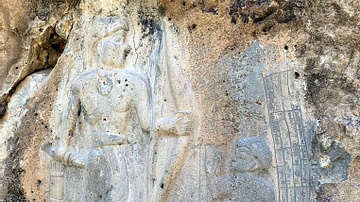
Rock-Relief of Tar...dunni, Darband-i Belula
This rock-relief depicts a triumphant warrior. Before him, two captives (probably Hurrians) can be seen. The Akkadian cuneiform inscription on the right side mentions the name of the warrior as "Tar...dunni", son of Ikki. The names of the...
