
Search
Did you mean: Midas?
Remove Ads
Advertisement
Search Results

Image
Attendant God Dedicated to Nabu
Limestone statue of attendant god dedicated to Nabu by Adad-Nirari III and Sammuramat. The figure was dedicated to Nabu, the god of learning, in the temple of Ezida at Calah by the governor of Calah and other cities, for the life of the king...
Image
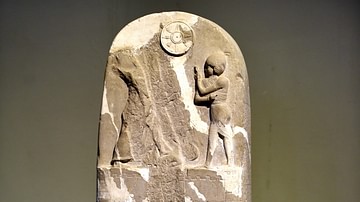
Stele of Dadusha, King of Eshnunna
The stele is an elongated stone monument which originally stood at the Temple of Adad at Eshnunna. The front side is carved with four registers while the narrow sides were inscribed with 220 lines of a cuneiform text divided into 17 columns...
Image
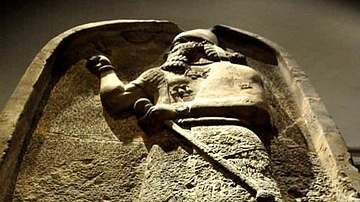
Gypsum Stela of Ashurnasirpal II
The Assyrian king worships gods (Ashur, Shamash, Sin, Adad, and Ishtar) and records his achievements. This freestanding gypsum monument was erected by King Ashurnasirpal II (reigned 883-859 BCE). This stela weighs over four tons and was erected...

Image
Two Statues of Shalmaneser III at the Iraq Museum
In the centre of this image is the so-called Kurba'il statue of Shalmaneser III (reigned 858-824 BCE), which was found in Fort Shalmaneser in 1961 CE by the British School of Archaeology in Iraq. The statue originally stood in the Temple...
Image
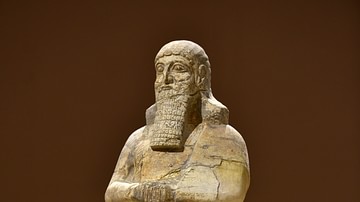
Kurba'il Statue of Shalmaneser III
Kurba'il statue of Shalmaneser III (r. 858-824 BCE), found in Fort Shalmaneser in 1961 by the British School of Archaeology in Iraq. The statue originally stood in the Temple of Adad at the city of Kurba'il, north of modern-day Mosul...
Image
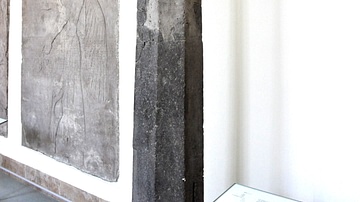
Basalt Column from Ashur
A number of basalt columns and their fragments were uncovered during archaeological excavations at the "Row of Stelae" at the city of Ashur. These were brought to the city as part of an important booty. The cuneiform inscriptions on this...
Image
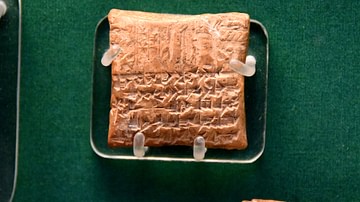
Clay Tablet from Alalakh with Idrimi's Seal
Agreement for annual dues of gold and sheep to be paid to the King, either Idirimi or his son Niqmepa, who often used his father's seal. The seal's inscription reads "Idrimi, servant of the god Adad". 1500-1450 BCE. From Level IV Palace at...

Video
The Ishtar Gate of Babylon at the Pergamon Museum, Berlin
This gate was built at the northern side of the city of Babylon by the king Nebuchadnezzar II in 575 BCE. It was the eighth gate into the city of Babylon, Mesopotamia (modern Babil Governorate, Iraq). The gate was built with glazed bricks...
