
Search
Did you mean: Midas?
Remove Ads
Advertisement
Search Results
Image
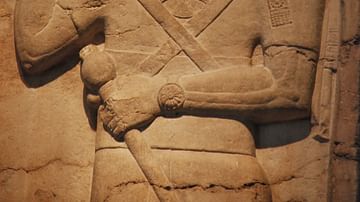
King Shamshi-Adad V
Assyrian stela of Shamshi-Adad V (823-811 BCE) from the temple of Nabu in Nimrud, c. 814 BCE, showing the kind worshipping symbols of the gods. The cross on the king's chest is a symbol of the sun god. Through his dress the Shamshi-Adad V...
Image
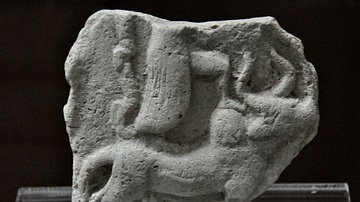
God Adad
In this partially survived terracotta plaque, the god Adad stands on the back of a bull. Adad was the God of weather, hurricanes, storms, thunder, and rain. From Mesopotamia, modern-day Iraq. Old-Babylonian period, 2000-1500 BCE. The Sulaimaniya...

Image
A door socket from Anu-Adad Temple
The cuneiform inscriptions on this door socket mention the name of Shalmaneser III, King of Assyria (858-824 BCE). The king dedicated the stone to the gods Anu and Adad for his life and the well-being of his people. From Anu-Adad temple at...
Image
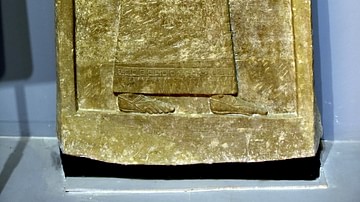
Stele of Adad-Nirari III
Limestone stele of the Assyrian king Adad-Nirari III (r. 810-783 BCE) from Tell al-Rimah, in modern-day Nineveh Governorate, Iraq. The king is praying before gods and goddesses symbols. The cuneiform inscriptions mention the king's titles...
Image
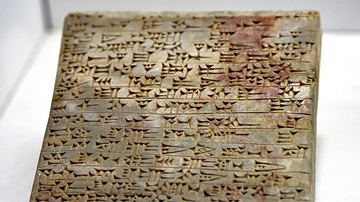
Tablet of Adad-Nirari II
The cuneiform inscription on this clay tablet states that the neo-Assyrian king Adad-nirari II (reigned 911 - 891 BCE) has built a city and a palace. From northern Mesopotamia, Iraq. (The Iraq Museum, Baghdad).
Image
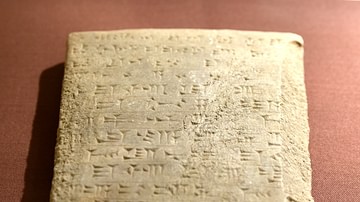
Clay Tablet of Adad-Nirari II from Assur
Cay tablet narrating the building works of the Assyrian king Adad-Nirari II (r. 911-891 BCE), from Ashur (Assur), modern-day Iraq.
The Iraq Museum, Baghdad.
Definition
Mari
Mari was a city-state located near the west bank of the Euphrates River in Northern Mesopotamia (now eastern Syria) during the Early Bronze Age and the Middle Bronze Age. One of the earliest known planned cities, Mari is believed to have...

Definition
Neo-Assyrian Empire
The Neo-Assyrian Empire (912-612 BCE) was the final stage of the Assyrian Empire, stretching throughout Mesopotamia, the Levant, Egypt, Anatolia, and into parts of Persia and Arabia. Beginning with the reign of Adad Nirari II (912-891 BCE...

Definition
Ashur - The First Great Assyrian City
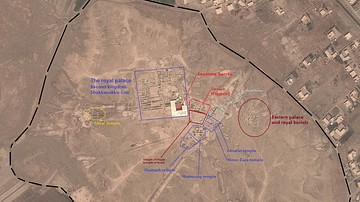
Ashur (also known as Assur) was an Assyrian city located on a plateau above the Tigris River in Mesopotamia (today known as Qal'at Sherqat, al-Shirqat District, northern Iraq). The city was an important center of trade, as it lay squarely...

Definition
Assyrian Warfare
Assyria began as a small trading community centered at the ancient city of Ashur and grew to become the greatest empire in the ancient world prior to the conquests of Alexander the Great and, after him, the Roman Empire. While the Assyrians'...
