


Under Philip II of Macedon (reign 359–336 BCE) and Alexander the Great (reign 336–323 BCE), the somatophylakes (“bodyguards”) formed an exceptionally exclusive circle of trusted Macedonian nobles around the king. Traditionally limited to seven men, they were distinct from ordinary battlefield guards and often served as senior commanders, governors, and royal advisers. During Alexander’s final campaigns, Peucestas was admitted as an unprecedented eighth somatophylax after helping save the wounded king during the Mallian campaign.
- Hephaestion – Alexander’s closest companion and later chiliarch, he became one of the king’s most important military and political partners before dying at Ecbatana in 324 BCE.
- Perdiccas – a senior commander who became regent of Alexander’s empire and guardian of the Argead kings after 323 BCE; he was killed by his own officers during the invasion of Egypt in 321 BCE.
- Ptolemy – a trusted bodyguard and commander who secured Egypt after Alexander’s death, seized Alexander’s body, and eventually founded the Ptolemaic dynasty.
- Lysimachus – a veteran companion appointed to govern Thrace in 323 BCE; he later built a powerful kingdom spanning Thrace and parts of Asia Minor and Macedon.
- Leonnatus – a prominent bodyguard who received Hellespontine Phrygia after Alexander’s death and became involved in dynastic politics before being killed in the Lamian War in 322 BCE.
- Peithon – appointed satrap of Media, he suppressed the revolt of Greek veterans in the east and later sought greater control over the Upper Satrapies before being executed by Antigonus.
- Aristonous – a long-serving bodyguard who remained loyal to the Argead dynasty and supported Olympias during the Successor struggles before being executed by Cassander around 316 BCE.
- Peucestas – rewarded for helping save Alexander during the Mallian assault, he became satrap of Persis and gained unusual local support by adopting elements of Persian language, dress, and court culture.
After Alexander’s death at Babylon in 323 BCE, proximity to the king became valuable political capital. Several former somatophylakes transformed royal trust, military commands, and provincial appointments into independent power bases, while others remained defenders of the Argead dynasty. Their careers trace the fragmentation of Alexander’s personal empire and the emergence of the Hellenistic kingdoms during the Wars of the Successors (323–281 BCE).
About the Author
Related Images

Portraits of Alexander and a Youth (Hephaestion?)

Alexander the Great, Macedonian Silver Tetradrachm
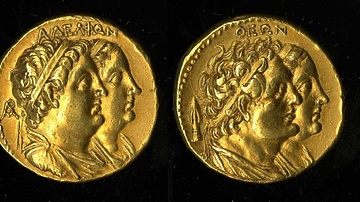
Ptolemy I with Berenice I & Ptolemy II with Arsinoe II

Hephaestion Votive
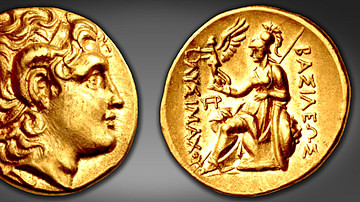
Coin of Lysimachus

Coins of Alexander the Great of Macedon
Cite This Work
APA Style
Netchev, S. (2026, September 04). Alexander the Great’s Eight Bodyguards: The Somatophylakes and the Macedonian Empire. World History Encyclopedia. https://www.worldhistory.org/image/22057/alexander-the-greats-eight-bodyguards/
Chicago Style
Netchev, Simeon. "Alexander the Great’s Eight Bodyguards: The Somatophylakes and the Macedonian Empire." World History Encyclopedia, September 04, 2026. https://www.worldhistory.org/image/22057/alexander-the-greats-eight-bodyguards/.
MLA Style
Netchev, Simeon. "Alexander the Great’s Eight Bodyguards: The Somatophylakes and the Macedonian Empire." World History Encyclopedia, 04 Sep 2026, https://www.worldhistory.org/image/22057/alexander-the-greats-eight-bodyguards/.
