


The city of Constantinople, founded as an imperial capital by Constantine I in 330 CE, occupied a commanding position on the Bosporus between Europe and Asia. Capital of the Byzantine Empire, it survived repeated attacks through the strength of the Theodosian Walls, naval defenses, strategic geography, military resistance, and diplomacy. Of roughly 30 recorded sieges, attacks, and major blockades, these twelve placed the city under particularly significant military pressure.
- Avar-Sasanian Siege (626 CE) – Avar, Slavic, and Sasanian forces attacked while Emperor Heraclius was campaigning abroad, but the walls held and the assault failed.
- Arab Naval Siege (674–678 CE) – Umayyad forces under Muʿawiya I repeatedly threatened Constantinople by sea, but Byzantine resistance under Constantine IV forced their withdrawal.
- Second Arab Siege (717–718 CE) – a major Umayyad offensive was defeated by Emperor Leo III, aided by Bulgarian forces under Khan Tervel.
- Bulgar Encirclement (813–814 CE) – Krum of Bulgaria threatened Constantinople after major victories over Byzantium, but his sudden death ended preparations for a decisive assault.
- Rebel Siege (1047 CE) – the Byzantine rebel Leo Tornikios besieged the capital during the reign of Constantine IX, demonstrating the danger posed by internal civil conflict.
- Pecheneg Encirclement (1090–1091 CE) – Pecheneg forces threatened Constantinople while Tzachas of Smyrna challenged it by sea; Alexios I defeated the Pechenegs with Cuman allies.
- Fourth Crusade (1203–1204 CE) – Latin crusaders and Venetian forces captured and sacked Constantinople, leading to the partition of Byzantine territories and creation of the Latin Empire.
- Nicaean-Bulgarian Siege (1235–1236 CE) – forces of the Empire of Nicaea and Bulgaria attempted to recover Constantinople, but Venetian and Western naval support helped the Latin defenders hold the city.
- Nicaean Siege and Recovery (1260–1261 CE) – after an unsuccessful siege in 1260, forces of Michael VIII Palaiologos recaptured Constantinople in 1261 and restored the Byzantine Empire.
- Long Ottoman Blockade (1394–1402 CE) – Bayezid I subjected Constantinople to an extended blockade that ended only after his defeat by Timur at the Battle of Ankara.
- Ottoman Siege (1422 CE) – Murad II attacked Constantinople with early Ottoman siege artillery but withdrew amid dynastic unrest encouraged by Byzantine diplomacy.
- Fall of Constantinople (1453 CE) – Mehmed II captured the city after sustained bombardment and repeated assaults breached its defenses, ending the Byzantine Empire.
Constantinople’s repeated survival preserved the Byzantine state through centuries of political and military upheaval and shaped the history of southeastern Europe and the eastern Mediterranean. Its capture on 29 May 1453 ended more than a millennium of Roman imperial rule in the east and established the city as the principal capital of the expanding Ottoman Empire.
About the Author
Related Images

Theodosian Walls
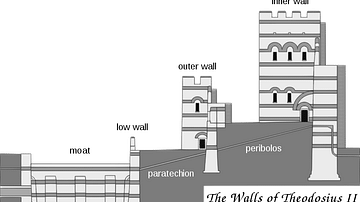
Cross-section of the Theodosian Walls
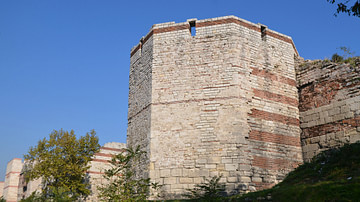
Tower, Theodosian Walls
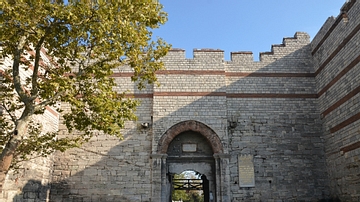
Gate, Theodosian Walls

Mehmed II Conquers Constantinople
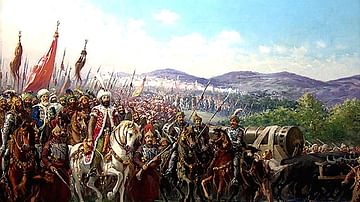
Mehmed II Conquering Constantinople
Cite This Work
APA Style
Netchev, S. (2026, August 06). The Twelve Major Sieges of Constantinople (626–1453 CE): War, Survival, and the Fall of the Byzantine Capital. World History Encyclopedia. https://www.worldhistory.org/image/21980/the-twelve-major-sieges-of-constantinople-626-1453/
Chicago Style
Netchev, Simeon. "The Twelve Major Sieges of Constantinople (626–1453 CE): War, Survival, and the Fall of the Byzantine Capital." World History Encyclopedia, August 06, 2026. https://www.worldhistory.org/image/21980/the-twelve-major-sieges-of-constantinople-626-1453/.
MLA Style
Netchev, Simeon. "The Twelve Major Sieges of Constantinople (626–1453 CE): War, Survival, and the Fall of the Byzantine Capital." World History Encyclopedia, 06 Aug 2026, https://www.worldhistory.org/image/21980/the-twelve-major-sieges-of-constantinople-626-1453/.
