


This text is available in other languages:

The 14th century was a time of crisis and transformation across much of the world. Plague, war, shifting power structures, and intellectual ferment reshaped societies from Asia to Africa, Europe to the Americas. Despite profound instability, new centers of influence emerged and long-distance connections intensified, forging an increasingly intertwined—yet fractured—global landscape.
The Black Death swept from China to Europe, decimating populations and disrupting economies, while the Delhi Sultanate expanded deep into the Indian subcontinent and the Mali Empire reached its zenith under Mansa Musa. The Mongol Empire fractured, Byzantium faltered, and new dynasties—like the Ming in China—rose from the wreckage. In West Africa, Islamic scholarship flourished in Timbuktu; in the Andes, regional centers consolidated power; and in Mesoamerica, the foundations of future empires were being laid. Trade routes carried goods, stories, and contagion across continents, linking distant cultures even as their internal structures reeled from conflict and change.
About the Author
Related Images

Map of European Expansion & Mercantile Empires, c. 1700

The Rashtrakuta, Gurjara-Pratihara and Pala Empires, Ancient India

Map of the Cradles of Early Civilization - Global Pathways to Agriculture, Urban Centers & Early States

Map of the Olmec Civilization
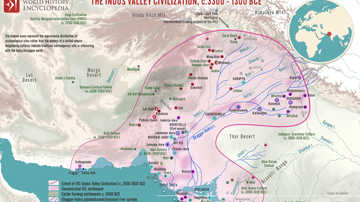
Map of the Indus Valley Civilization, c. 3300-1300 BCE - Cities, Trade, and Settlement in the Bronze Age

Map of the Sumerian Civilization - Where Cities Began
Cite This Work
APA Style
Netchev, S. (2025, May 28). Map of the World in the 14th Century. World History Encyclopedia. https://www.worldhistory.org/image/20507/map-of-the-world-in-the-14th-century/
Chicago Style
Netchev, Simeon. "Map of the World in the 14th Century." World History Encyclopedia, May 28, 2025. https://www.worldhistory.org/image/20507/map-of-the-world-in-the-14th-century/.
MLA Style
Netchev, Simeon. "Map of the World in the 14th Century." World History Encyclopedia, 28 May 2025, https://www.worldhistory.org/image/20507/map-of-the-world-in-the-14th-century/.
