
Search
Remove Ads
Advertisement
Search Results

Definition
Batu Khan
Batu Khan (l. 1205-1255 CE) was a grandson of Genghis Khan and the founder of the Golden Horde. Batu was a skilled Mongol military commander and won battles from China to Persia, although his most famous exploits involve the grand...

Definition
Alexander Selkirk - The Inspiration For Robinson Crusoe
Alexander Selkirk (or Selcraig, 1676-1721) was a Scotsman famously marooned for four years and four months on a desert island in the Pacific Ocean until his rescue by a passing British ship in February...

Definition
Chlothar I
Chlothar I (l. c. 498-561) was a Merovingian king of the Franks, the second to rule over a unified Frankish kingdom after his father, Clovis I (l. c. 466-511). When Clovis died in 511, his kingdom was divided up between his four sons...

Definition
The Gospels
The New Testament contains four gospels attributed to Matthew, Mark, Luke, and John. The four gospels are not biographies of Jesus, nor are they history as we define it. What each gospel attempted to do was write a theological explanation...

Definition
Taj Mahal - Symbol of Love, Power, & Mughal Architecture
The Taj Mahal is a mausoleum complex in Agra, Uttar Pradesh, northern India. Commissioned by the Mughal Emperor Shah Jahan to inter and memorialise his wife Mumtaz Mahal, the building is the finest...
Definition
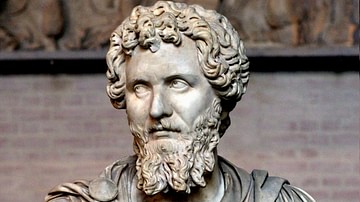
Septimius Severus
Lucius Septimius Severus was Roman emperor from April 193 to February 211 CE. He was of Libyan descent from Lepcis Magna and came from a locally prominent Punic family who had a history of rising to senatorial as well as consular...

Definition
New Testament
New Testament is the name for the second half of the Christian Bible, compiled from the 2nd century CE, after the separation of Christianity from Judaism. The Christian Bible retained books of the Jewish scriptures, the Old Testament...

Definition
Shang Dynasty
The Shang Dynasty (c. 1600-1046 BCE) was the second dynasty of China, which succeeded the Xia Dynasty (c. 2070-1600 BCE) after the overthrow of the Xia tyrant Jie by the Shang leader, Tang. Since many historians question whether...

Definition
Legio II Augusta
Legio II Augusta was a legion of the Roman army that, throughout its centuries-long history, had fought in the Cantabrian Wars of 29-19 BCE, Germanicus' German campaigns in 9 CE, the invasion of Britain in 43 CE, and Septimus...

Definition
Roman Army
The Roman army, famed for its discipline, organisation, and innovation in both weapons and tactics, allowed Rome to build and defend a huge empire which for centuries would dominate the Mediterranean world and beyond. Overview...
