
Search
Remove Ads
Advertisement
Search Results

Definition
Early Joseon Period
The Early Joseon Period (1392 - c. 1550 CE) in Korea was bookended by internal power struggles but witnessed major scientific and societal advances and prosperity. The Joseon (Choson) Dynasty ruled Korea from 1392 CE to 1897...

Definition
Quran
The Quran (also written Qur’an or Koran), revealed in the 7th century, is the sacred book of Islam, following in the tradition of the Abrahamic faiths, with the Torah as the sacred book of Judaism and the New Testament as the sacred book...

Definition
Sphinx
A sphinx is a mythical creature with the body of a lion, most often with a human head and sometimes with wings. The creature was an Egyptian invention and had a male head - human or animal; however, in Greek mythology, the creature had...

Definition
Three Kingdoms Period in Korea
The Three Kingdoms Period of ancient Korea (57 BCE – 668 CE) is so-called because it was dominated by the three kingdoms of Baekje (Paekche), Goguryeo (Koguryo), and Silla. There was also, though, a fourth entity...
Definition
Pankration
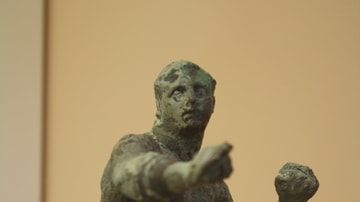
Pankration is an ancient martial art which mixes wrestling and boxing. The sport can be traced as far back as the second millennium BCE in the territory of ancient Greece. Its name derives from the ancient Greek words pan (all) and...
Definition
Chavin Civilization
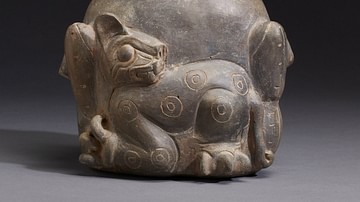
The Chavin civilization flourished between 900 and 200 BCE in the northern and central Andes and was one of the earliest pre-Inca cultures. The Chavin religious centre Chavin de Huantar became an important Andean pilgrimage...

Definition
Leto
Leto is a Titan and the mother of the gods Apollo and Artemis in Greek mythology. Leto's twin children were the result of an amorous encounter with Zeus, and to avoid his wife Hera's wrath, the Titaness was obliged to give birth on the...

Article
Baroque, Age of Contrasts - Exhibition Interview Schweizerisches Landesmuseum
The Baroque era, which lasted from roughly 1580 and 1780, was a time of enormous contrasts: Opulence and innovation, on the one hand; death and crises, on the other. Ongoing religious...

Definition
Urartu Religion
The religion of the Urartu civilization, which flourished principally in ancient Armenia from the 9th to 6th century BCE, was a unique mix of indigenous, Hurrian and Mesopotamian gods and symbolism. The pantheon was headed by...
Definition
Ife
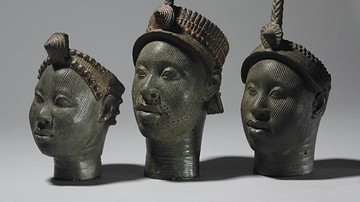
Ife (aka Ile-Ife) was an ancient African city which flourished between the 11th and 15th century CE in what is today Nigeria in West Africa. Ife was the capital and principal religious centre of the Yoruba kingdom of Ife, which prospered...
