
Search
Remove Ads
Advertisement
Search Results

Definition
Nazca Civilization
The Nazca civilization flourished on the southern coast of Peru between 200 BCE and 600 CE. They settled in the Nazca and other surrounding valleys with their principal religious and urban sites being Cahuachi and Ventilla...

Definition
Ganges - The Sacred Hindu River
The River Ganges, also known as the Ganga, flows 2,700 km from the Himalaya mountains to the Bay of Bengal in northern India and Bangladesh. Regarded as sacred by Hindus, the river is personified as the goddess Ganga...

Definition
Sukhothai
Sukhothai or Sukhothai Historical Park was the former capital of the Kingdom of Sukhothai (1248-1438 CE), which was founded by King Si Inthrathit (r. 1238-1270 CE) and was the first in a series of independent polities that would eventually...

Definition
Bes
Bes is the ancient Egyptian god of childbirth, fertility, sexuality, humor, and war, but served primarily as a protector god of pregnant women and children. He is regularly depicted as a dwarf with large ears, long-haired and bearded, with...

Definition
Poseidon
Poseidon was the Greek god of the sea and rivers, creator of storms and floods, and the bringer of earthquakes and destruction. He was perhaps the most disruptive of all the ancient gods but he was not always a negative force. He was...
Definition
Perseus
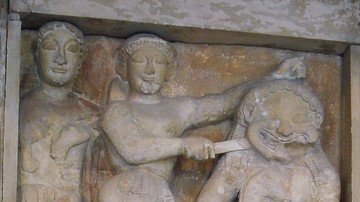
Perseus is one of the greatest and oldest pan-Hellenic heroes of Greek mythology. Perseus famously killed the dreaded Medusa, a Gorgon with snakes as hair and whose stare turned men to stone. Perseus also carried out the daring rescue...
Definition
Bellerophon
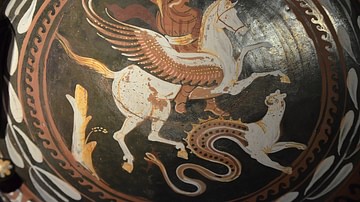
Bellerophon (aka Bellerophontes) is the Corinthian hero of Greek mythology who famously battled and killed the fantastical Chimera monster, a fearsome fire-breathing mix of lion, goat, and snake. Bellerophon was the son of Poseidon...

Definition
Djed
The djed is an ancient Egyptian symbol for stability which features prominently in Egyptian art and architecture throughout the country's history. `Stability' should be understood to mean not only a firm footing but immutability and permanance...

Definition
Arachne
Arachne, from the Greek arákhnē (meaning spider), is a figure in Greek mythology whose talent for weaving was renowned and who famously challenged the goddess Minerva to a weaving competition. As told in Ovid’s (43 BCE-17 CE) Metamorphoses...

Definition
Greek Archaic Period
The Greek Archaic Period (c. 800-479 BCE) started from what can only be termed uncertainty, and ended with the Persians being ejected from Greece for good after the battles of Plataea and Mykale in 479 BCE. The Archaic Period...
