
Search
Remove Ads
Advertisement
Search Results
Definition
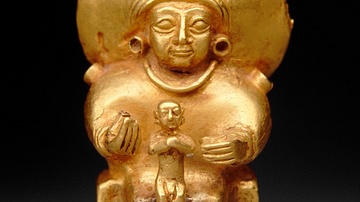
Sauska - The Hurrian's Radiant Goddess of Fertility and War
Sauska (also known as Shaushka, Sausga, and Anzili) was the Hurrian-Hittite goddess of fertility, war, and healing. She was worshipped throughout the region known as Hanigalbat (present day Iraq...

Definition
Writing - The Preservation of Human Thought and Action
Writing is the physical manifestation of a spoken language. It is thought that human beings developed language circa 35,000 BCE as evidenced by cave paintings from the period of the Cro-Magnon Man...

Definition
Lamia
Lamia is a female or a hermaphroditic demon found in Greek mythology who devoured children and seduced men. She appears in literature as early as the 6th century BCE and is said to be fearsome to look upon with an ugly face, the upper...

Definition
Egyptian Medicine
Medical practice in ancient Egypt was so advanced that many of their observations, policies, and commonplace procedures would not be surpassed in the west for centuries after the fall of Rome and their practices would inform...
Image
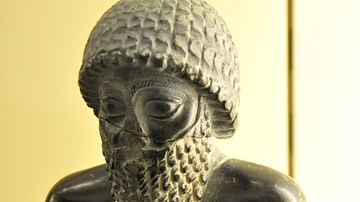
Statue of Ur-ningirsu
The cuneiform inscriptions on the back of this small diorite statue (height 18 cm) read, "Dedicated to the god Ningizzida, his god, by Ur-ningirsu, priest-prince of Lagash, son of Gudea, priest-prince of Lagash." This...

Definition
Ancient Egyptian Architecture
Ancient Egyptian architecture is often associated closely with the pyramids of Giza but was actually quite diverse, taking a number of forms in the construction of administrative buildings, temples, tombs, palaces...

Definition
Hans Holbein the Younger
Hans Holbein the Younger (c. 1497-1543 CE) was a German Renaissance painter who is most famous for his portraits. A versatile artist and superb draughtsman, Holbein was accomplished in different mediums from woodcut engravings...

Definition
Ancient Korean Sculpture
The sculpture of ancient Korea was dominated by Buddhist themes such as figurines and monumental statues of the Buddha and his followers, and large bronze bells for temples. Gilded-bronze was the most common material used...

Article
Renaissance Altarpieces
During the Renaissance (1400-1600) just about any artist of worth found themselves commissioned at some point in their careers to produce an altarpiece. Some of the greatest names in European art were so called upon, from...
Image
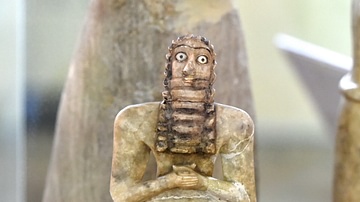
Male Worshiper from Tell Asmar Hoard, Iraq Museum
This is a votive statuette of a male Sumerian worshiper from the Square Temple of Abu at Tell Asmar (ancient Eshnunna, Mesopotamia, Iraq), Early Dynastic III, 2600-2400 BCE. Excavated by the Oriental...
