
Search
Did you mean: Phoenicia?
Remove Ads
Advertisement
Search Results
Definition
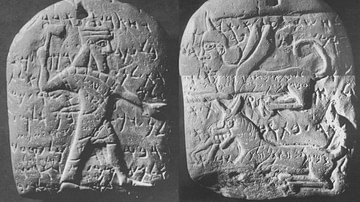
Arslan Tash Amulet
Dated to the 7th century BCE, the Arslan Tash amulet (AT1) was discovered in Arslan Tash, Syria and contains the writing of Phoenician, magic incantations. The limestone plaque includes a variety of features: incantations perceived to prevent...

Definition
Jezebel
Jezebel (d. c. 842 BCE) was the Phoenician Princess of Sidon who married Ahab, King of Israel (r. c. 871 - c. 852 BCE) according to the biblical books of I and II Kings, where she is portrayed unfavorably as a conniving harlot who corrupts...

Article
Top 5 Archaeological Sites in Lebanon
Home to some of the Middle East’s most majestic ancient ruins, Lebanon has a rich and varied heritage with over 5,000 years of recorded history. Over the millennia, different conquering empires have left their footprints on the architecture...

Video
History of the Phoenicians: The Maritime Superpowers of the Mediterranean
The Phoenicians were the maritime superpowers of the Mediterranean. Their culture flourished and was at its most powerful between 1500 and 332 BCE when Alexander the Great entered the region and decimated the cities and their populations...

Definition
Dido - Legendary Queen of Tyre
Queen Dido (aka Elissa, from Elisha, or Alashiya, her Phoenician name) was a legendary Queen of Tyre in Phoenicia who was forced to flee the city with a loyal band of followers. Sailing west across the Mediterranean she founded the city of...

Definition
Tyre
Tyre (in modern-day Lebanon) is one of the oldest cities in the world, dating back over 4,000 years, during which it has been inhabited almost continuously. It was one of the most important, and at times the dominant, city of Phoenicia, whose...
Article
Phoenician Names
Phoenician names are generally composite words with a specific meaning. The naming of children had a significance in the Ancient Near East that is difficult to understand nowadays. By choosing a name for their child, the parents could not...
Definition
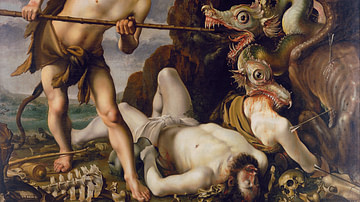
Cadmus
Cadmus is a Phoenician-born prince and the founder and king of Thebes in Boeotia in Greek mythology. He travelled to Greece from his home in Tyre in search of his sister Europa who had been kidnapped by Zeus. His rescue mission was abandoned...

Definition
Utica
Utica (also Utique), 33km north of Tunis, was the first Phoenician colony on the North African coast. The strategically important port was an ally to Carthage in the First Punic War, but the city switched sides in the Second and Third Punic...

Definition
Leptis Magna
Leptis Magna (aka Lepcis Magna), located in western Libya, North Africa, was a Phoenician city founded by Tyre in the 7th century BCE. Continuing to be a major city in the Roman period, it was the birthplace of Emperor Septimius Severus (r...
