
Search
Did you mean: Phoenicia?
Remove Ads
Advertisement
Search Results

Definition
Tyrian Purple - The Super-Expensive Dye of Antiquity
Tyrian purple (aka Royal purple or Imperial purple) is a dye extracted from the murex shellfish which was first produced by the Phoenician city of Tyre in the Bronze Age. Its difficulty of manufacture, striking purple to red colour range...

Definition
Astarte
Astarte is the Canaanite/Phoenician goddess of love, sex, war, and hunting who developed from the Mesopotamian deity Inanna/Ishtar. She is usually associated with the storm god Baal but seems to have been much more popular. She traveled to...

Definition
Script - The Written Record of Humanity
Script is the written expression of a language. Cuneiform, the first script, was invented in Sumer, Mesopotamia, circa 3600/3500 BCE; hieroglyphics sometime prior to the Early Dynastic Period in Egypt (circa 3150-2613 BCE); and Sanskrit in...

Definition
Alphabet
The history of the alphabet started in ancient Egypt. By 2700 BCE Egyptian writing had a set of some 22 hieroglyphs to represent syllables that begin with a single consonant of their language, plus a vowel (or no vowel) to be supplied by...

Definition
Ancient Israelite Art
Ancient Israelite art traditions are evident especially on stamps seals, ivories from Samaria, and carvings, each with motifs connecting it to more general artistic traditions throughout the Levant. Ancient Israel, and therefore its art...

Definition
Yamm
Yamm (from the Semitic word yam for 'sea', also known as Yam and Yam-Nahar) was the god of the sea and storm in the pantheon of the Canaanite-Phoenicians. Depicted consistently as tyrannical, angry, violent, and harsh, Yamm was the brother...
Collection
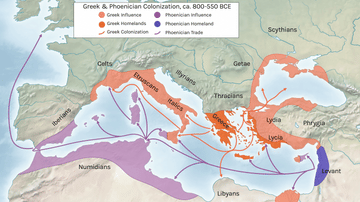
Colonization in the Ancient Mediterranean
Colonization of the ancient Mediterranean had been taking place since the Bronze Age, especially with Minoan and Mycenaean expansion, but it was the Phoenicians from the 10th century CE that really took the whole idea to a new level. The...

Article
The Splendours of Roman Algeria
Algeria, Africa's largest country, stretches from the Mediterranean coastline to the Saharan desert interior. The country has some of the finest and most diverse Roman sites, including Timgad and Djémila, both well-preserved and UNESCO-listed...

Article
Caesarea Maritima's Role in the Mediterranean Trade
Caesarea Maritima was located on the eastern coast of the Mediterranean Sea. Built from the ground up in 22-10 BCE by Rome's client king, Herod the Great (r. 37-4 BCE), its location in relation to ship traffic and proximity to historical...

Definition
Mauretania
Mauretania was an ancient kingdom in northwest Africa, encompassing regions of modern-day Morocco and Algeria. Although it shares a name with the modern country of Mauritania, they do not overlap. Ancient Mauretania was named after the Mauri...
