
Search
Did you mean: Phoenicia?
Remove Ads
Advertisement
Search Results

Definition
Tartessos
The Tartessian culture existed from the 9th to the 6th centuries BCE in the south-westernmost part of Spain. The landscape between the modern cities Huelva and Cádiz is defined nowadays by the lower course of the Guadalquivir, but in antiquity...

Image
Map of the Phoenician Expansion c. 11 - 6 centuries BCE
The Phoenician expansion between the 11th and 6th centuries BCE grew out of the maritime cities of the Levant—most notably Tyre, Sidon, and Byblos, whose skilled sailors and merchants created one of the ancient Mediterranean’s most dynamic...
Image
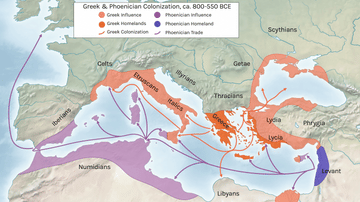
Greek and Phoenician Colonization
Both the ancient Greeks and Phoenicians extensively colonized vast areas of Europe, along the Mediterranean and Black Sea coasts. In doing so, they spread their culture, which strongly influenced the local tribes. For the Greeks, this is...

Image
Evolution of the Phoenician Alphabet
The Phoenician alphabet and its equivalents in four modern alphabets. From left to right: Latin, Greek, Phoenician, Hebrew, Arabic. Legend: In the middle column you'll find the original Phoenician letters, with their modern equivalents in...
Image
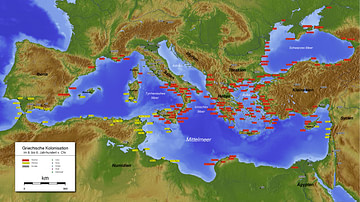
Greek & Phoenician Colonies
Greek (Red) and Phoenician (Yellow) colonization between the 8th and the 6th century BC.
German placenames.
Image
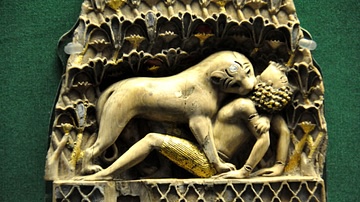
Lioness Devouring a Boy, Phoenician Ivory Panel
This Phoenician carved ivory panel is one of an almost identical pair with one now in the Iraq Museum, Baghdad. They originally formed part of a piece of furniture, perhaps a throne. The incised letter 'aleph' beside holes on the top and...
Image
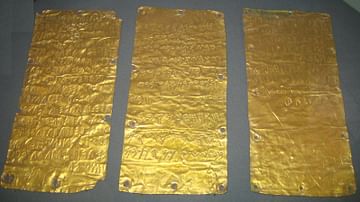
Etruscan & Phoenician Inscriptions
Gold sheet plaques from Pygri, the port of Etruscan Cerveteri. In both the Etruscan and Phoenician alphabet they describe the separation of a space dedicated in the temple there for Astarte. c. 500 BCE (Museo di Villa Giulia, Rome)
Image
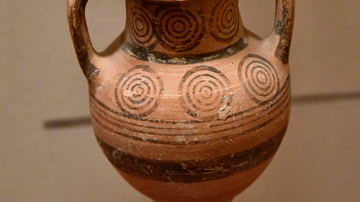
Cypro-Phoenician Pottery Vessel
This vessel belongs to a ceramic tradition known as "black-on-red" ware, the most ubiquitous of the Iron Age's Cypro-Phoenician exports. Iron Age II, 1000-539 BCE. From Amman, Jordan. (The Jordan Museum, Amman, Jordan).

Image
Head of a Phoenician Woman
This is a head of woman wearing an Egyptian wig. The hole at the top is a hole for suspension. Part of a baked clay votive figure. The Canaanite traditions of terracotta figurine manufacturer were continued by the Phoenicians, both at home...

Image
Stela of Kulamuwa with Phoenician Inscription
Plaster mould of a stela found in Sam'al (modern Zincirli, Turkey), dated to 825 BCE. It shows king Kulamuwa alongside a long inscription in Phoenician writing. In his left hand, the king holds a lotus in his left hand and four divine symbols...
