
Search
Remove Ads
Advertisement
Search Results
Definition
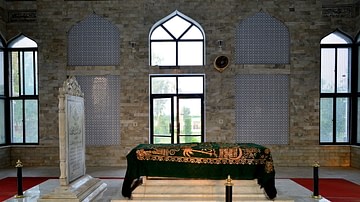
Muhammad Ghori
Shihab al-Din (also Muʿizz al-Din Muhammad ibn Sam), popularly known as Muhammad Ghori (r. 1173-1206 CE), was the Muslim ruler who laid the foundation for the subsequent Islamic ruling dynasties of India which saw its pinnacle...

Definition
Chitrali Mythology
Chitrali mythology developed in the region of Chitral, the tallest portions of the Hindu Kush mountains, where the Chitrali people, at the juncture of South, Central, West, and East Asia, were exposed to many external cultural...

Definition
First Anglo-Sikh War
The First Anglo-Sikh War (1845-6) was a short and bloody conflict won by the British East India Company (EIC) against the Sikh Empire. The EIC was keen to expand into northern India, but the Sikh army was a well-trained, well-equipped...

Definition
Katas Raj
The Katas Raj Temples near Chakwal in Punjab province of Pakistan are attributed to the eras of the Hindu Shahis (kings) dating from about 615-950 CE and are dedicated to Lord Shiva. As such they constitute one of the most important...
Image
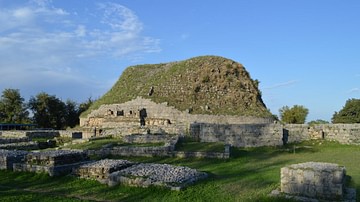
Dharmarajika Stupa (Taxila)
Dharmarajika stupa is land mark of Gandhara Art/Civilization. This stupa is locally called “Cheer Top” in Taxila (Punjab-Pakistan). This stupa is attributed to Asoka the Great and was erected in the 3rd Century BCE. It...
Image
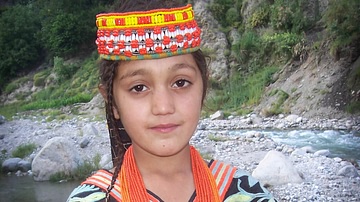
Kalasha People
A girl in traditional costume from Kalash valley, Chitral, Pakistan. Kalasha tribe is the sole pagan tribe of Pakistan.
Image
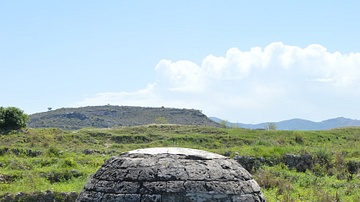
Round Stupa (Taxila)
Sirkap is a Greek style city of Gandhara once the Indian Subcontinent and modern Pakistan in Taxila (Punjab-Pakistan). Sirkap city was built in 2nd Century BCE by Greco-Bactrian ruler. The Round stupa of Sirkap is remarkable...

Article
Early Muslim Conquests (622-656 CE)
Islam arose as a religious and socio-political force in Arabia in the 7th century CE (610 CE onwards). The Islamic Prophet Muhammad (l. 570-632 CE), despite facing resistance and persecution, amassed a huge following...

Article
Ancient Iranian Salt Mine Mummies
As a young girl interested in archaeology and history, mummies always intrigued me. From the intricate Egyptian mummies to the naturally and beautifully preserved mummies of the Incas, they seemed to me to be beautiful...
Image
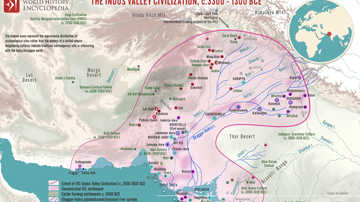
Map of the Indus Valley Civilization, c. 3300-1300 BCE - Cities, Trade, and Settlement in the Bronze Age
The Indus Valley Civilization (c. 3300–1300 BCE) was one of the earliest complex societies of the Bronze Age world, extending across parts of present-day Pakistan...
