
Search
Remove Ads
Advertisement
Search Results
Image
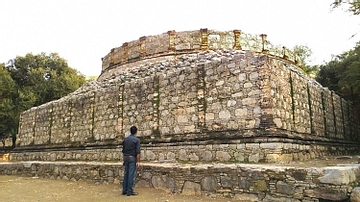
Mohra Moradu Stupa
The stupa of Mohra Moradu. Part of the Buddhist monastery complex at Taxila, northern Pakistan. Third century, CE.

Image
Silver Coin from Manikyala Stupa
Silver coin of "Abdalla ibn Khazim". From Merv (modern-day Turkmenistan), circa 684 CE. Found inside the Buddhist monument (called deposit A) at Manikyala, modern-day Pakistan. This shows that coins from several places...

Image
Worship of Buddha's Bowl
A sculpture from Gandhara depicting the worship of Buddha's bowl, 2nd-5th century CE.
Islamabad Museum, Pakistan.
Image
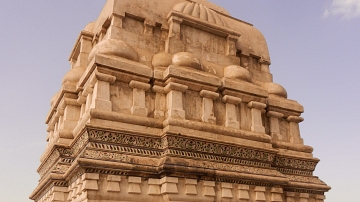
Sath Graha Temple (Side)
One of the temples at the Sath Graha section of Katas Raj, Chakwal, Punjab, Pakistan, an ancient Hindu site dedicated to the worship of Shiva and prior to that a Buddhist site as well. This particular building is dated...

Definition
Indus Valley Civilization
The Indus Valley Civilization was a cultural and political entity which flourished in the northern region of the Indian subcontinent between c. 7000 - c. 600 BCE. Its modern name derives from its location in the valley...

Definition
Ibn Battuta
Ibn Battuta (l. 1304-1368/69) was a Moroccan explorer from Tangier whose expeditions took him further than any other traveler of his time and resulted in his famous work, The Rihla of Ibn Battuta. Scholar Douglas Bullis notes that...

Definition
Islamic Caliphates
Caliphate (“Khilafat” in Arabic) was a semi-religious political system of governance in Islam, in which the territories of the Islamic empire in the Middle East and North Africa and the people within were ruled by a supreme...
Definition
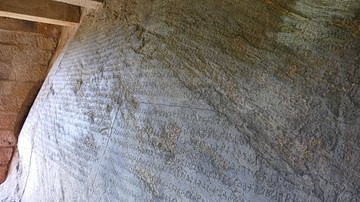
The Edicts of Ashoka the Great
The Edicts of Ashoka are 33 inscriptions engraved on pillars, large stones, and cave walls by Ashoka the Great (r. 268-232 BCE), the third king of the Mauryan Empire (322-185 BCE) of India. One set, the so-called Major...

Definition
Timur - The Brutal Conqueror of Central Asia
Timur (1336-1405), also known as Tamerlane, Temür, or Timur Leng, was the founder of the Timurid Empire (1370-1507), which had its heartlands in modern-day Uzbekistan and capital at Samarkand. A Muslim Turkic...

Definition
Suleiman the Magnificent
Suleiman the Magnificent (aka Süleyman I or Suleiman I, r. 1520-1566) was the tenth and longest-reigning sultan of the Ottoman Empire. Hailed as a skilled military commander, a just ruler, and a divinely anointed monarch...
