
Search
Remove Ads
Advertisement
Search Results

Definition
Sargonid Dynasty
The Sargonid Dynasty was the last ruling house of the Neo-Assyrian Empire from 722-612 BCE, beginning with the reign of Sargon II and ending with fall of the Neo-Assyrian Empire. Some of the most famous kings in the history of...

Definition
Taj Mahal - Symbol of Love, Power, & Mughal Architecture
The Taj Mahal is a mausoleum complex in Agra, Uttar Pradesh, northern India. Commissioned by the Mughal Emperor Shah Jahan to inter and memorialise his wife Mumtaz Mahal, the building is the finest...

Definition
Crafts
The word 'Craft' comes from the Middle English word for 'strength' or 'skill' derived from the Old English word craeft which comes from Old High German kraft, for strength, and means “skill in planning, making, executing” and, by extension...

Definition
Sogdiana
Sogdiana (or Sogdia) is a region in Central Asia between the mighty rivers Iaxartes in the north and Oxus in the south. Its eastern and western limits are more difficult to determine, especially since the toponym Sogdiana covered different...

Definition
Dur-Sharrukin
Dur-Sharrukin (modern Khorsabad, Iraq) was a city built by Sargon II of Assyria (r. 722-705 BCE) as his new capital between 717-706 BCE. The name means Fortress of Sargon and the building project became the king's near obsession...

Definition
Ajanta
Approximately 67 miles (107 km) to the north of Aurangabad in the Indhyadri range of Western Ghats lie the caves of Ajanta. The 30 caves, famous for their early Buddhist temple architecture and many delicately drawn murals, are located...

Definition
Lumbini
Lumbini is a village, archaeological site, and place of pilgrimage honored as the birthplace of Siddhartha Gautama (the Buddha, l. c. 563-483 BCE) located in modern-day Rupandehi District of Nepal, Province 5, near the Indian border...
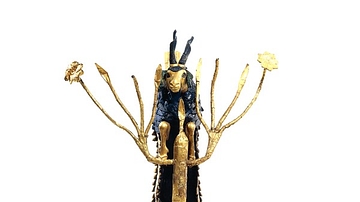
Image
Ram in a Thicket
From Ur, southern Iraq, about 2600-2400 BC This is one of an almost identical pair discovered by Leonard Woolley in the 'Great Death Pit', one of the graves in the Royal Cemetery at Ur. The other is now in the University of...

Article
Mesopotamian Inventions - Creating the Future
Mesopotamian inventions include many items taken for granted today, most of which were created during the Early Dynastic period (circa 2900-2350/2334 BCE) or developed from achievements of the Uruk period...

Article
The Spice Trade & the Age of Exploration
One of the major motivating factors in the European Age of Exploration was the search for direct access to the highly lucrative Eastern spice trade. In the 15th century, spices came to Europe via the Middle...
