
Search
Remove Ads
Advertisement
Search Results
Image
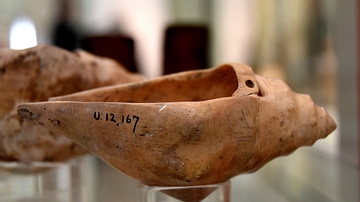
Shell Lamp or Pouring Vessel
This shell was imported from modern-day Oman and was incised and decorated. One end (the upper one) was engraved with a bird's head; the bird's eye would have been inlaid with lapis lazuli. As a lamp, this shell would...
Image
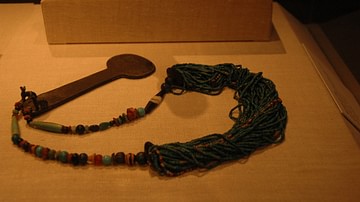
Menit Necklace
18th Dynasty, reign of Amenhotep III (c. 1390-1352 BCE)
Bronze or copper alloy, faience, glass, agate, carnelian, lapis lazuli, turquoise
Metropolitan Museum of Art
Image
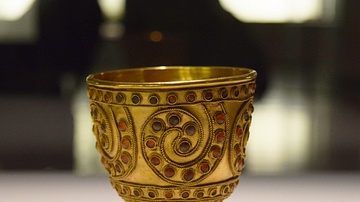
Ancient Goblet from Georgia
This goblet is made on a lath from a single piece of gold. It was found in Trialeti barrow no. 17, in eastern Georgia, and dates from the 18th-17th centuries BCE. It was made by craftsmen belonging to the Trialeti Culture...
Image
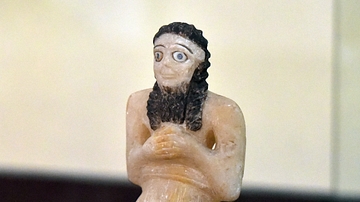
Male Worshiper from Khafajah at the Iraq Museum
Statue of a Sumerian male worshiper from the hoard in Nintu Temple V at Khafajah (ancient Tutub), Mesopotamia, Iraq. Early Dynastic period, 2600-2400 BCE. Excavated by the Oriental Institute of the University...
Image
Partial Headdress
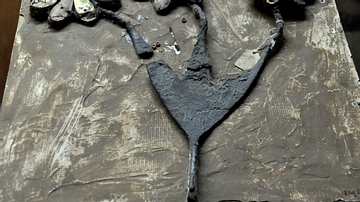
This headdress was made of silver and inlaid with gold, lapis lazuli, and other precious stones. It was found in one of the royal cemeteries at Ur and belonged to one of queen/princess Pu'Abi's female attendants. Early dynastic...
Image
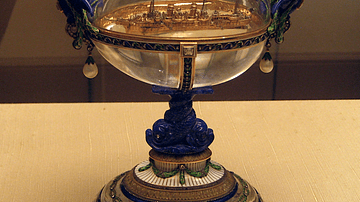
Standart Egg by Fabergé
The 1909 Standart Egg by Peter Carl Fabergé (1846-1920). The egg was given by Tsar Nicholas II (r. 1894-1917) to his wife Alexandra Feodorovna. The egg is made of rock crystal with a gold mount. The foot of the egg is formed...
Image
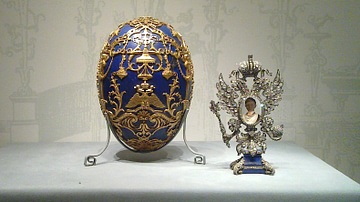
Imperial Tsarevich Egg by Fabergé
The 1912 Imperial Tsarevich Egg by Peter Carl Fabergé (1846-1920). The egg was given by Tsar Nicholas II (r. 1894-1917) to his wife Alexandra Feodorovna. The egg is made of gold and six lapis lazuli sections with...
Image
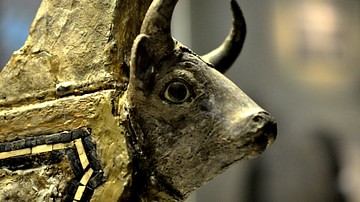
Cow's Head Detail, Silver Lyre, Ur
The silver cow's head decorating the front has inlaid eyes of shell and lapis lazuli. This lyre was found in the 'Great Death-Pit', one of the graves in the Royal Cemetery at Ur. From Ur, southern Mesopotamia, Iraq...
Image
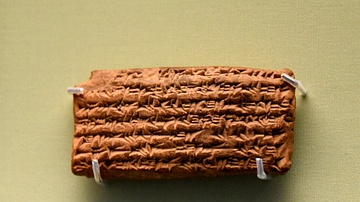
A Seal with a History
This clay tablet records several inscriptions found on an old lapis lazuli cylinder seal. The seal had belonged first to the Kassite king Shagarakti-Shuriash (reigned 1245-1233 BCE) in Babylon. It was taken to Assyria; later...
Image
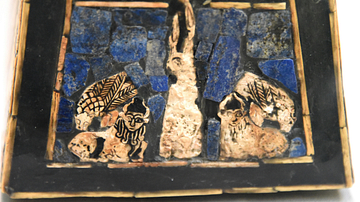
Human-Headed Bull in the Standard of Ur
This is one of the scenes depicted on one of the sides of the Standard of Ur; this is not part of the so-called "Peace and War Scenes" of the Standard. Here, at the center, there is what appears to be a tall...
